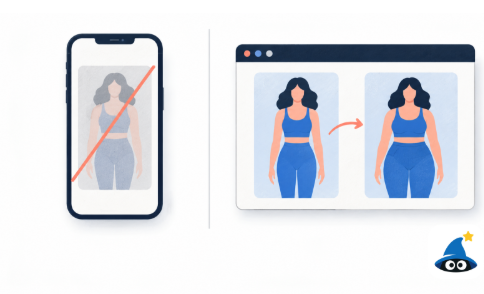
In March 2025 TikTok removed the filter that made people look heavier. A spokesperson confirmed it to the BBC and to the New York Post, and the effect disappeared from CapCut, the editing app it had been built in. That should have been the end of it. It was not. By 2026 the same transformation was available from general-purpose AI image tools, where no platform moderation applies and nobody has to approve a filter for a store. Products like vofy offer it as a straightforward fat filter — upload a photo, preview a heavier version of yourself, decide whether to keep it. The removal did not eliminate the demand. It moved it somewhere the removal could not reach.
That gap — between what a platform can ban and what a general tool can do — is the actual story here, and it is not one the coverage from 2025 anticipated.
The removal was not arbitrary
It is worth being precise about why it happened, because the reasons shape what a responsible version of this tool looks like.
The complaints clustered into three groups. The first was the framing of the videos themselves: the format almost always opened with an unedited clip of a slim creator, then transitioned to the altered version, usually with captions treating the result as embarrassing. The Independent reported users saying the effect was being used to make fun of larger people and to reinforce the idea that being thin is the price of being seen as attractive.
The second was the comment sections. Reporting at the time documented people leaving derogatory remarks on the altered clips — the joke was not the transformation, it was the body.
The third, and the one that is least discussed, was consent. Some accounts applied the effect to other people’s photographs without asking. That is a different category of harm from a bad joke, and it is the part that most obviously has to be designed against rather than merely discouraged.
TikTok’s removal followed the backlash, and a teenage health app called Luna publicly criticised the effect for reinforcing unhealthy standards. The platform response was, in the narrow sense, correct: the filter as shipped made the harmful use case at least as easy as the harmless one.
The same effect, the other direction, was fine
Here is the part that makes the episode worth revisiting rather than just filing under “platform does the right thing”.
CapCut shipped both directions. There was a filter that added weight, and a filter that removed it. The second one did not get pulled. Reporting at the time noted that the “skinny filter” drew far less controversy — and that some users were posting it with captions about motivation, framing the thinner version of themselves as a goal rather than a punchline.
One commentary piece put the asymmetry plainly: when someone is called too skinny, the response tends to be concern. When someone is called too heavy, it tends to be mockery.
This is uncomfortable, and it is also the most honest argument for keeping a weight-gain effect available at all. A tool that can only make you thinner is a tool that has taken a side. Being able to see yourself heavier — in a context where nobody is laughing — is not obviously the more harmful of the two directions. Grazia’s write-up called the trend “mockery disguised as a joke”; that is a fair description of the videos, and it is not a description of the capability.
What actually changed is who can make it
For most of the last decade this effect required a filter: a small piece of software distributed inside an app, reviewed (or not) by that app, and revocable by that app. That is why the removal worked, and why the 2022 version of the same idea — a facial effect that drew roughly thirty million views on a single clip — also came and went.
General-purpose image models broke that structure. The capability is no longer a product that a platform ships; it is a thing the underlying models can do that any tool can wrap. You cannot withdraw it from a store because it was never in one.
A side effect of that shift is that the design decisions the filter app used to make are now made by whoever builds the tool. Whether the result is previewed before it is kept, whether the draft is private until shared, whether the framing suggests a joke or a verdict — none of that is imposed from outside any more. It has to be built in on purpose.
What that means for the tool, not the thinkpiece
The practical version of all this is fairly short.
Preview before commit matters more than it sounds. The single biggest difference between the 2025 videos that upset people and a neutral use of the same effect is that the second one never has to be published. vofy’s page states the framing explicitly: the result is a preview, the edits are meant to stay self-directed, and the copy asks users to keep prank edits clearly fictional and to check the result for background warping and identity stability before sharing. That is a product decision rather than a disclaimer, and it is the reason the effect can exist at all now that no platform is making the call.
Consent has to be a design constraint, not a value statement. The documented harm in 2025 included applying the effect to people who had not agreed. A tool that only edits a photo the user supplied is doing most of that work already.
And the direction deserves to be stated honestly. This effect runs opposite to almost everything else in the category. That is the interesting thing about it, and pretending otherwise — treating it as a quirky slimming filter with the sign flipped — is how you end up shipping something that reads as a verdict rather than a preview.
The takeaway
The 2025 removal was a platform deciding it could not ship this responsibly. That judgement was defensible, and it also could not hold, because the capability had already stopped being a platform feature. What replaced it — general-purpose tools, no store, no review — is less accountable in every way except one: the design choices are now visible in the product instead of buried in a filter pack. That is a thinner protection than a moderation team, and it is the protection that exists.
The honest reading of the last year is not that the effect should not exist. It is that the version pulled in 2025 was built to make the cruel use case easy, and the version that exists now has to be built the other way, on purpose, by whoever makes it.