There is a particular kind of exhaustion that comes from watching a child you love disappear into a storm they cannot name. One week they are impossibly bright, staying up until 2 a.m. to finish a self-assigned project on ancient Egypt, talking in full sentences before the school bus even pulls away. Three weeks later, they won’t leave their room. Parents of children with bipolar disorder know this rhythm intimately, even when they don’t yet have a word for it. And for far too long, neither did medicine. Bipolar disorder in children has historically been one of the most underdiagnosed and misunderstood conditions in pediatric psychiatry, not because the signs aren’t there, but because the tools to catch them have lagged far behind the need.
That is beginning to change. A remarkable wave of technological innovation is reshaping how clinicians screen for, monitor, and treat childhood mental illness, and bipolar disorder, in particular, is at the center of that shift. From AI-powered voice analysis to lab-grown “mini brains” capable of producing measurable electrical signatures, science is finally catching up to what families have known for years: this is a real, biological condition that deserves real, precise tools.
The Diagnostic Problem That Tech Is Trying to Solve
Part of what makes bipolar disorder so difficult to catch early in children is how convincingly it wears other masks. The hyperactivity looks like ADHD. The depressive crashes look like anxiety. The irritability gets chalked up to adolescence. A child can spend years collecting wrong diagnoses before someone finally connects the dots.
Understanding the full picture of what bipolar disorder looks like in children and adolescents, from the cycling of moods to the behavioral patterns that distinguish it from other conditions, is foundational to any conversation about treatment. For parents navigating this landscape for the first time, Bipolar Disorder in Children and Adolescents offers a thorough, accessible breakdown of what the condition actually looks like in young people, how it differs from adult presentations, and what early warning signs families should watch for. That kind of grounded clinical knowledge matters especially now, when new technology is expanding what’s possible, but can’t replace the understanding that comes from knowing what you’re looking for.
Image source: Freepik

What the Government Research Is Telling Us
The National Institute of Mental Health (NIMH) has been explicit about the complexity of diagnosing bipolar disorder in young people. According to NIMH’s published guidance on Bipolar Disorder in Children and Teens, the symptoms of bipolar disorder in youth frequently overlap with those of ADHD, conduct disorder, oppositional defiant disorder, and anxiety, making accurate diagnosis dependent on thorough, longitudinal evaluation rather than a single clinical snapshot. NIMH also emphasizes that treatment works best when providers, caregivers, and young people actively collaborate, and recommends tools like daily mood charts to track behavioral patterns over time. What’s striking about that last recommendation is that it essentially describes what today’s technology is automating at a far more granular scale.
NIH-affiliated researchers have also studied how wearable devices can objectively track the physical activity and sleep disruptions that are core biological features of bipolar episodes, data that is nearly impossible to capture reliably through a once-a-month office visit alone.
AI Is Learning to Hear What Clinicians Might Miss
One of the more remarkable developments in this field involves voice. Researchers published a study in early 2026 in BMC Psychiatry describing a machine-learning model trained specifically on the voice patterns of children and adolescents, not adults, to screen for bipolar disorder and major depressive disorder. The model used short reading exercises to capture speech data, then applied feature-selection algorithms to identify patterns most predictive of a mood disorder. The results suggested that voice-based AI could offer a low-cost, non-invasive screening layer that doesn’t rely on a child being able to articulate their inner experience, something many children simply cannot do.
Meanwhile, at Johns Hopkins, scientists grew miniature brain organoids from the cells of patients with bipolar disorder and schizophrenia, then placed them on microchip arrays to record their electrical activity. The organoids from bipolar patients showed distinct firing patterns compared to healthy controls, essentially, a biological fingerprint of the disorder detectable at the cellular level. The long-term implication is staggering: the possibility of confirming a diagnosis, or testing medication responses, on a tiny model of the patient’s own brain before a single pill is prescribed.
Digital phenotyping is another rapidly developing front. By passively collecting data from smartphones and wearables, GPS movement, sleep duration, call and text frequency, even typing speed, researchers are building behavioral profiles that can detect early warning signs of a mood episode days before it becomes clinically visible. Studies have shown that wearable actigraph technology can differentiate children with bipolar disorder from those with ADHD with accuracy rates above 80%, based entirely on objective measurements of sleep, circadian rhythm, and activity patterns.

TMS Therapy: A Non-Drug Option Gaining Ground
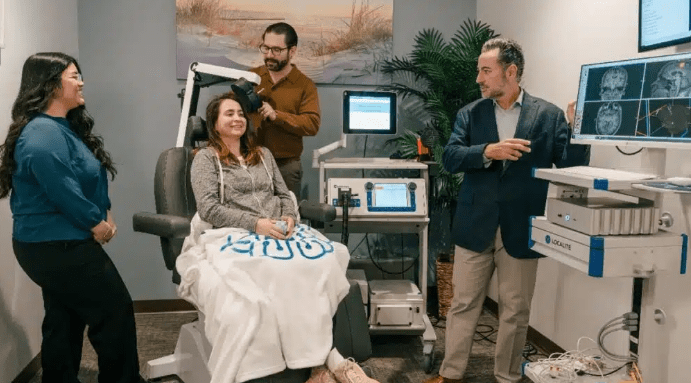
For children and adolescents who have already been diagnosed and are struggling with the depressive side of bipolar disorder, one of the most promising developments in treatment technology is Transcranial Magnetic Stimulation, or TMS. TMS uses precisely targeted magnetic pulses to stimulate specific regions of the brain involved in mood regulation, without medication, without sedation, and without the systemic side effects that make many families hesitant about long-term pharmaceutical management in young patients.
TMS has FDA clearance for major depressive disorder and is increasingly being explored and applied in the context of bipolar depression, particularly for patients who haven’t responded adequately to medication alone. The treatment is non-invasive and typically administered in short outpatient sessions, making it a realistic option for younger patients. For families looking to understand how TMS fits into a comprehensive bipolar depression treatment plan, MindPulse Center’s approach to bipolar depression outlines how this technology is being integrated alongside evidence-based care, a model that reflects where the field is increasingly heading: not one tool, but a layered, personalized approach.
What This Looks Like in Real Life
Consider a twelve-year-old, call her Maya, who spent three years being treated for ADHD that never quite fit. She was impulsive, yes, but the impulsivity came in waves. There were weeks her teachers described her as a completely different child: withdrawn, tearful, unable to finish sentences she’d started. Her parents kept a notebook. Pediatrician after pediatrician told them she was anxious, or going through a phase, or adjusting to middle school.
It wasn’t until a child psychiatrist reviewed several months of data tracked through a sleep-monitoring app, combined with a structured mood assessment, that the cycling pattern became undeniable. The diagnosis of early-onset bipolar disorder opened a door. Not an easy door, but the right one. With a stabilized treatment plan that included therapy and, later, TMS sessions for a particularly difficult depressive period, Maya began to recognize her own patterns. She called the early signs of a manic swing her “too-fast brain days.” She learned to slow down before the world sped up without her permission.
Stories like Maya’s are playing out in clinics across the country with increasing frequency, not because bipolar disorder is becoming more common, but because the tools to see it are finally becoming sharp enough to catch it.
The Bigger Picture
Technology will not make bipolar disorder simple. The condition is too heterogeneous, too woven into biology and environment and family history, to yield entirely to any algorithm. But what technology is doing, and doing increasingly well, is closing the gap between what is happening in a child’s brain and what a clinician can observe in a forty-five-minute appointment. Wearables that track circadian rhythms. AI that listens to speech patterns. Brain organoids that replicate neural misfires at the cellular level. TMS that recalibrates mood circuits without a single pill.
For families who have spent years watching a child struggle without answers, these are not small things. They are, in the quietest and most important sense, a form of being seen.