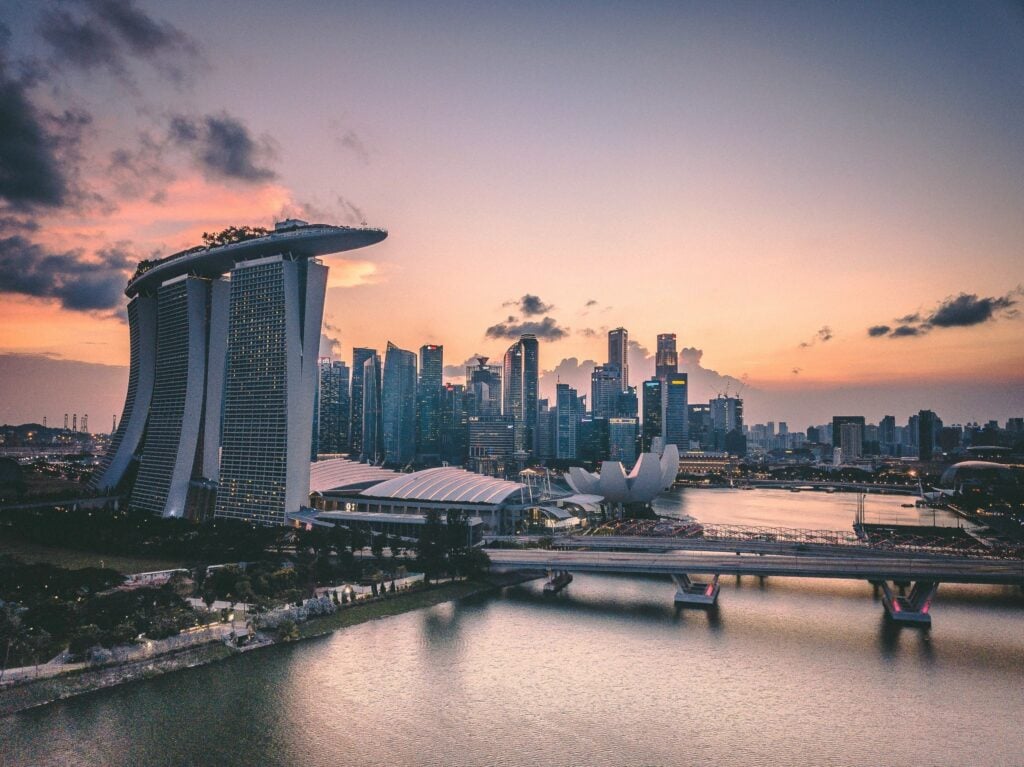
North America and Europe are losing Web3 superiority to Asia — and Singapore steadily becomes the welcoming hub for top tier talent thanks to its laws on crypto.
Transition signals started in 2021, when Huobi Group moved to Singapore. In the same year Crypto and Blockchain investments in Singapore grew x10 to $1.48B according to KPMG 6% of global crypto funds were located in Singapore, keeping toe to toe with Switzerland and Hong Kong. Crypto ownership rate in the region changed from 11% to 24% in just under a year.
Broader pivot towards Asia accelerated after China cracked down on mining and crypto trading in 2021. When the FSMA act was passed, institutions followed and in 2022 Paxos received first regulatory approval both in NY and Singapore.
In 2022 the collapse of Three Arrows Capital made the region worry about regulatory safeguards, and MAS issued papers on how to reduce such risks. By 2023 a Single-Currency Stablecoin (SCS) framework and announcement of Digital Payment Token (DPT) made Singapore a premier spot for Web3 and Blockchain talent who sought regulatory certainty.
In 2023 Singapore and Hong Kong de-facto became the launchpad for crypto startups. Crypto.com launched R&D Labs in Singapore, focusing on blockchain technology, Web3, and artificial intelligence (AI). In late October of 2023, cryptocurrency exchange LocalTrade joined in on the relocation trend and moved HQ to Singapore after Linkomo acquisition.
Why does Singapore get so much attention from Web3?
Simply put — Singapore is good at having laws in check with innovations.
Instead of regulating crypto projects like old-school stock market companies, Singapore implemented one of the world’s clearest licensing frameworks for digital payment token service providers under the supervision of the Monetary Authority of Singapore (MAS).
MAS’s Managing Director, Ravi Menon, articulated Singapore’s stance in a 2022 speech: “Yes to digital asset innovation, no to cryptocurrency speculation.”
Over 3 years Singapore launched Single-Currency Stablecoin (SCS) and laid foundations for the Digital Payment Token (DPT) framework. These two basically boil down to being the most transparent and fair rulebooks for digital assets. This approach made Singapore a favorable region for long-term growth without sudden regulatory risks.
Highest concentration of Asia’s largest Venture Capital funds, Family Offices and Financial Institutions helped as well. The region boasts over 30 active funds, including Defiance Capital, Spartan Group, and DWF Labs. For Web3 companies, proximity to capital has become just as valuable as access to customers.
Since China started to crack down on crypto, talent fled and moved capital to safer regions across Asia. Singapore with its transparent law frameworks, focus on growth and favorable business environment simply became prime real estate to accept any Web3 and Blockchain talent.
Trend on Growth Frontiers in Asia
When Singapore became a center of trade for Web3 projects, Strategic Investments and Acquisitions led by Singapore-based businesses followed. To match the market’s speed, companies started to acquire established exchanges and digital asset infrastructure.
Key Trend is Ecosystem Expansion via Acquisitions:
- In 2022 stablecoin emittent Circle acquired Singapore-based Cybavo, specialized in enterprise-grade asset cybersecurity and custody infrastructure, pioneering the Infrastructure-as-a-Service approach;
- In 2023 Fireblocks’ Singapore division acquired Melbourne-based BlockFold focused on Smart Contract development and Tokenization, both of which are crucial for Fireblocks secure multi-signature fund management ecosystem;
- In 2023, Treehouse bought NFT analytics platform Origins — an on-chain and off-chain data analytics engine, needed to reinforce Hyperion portfolio management platform and meet NFT exposure demands from TH clients;
- In late 2023, cryptoexchange LocalTrade was acquired by Singapore-based software developer Linkomo as part of the 2026-2027 roadmap for ecosystemic integration push to obtain a reliable trading engine, and meet demand for structured and secure financial services in the region.
Working from Singapore just makes sense from a mathematical standpoint: it’s less regulatory risks, transparent legal frameworks and access to capital other regions can’t offer, which means growth for long-term projects.
Powered by transparent and fair crypto laws, Singapore moved from being just a crypto-friendly jurisdiction to becoming one of the foundational stones for the Web3 market.