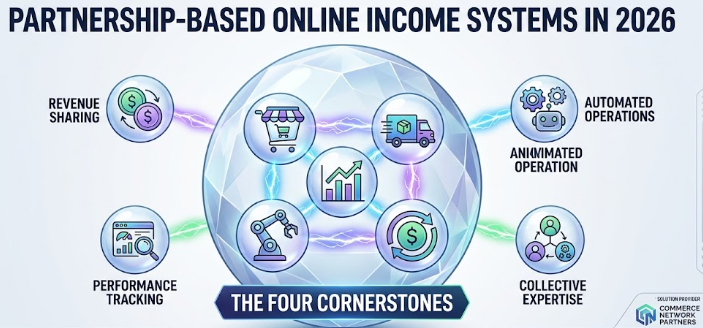
There has been a huge shift in how people engage in online business. Instead of trying to build everything on their own, now most people want to establish a partnership-based online income system in which every partner works together by sharing expertise, responsibility, and revenue. Partnership-based online income systems provide a connection point for individuals to join a group that already has a large operational framework. The partnership-based online income system does all of the heavy lifting for each partner so that the partners can concentrate on creating an outcome, not on managing the daily operations of an individual business.
This is not about myths of passive income or e-Commerce overnight success stories; this is about how joint revenue sharing partnerships operate together, what the roles of each partner are within each model, and how some partnership structures perform better over the long haul than others. When you are choosing which type of affiliate partnership model to begin with, regardless of whether it is your first affiliate partnership model, or whether you want to implement a completely managed ecommerce partnership system, the choices you make at the start will create your experience over time. Your results will always vary due to the amount of effort you put into the effort, the current state of the marketplace when you enter, and the level of quality of the systems you are using.
Understanding Partnership-Based Online Income Systems
Structured partnerships are changing the way people create online income. Before diving into different types of structured partnerships, let’s look at the core elements of structured partnerships to understand their movement of funds and the evolution of structured systems.
What Are Partnership-Based Online Income Systems?
A partnership-based online income system is a structured arrangement where two or more parties collaborate to generate digital revenue. Each party brings something to the table, capital, operational expertise, technology, or distribution. Responsibilities are divided by agreement, and income is shared based on defined terms. Unlike solo ventures, these systems are built on interdependence.
How Revenue Sharing and Collaboration Drive Online Income
At the core of most online revenue sharing systems is a simple principle, value created together is split according to contribution. One party may manage product sourcing while another handles marketing or customer service. The income generated flows through a shared structure, with each partner receiving a pre-agreed percentage.
The Evolution of Strategic Partnerships in Digital Business
Early digital business was largely independent, one person, one website, one income stream. That model still exists, but it has limitations. As ecommerce scaled and competition increased, strategic partnership income models emerged as a practical alternative. Platforms, fulfillment networks, and managed service providers created ecosystems where collaboration became more efficient than going solo. Today, companies like Commerce Network Partners represent this evolution, offering individuals entry into business partnership income models backed by operational infrastructure rather than guesswork.
Core Types of Online Income Partnership Models
Numerous variations exist among partnership structures, although each variation has distinct objectives, expectations, and types of stakeholders involved; thus, it is essential to construct an outline describing the primary types of partnership structures that are currently being utilized.
Revenue Sharing Partnerships Explained
Revenue sharing partnerships divide earned income between parties based on a fixed or performance-linked formula. One partner may operate the system while another provides funding or customer access. The split is defined upfront in a formal agreement. Both participants contribute unique and non-overlapping skill sets, which makes this comprehensive structure work; this means that all operational responsibilities do not fall on one person. Each participant has a direct interest in the final outcome; therefore, the results will depend on the quality of execution and the conditions of the market in which they participate together.
Affiliate Models vs Long-Term Partnership-Based Systems
Affiliate partnership models are transactional, you refer a customer, earn a commission, and the relationship ends there. Partnership-based online income systems go deeper. They involve ongoing collaboration, shared infrastructure, and long-term revenue alignment. With affiliate models, income stops when referrals stop. With structured partnerships, income is tied to system performance over time.
Joint Venture and Strategic Collaboration Models
Joint venture income systems online involve two or more entities combining resources for a specific business goal. Unlike general partnerships, joint ventures are often project-bound or time-limited. Strategic online partnership revenue systems take a broader view, they are built for long-term collaboration across multiple functions. Both models require clear agreements on roles, contributions, and profit distribution.
The Income Structures Involve Free and Performance-Based Income
Recurring income programmes allow to receive revenue on a continuous basis through subscriptions, commissions on repeat purchases, or fees for ongoing services. Similarly, performance-based online partnerships connect payments directly to measurable results, such as the amount of sales made, the percentage of conversions, and the number of customers retained, rather than through one-off instances.
Both types of income structures provide incentives for repetitive actions in a prolonged manner.
Quick Comparison: Online Income Partnership Models at a Glance
| Model Type | Income Structure | Involvement Level | Best Suited For |
| Revenue Sharing Partnership | Split by contribution | Moderate | Complementary skill sets |
| Affiliate Partnership Model | Per referral commission | Low to moderate | Content creators, marketers |
| Joint Venture Model | Project-based profit split | High | Short-term collaborative goals |
| Managed Partnership System | Ongoing revenue share | Low to moderate | Beginners, capital deployers |
| Recurring Income Partnership | Subscription-based cycles | Low | Long-term income stability |
How Online Partnership Programs Generate Income
Understanding where money enters and how it moves through a partnership system removes a lot of guesswork. These three areas, revenue flow, tracking, and automation, form the operational backbone of any serious income partnership.
Understanding Revenue Flow in Partnership Systems
In most online income partnership programs, revenue enters through a front-end channel, a product sale, a subscription, or a service fee. That revenue then moves through the system according to pre-agreed distribution rules. Operational costs are deducted first. Income is split among the different divisions of a business and then divided among the partners with job descriptions as outlined in their partnership agreement. The online revenue-sharing systems allow for an easily trackable distribution by providing documentation of the distribution layers, and each business partner will have a clear understanding of how the income has made its way to them and when.
Tracking, Attribution, and Performance Measurement
Tracking and attributing income in partnerships is what separates well-run systems from unreliable ones. Attribution identification allows for the resolve of revenue generating disputes if they occur between two partners. To achieve this modern platforms of partnership utilize dedicated tracking platforms, distinctive link tracking, pixel-based attribution, dashboard reporting, etc. In addition, an organization can utilize performance based partnerships to determine revenue share payouts. You can use regular reports on the performance of each partnership to determine what works, where there are issues requiring an adjustment, or how to optimize ongoing performance from these relationships.
The Role of Automation in Partnership-Based Operations
Automated partnership income systems reduce the need for constant manual oversight by handling routine functions, order processing, payment distribution, reporting, and customer communication, through integrated software. For participants in managed income partnership systems, automation is what makes scale possible without proportionally increasing workload. Companies like Commerce Network Partners build automation directly into their operational infrastructure, allowing backend processes to run consistently while partners focus on higher-level decisions rather than day-to-day execution.
Key Benefits of Partnership-Based Income Models
Joining a structured partnership offers advantages that solo online ventures rarely provide. These four benefits explain why more individuals are choosing collaborative income models over independent ones.
Access to Shared Resources and Expertise
One of the strongest advantages of business partnership income models is immediate access to resources you did not build yourself. That includes fulfillment networks, supplier relationships, marketing systems, and operational know-how. Rather than spending months or years developing these independently, participants enter systems where infrastructure already exists. Commerce Network Partners operates on this principle, connecting individuals with established backend frameworks so they benefit from collective expertise rather than learning everything through costly trial and error.
Scalability Through Collaborative Business Models
To grow a solo-operated online business means finding, hiring, & training new staff and then managing those staff, all of which cost you time and money; however, by using strategic partnerships instead, it eliminates much of this time and cost. Each member of the network can take advantage of economies of scale since they share the operational capacity of the entire network and do not have to incur the additional costs of growing by themselves. Growth strategies addressing partnership-based online income are most commonly established through expansion of the existing system being utilized as opposed to re-creating a brand new system to generate revenue.
Diversification of Online Income Streams
Relying on a single income source carries real risk. Passive income partnerships allow individuals to participate in multiple revenue-generating systems simultaneously without managing each one independently. Through an ecommerce affiliate program participants may earn recurring income through a variety of subscription-based product sales. This diversification of sales channels and customer demographic spreads the risk of losing a significant amount of income due to a sudden change in market conditions or reduced sales of one particular product.
Streamlined Operations Compared to Independent Models
Running an online business independently means owning every problem, logistics, customer service, tech issues, and supplier disputes all land on one person. Managed income partnership systems distribute those responsibilities across experienced teams. Automated partnership income systems handle routine processes without manual intervention. The result is a leaner operational experience for participants. Less time spent on execution means more bandwidth for evaluating performance, refining strategy, and making decisions that actually move the business forward.
Partnership-Based Income vs Traditional Online Income Models
Choosing the right income model starts with understanding the real differences between them. Structure, responsibility, and long-term sustainability vary significantly across partnership and traditional approaches.
Differences in Structure and Responsibility
Traditional online income models place every responsibility on one individual, product creation, marketing, fulfillment, and customer service. Partnership-based online income systems divide those responsibilities across multiple parties by design. Each partner handles a specific function they are best equipped for. This structural difference is significant. It means participants in managed income partnership systems are not required to be experts in every area. Competence in one domain, combined with a well-matched partner network, is often enough to participate effectively.
Comparing Affiliate, Freelance, and Partnership Approaches
Freelancers trade time for money, income stops when work stops. Affiliate partnership models generate commissions per referral but offer no ongoing stake in the business being promoted. Partnership-based online income systems sit in a different category altogether. Participants hold a continued interest in system performance rather than earning isolated payouts. This distinction matters for anyone evaluating how online partnership programs generate income beyond short-term activity. The structure itself is designed to reward sustained involvement, not just one-time transactions.
Long-Term Sustainability of Revenue Sharing Systems
Revenue sharing partnerships are built for durability when structured correctly. Income tied to ongoing system performance tends to be more stable than project-based or commission-only arrangements. Recurring income partnership programs strengthen this by producing revenue from numerous cycles, rather than from one-time events. Subsistence remains primarily dependent on the systemic quality (i.e., the underlying system), market need, and the management of functions throughout the complete life cycle of the program. No model can guarantee success or sustainability over time; however, properly architected online revenue-sharing systems provide a much more stable base than most.
Important Considerations Before Participating
Entering any partnership model requires clear thinking. These five considerations help individuals evaluate their readiness and make responsible, informed participation decisions.
Understanding Participation and Ongoing Involvement
Becoming part of an online income-generating system using partnerships is typically not a hands-off model. Although there’s a fair amount of difference in how much effort will be involved, most models require at least some continued effort through reviewing your results, communicating with your partners, and making some occasional decisions. Although you may find that Commerce Network Partners systems do a great job of reducing that right for you, anyone who remains active and connected to their partners after they are onboarded has a much greater success rate than those who go inactive soon after being onboarded.
Legal Considerations in Revenue-Sharing Agreements
Legal considerations in partnership-based income models are not optional. Every revenue-sharing agreement for online businesses should clearly define income distribution, exit terms, dispute resolution, and each party’s obligations. Before signing any agreement, independent legal review is strongly recommended. Well-structured contracts protect all participants. Vague or verbal arrangements create risk. Clarity in documentation is one of the clearest signs of a trustworthy and professionally managed partnership system.
Not a Financial or Investment Advisory Service
Commerce Network Partners operates as a business solutions provider, not a financial advisory or investment service. Participation in any managed income partnership system should be evaluated as a business decision, not an investment. Individuals are encouraged to consult qualified financial or legal professionals before committing. No participation model, regardless of how well it is structured, constitutes financial advice or guarantees any specific income outcome.
Real-World Applications of Partnership-Based Income Systems
Theory only goes so far. These four examples show how partnership-based online income systems function across real industries, from ecommerce and SaaS to influencer networks and managed partnership organizations.
Ecommerce Partnership Systems in Practice
Ecommerce partnership systems connect product suppliers, logistics providers, and sales participants under one coordinated structure. One party sources inventory, another manages the storefront, and a third handles fulfillment. Revenue is distributed across all contributing roles. This model allows individuals to participate in online retail without owning stock or managing warehouses, making entry far more accessible than traditional ecommerce setups require.
SaaS and Digital Product Revenue Sharing Models
SaaS partner income generation models work by rewarding partners who refer, resell, or integrate software products into their own networks. Licensing and partnership income models follow a similar logic, revenue is generated each time a licensed product or tool is used. These structures produce recurring income partnership programs because software subscriptions renew monthly, creating consistent, compounding revenue streams for every active partner in the system.
Influencer and Affiliate Partnership Ecosystems
Influencer and affiliate partnership programs operate by connecting content creators directly with brands through structured commission agreements. Each sale or referral is tracked, attributed, and compensated accordingly. While affiliate partnership models are transactional, larger influencer ecosystems increasingly shift toward long-term brand partnerships, moving beyond single commissions into ongoing revenue sharing partnerships that reward audience trust and consistent promotional performance over time.
How Commerce Network Partners Operates Within Partnership Ecosystems
Commerce Network Partners functions as a structured connector within the broader ecommerce partnership system landscape. The company brings together operational service providers, fulfillment networks, and individual participants under one managed framework. Rather than asking participants to source their own partners, Commerce Network Partners provides pre-built infrastructure, reducing setup complexity and positioning individuals within strategic online partnership revenue systems that are already operational.
Best Practices for Building Sustainable Partnership Income
A well-chosen model is only the starting point. How you structure roles, use tools, and manage relationships determines whether a partnership produces consistent results or stalls early.
Signs of a Well-Structured Partnership-Based Income System
- Revenue-sharing agreements are documented and legally reviewed
- Roles and responsibilities are clearly defined for every partner
- Tracking and attribution systems are transparent and auditable
- Automated systems handle routine operations without manual gaps
- Performance data is shared regularly with all participating partners
- Dispute resolution terms are included in the partnership agreement
- Onboarding process is structured, clear, and professionally managed
Choosing the Right Partnership Model for Your Goals
Not every online income partnership program suits every individual. Your available time, capital, and skill set should directly influence which model you enter. Managed income partnership systems work well for those with limited operational experience. Performance-based online partnerships suit individuals who can actively drive results. Matching your model to your actual capacity, not your ideal scenario, is the most reliable starting point.
Setting Clear Roles and Revenue Expectations
Ambiguity destroys partnerships faster than poor performance. Every revenue-sharing agreement for online businesses should define who does what, how income is calculated, and when distributions occur. Commerce Network Partners builds this clarity into its onboarding process, ensuring participants understand their role and income structure before any operational activity begins. Clear expectations protect all parties and reduce friction down the line.
Building Long-Term, Transparent Partner Relationships
Strategic partnership income models thrive on transparency. Regular communication, honest performance reporting, and mutual accountability keep partnerships functional over time. Short-term thinking erodes trust quickly. The strongest revenue sharing partnerships are built on shared goals and consistent follow-through, not just initial agreements. Treating partners as long-term collaborators rather than transactional contacts is what separates sustainable systems from ones that collapse within the first year.
Trends Shaping Partnership-Based Online Income in 2026
The partnership income landscape continues to shift. Four trends are actively reshaping how these systems are structured, scaled, and sustained across digital business in 2026.
Growth of Performance-Based Partnerships
Businesses are moving away from flat-fee arrangements toward performance-based online partnerships that tie compensation directly to measurable output. This shift benefits both sides, operators pay for results, and high-performing partners earn more. As tracking technology improves, attribution becomes more precise, making performance-based online partnerships easier to manage and harder to game across competitive digital markets.
Expansion of Automated Operational Systems
Automated partnership income systems are expanding rapidly. Order management, revenue distribution, reporting, and customer communication are increasingly handled without manual input. Organizations like Commerce Network Partners are integrating deeper automation layers into their operational frameworks, reducing participant workload while maintaining consistency. This trend makes managed income partnership systems more accessible to individuals with limited technical backgrounds.
Future Outlook for Revenue Sharing Models
Revenue sharing partnerships are positioned for continued growth as digital commerce expands globally. Increased platform transparency, stronger legal frameworks, and better tracking infrastructure are making online revenue sharing systems more reliable than ever. For individuals evaluating entry points, 2026 represents a mature moment, systems are more structured, expectations are clearer, and the tools supporting partnership-based online income systems are more capable than at any previous point.
Is a Partnership-Based Online Income System Right for You?
These models are not a universal fit. Understanding who benefits most, what to evaluate upfront, and why outcomes differ helps individuals make smarter participation decisions from the start.
Who Can Benefit from Partnership-Based Models
Partnership-based online income systems suit individuals who want structured entry into digital commerce without building operational infrastructure independently. They work particularly well for those with capital to deploy but limited time, or those with complementary skills, marketing, logistics, or sales, that fit within an existing system. Commerce Network Partners specifically designed its model for individuals seeking managed access to ecommerce without prior industry experience.
Key Factors to Evaluate Before Participating
Before entering any online income partnership program, evaluate the transparency of the revenue model, the track record of the operating partner, and the clarity of the legal agreement. Understand how tracking and attributing income in partnerships is handled.
Conclusion
The Growing Role of Partnerships in Online Business
Digital commerce has grown too complex for most individuals to manage alone. Partnership-based online income systems fill that gap by distributing operational responsibility across experienced networks. Revenue sharing partnerships, ecommerce partnership systems, and managed income partnership systems are not trends, they are structural responses to how online business actually works at scale today. Organizations like Commerce Network Partners represent the practical application of this model, built for accessibility, supported by infrastructure, and designed for long-term participation rather than short-term activity.
Making Informed and Responsible Participation Decisions
No partnership-based online income system delivers results without informed, deliberate participation. Evaluate every model carefully, review agreements, understand revenue structures, and seek independent legal or financial counsel where appropriate. Results will always vary based on individual effort, market conditions, and system quality.