
How FinTech Consulting Projects Works: A Guide for the US Financial Market

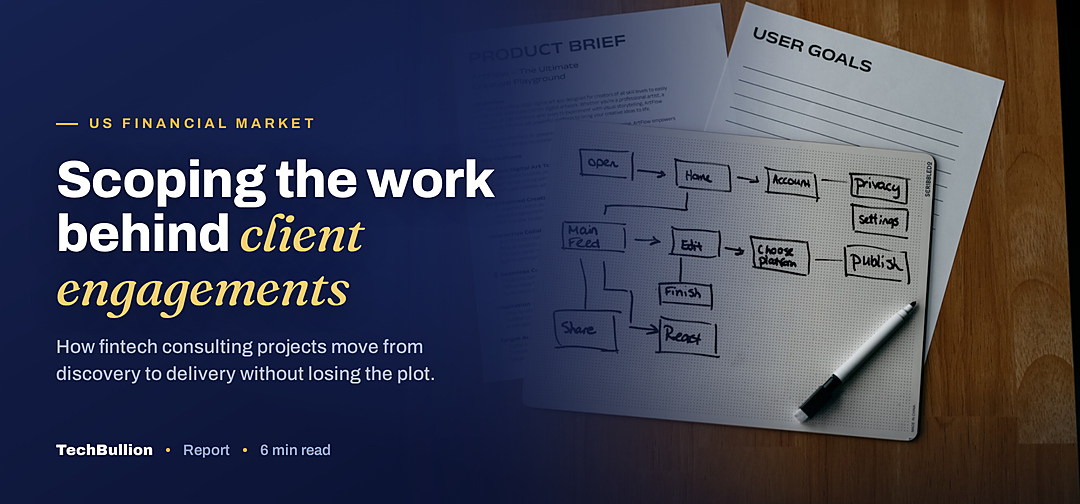
To understand how FinTech consulting projects work, follow a team from a clients first request to a finished, handed-over system, watching how they scope the work, design a solution, build it and prove it. The process turns a business goal into a delivered change. In the United States, the management consulting market behind such work reached $132.34 billion in 2026, per Mordor Intelligence.
The steps look orderly from outside, but each demands judgment, from agreeing what to build to proving it worked. This guide walks through how FinTech consulting projects work stage by stage in the US market, set against an AI in fintech market worth $36.61 billion in 2026 that many of these projects help firms adopt, per Mordor Intelligence.
How FinTech consulting projects work from request to handover
They start by framing the goal. The team and client agree what success looks like, such as a launched app or a passed audit, so the project has a clear target. A sharp goal keeps the work focused, because a vague brief produces a vague and often costly engagement.
They move through design and build. Consultants plan the solution, then build or integrate it with the client team, the joint method we connect to agentic AI tools in finance. Working alongside client staff helps the firm keep the knowledge once the project ends.
They finish with handover and proof. The team transfers the work, documents it and checks the result against the goal, so the client can run and trust what was delivered. A project is only finished when it works in the clients hands, not when the consultants stop billing.
How teams scope and plan the work
They study the firm first. Consultants examine the clients systems, rules and goals before promising anything, so the plan fits reality, the grounding we examine in managing money and crypto in one app. Skipping this discovery is the fastest way to a plan that looks good but cannot be delivered.
They agree a clear scope. The team defines what the project will and will not cover, with a timeline and budget, so everyone shares the same expectations. In finance, a tight scope is what keeps a project from drifting into delay, overspending and disappointment.
They set measures of success. Teams decide in advance how the result will be judged, such as a working feature or a passed test, the discipline we connect to AI in financial advisory services. Defining success early prevents the trap of calling a project done simply because time ran out.
How design and delivery reduce risk
They design before they build. Consultants plan the solution and test the idea on paper or in a prototype before committing, so flaws surface early, the safeguarding we link to working with verified developers. In finance, catching a design problem before build can prevent expensive rework later.
They deliver in stages. Teams build in steps, checking each part works before moving on, rather than launching everything at once. This staged delivery limits the damage if something goes wrong and lets the client see progress instead of waiting for one risky reveal.
They work with the client team. Consultants build alongside client staff so knowledge transfers as they go, and with the AI in fintech market growing at a 22.04 percent CAGR, as the table shows, firms want to keep these scarce skills. A project that leaves no capability behind has only half done its job.
| Metric | Figure | Source |
|---|---|---|
| US management consulting market, 2026 | $132.34 billion | Mordor Intelligence |
| US management consulting market, 2031 (projected) | $168.46 billion | Mordor Intelligence |
| Digital transformation consulting forecast CAGR | 6.11 percent | Mordor Intelligence |
| AI in fintech market, 2026 | $36.61 billion | Mordor Intelligence |
| AI in fintech market, 2031 (projected) | $99.09 billion | Mordor Intelligence |
| AI in fintech forecast CAGR | 22.04 percent | Mordor Intelligence |
Sources: Mordor Intelligence US management consulting services market report; Mordor Intelligence AI in fintech market report.
How compliance and security shape the project
Rules are built in from the start. A financial project must meet privacy, consent and fraud requirements, so consultants design these in rather than adding them late, the protection we connect to cross-border payment solutions. Treating compliance as part of the build avoids costly fixes after launch.
Security is treated as core. Because these projects touch money and data, teams plan for strong authentication, testing and monitoring throughout, the openness we examine in how Bizum is reshaping payments. In finance, a security flaw is not a detail to patch later, it is a risk that can end a project.
Regulators are kept in view. Good teams track the rules that apply and prepare evidence that the work complies, so the client can answer questions later. With digital transformation consulting growing at a 6.11 percent CAGR, as the table shows, much of this work now blends technology with regulatory fluency.
How results are measured and handed over
They test against the goal. Before handover, the team checks the result does what was promised, so the client is not left with an unfinished system, the evidence-led approach we connect to agentic AI tools in finance. Real testing is the final proof that a project worked.
They document and transfer. Consultants write down how the system works and train the client team to run it, so the knowledge does not leave with them. This handover is what turns a temporary engagement into a lasting capability for the firm.
They review what was learned. Teams and clients look back at what went well and what did not, so the next project is better, the continuous-improvement mindset we link to working with verified developers. Honest review is how both firms and consultants keep raising their standard over time.
Reading the process without overpromising
Delivery matters more than advice. A strong plan that is never built helps no one, so the best projects produce working results, not just recommendations. Clients are well served when an engagement changes the business, not only the slide library.
Knowledge transfer is the real prize. A project that leaves the client unable to run what was built has failed in a quiet but serious way, so handover deserves as much care as delivery. The aim is a stronger client, not a permanent dependence on outside help.
The honest conclusion is that FinTech consulting projects work by moving through scope, design, staged delivery, compliance and proof until a change is real and the client can own it. When US teams hold that process to a high standard, the result is technology that works and a firm that can keep it running.
How FinTech consulting projects work comes down to a disciplined path from clear scope through staged, compliant delivery to tested handover. When US teams keep that path honest and transfer the knowledge they create, a project becomes more than a temporary fix, it becomes a lasting improvement that the financial firm and its customers can rely on.







Comment