
How Distributed Ledger Technology Works: A Guide for the US Financial Market
How distributed ledger technology works: nodes, consensus and cryptographic blocks explained for the US financial market, a USD 39.82 billion sector in 2026.

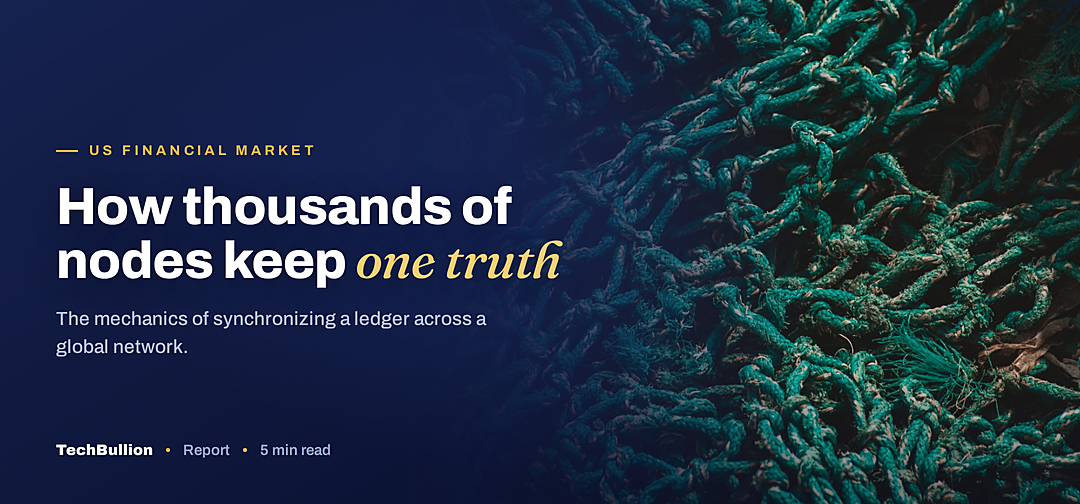
Picture a stadium where thousands of people each keep an identical scorecard, and a point counts only when most of the cards agree. That is closer to how distributed ledger technology works than any image of a single bank vault. The mechanics behind it now sit under a fast-growing market: the global blockchain technology sector, the most common form of distributed ledger technology, is worth USD 39.82 billion in 2026 and is projected to reach USD 455.16 billion by 2031, according to Mordor Intelligence. For the US financial market, understanding the plumbing matters as much as the headline numbers.
How distributed ledger technology works at the core
A distributed ledger is a shared database copied across many computers, called nodes. When someone proposes a new transaction, it is broadcast to the network. The nodes check it against the rules and the existing record, and only valid transactions are accepted. Once accepted, the entry is written to every copy at roughly the same time. There is no master server that everyone else trusts. The agreement of the network is the authority.
Three building blocks make this possible. Cryptographic hashing turns each block of transactions into a fixed fingerprint, so any later change would be obvious. Linking each block to the fingerprint of the one before it creates a chain that cannot be quietly rewritten. And a consensus mechanism gives the nodes a shared procedure for agreeing on what the next block should contain.
Consensus, the part that replaces the middleman
Consensus is where a distributed ledger earns its trust. Because no single party is in charge, the network needs a fair way to decide whose version of events wins. Different ledgers use different methods, and the choice shapes speed, cost, and energy use.
| Consensus method | How agreement is reached | Common use |
|---|---|---|
| Proof of work | Nodes compete to solve a hard puzzle; the winner adds the block | Public networks such as Bitcoin |
| Proof of stake | Validators are chosen based on the value they lock up as a deposit | Ethereum and many newer chains |
| Permissioned voting | A known set of approved nodes vote to confirm each block | Bank and enterprise ledgers |
Descriptions reflect how each consensus model operates in practice.
Proof of work is secure but slow and energy hungry. Proof of stake keeps security while cutting energy use sharply. Permissioned voting is fast and cheap because the participants are already known and trusted, which is why most bank projects use it. The same appetite for verifiable records that drives AI-driven defense systems pushes financial firms toward the permissioned model.
What happens when you send a transaction
Follow a single payment through the system. You sign the transaction with a private key, a secret only you hold, which proves the request is really from you. The transaction enters a waiting pool. Validators pick it up, confirm you have the funds and that you have not already spent them, and bundle it with others into a candidate block. The network runs its consensus procedure, the block is accepted, and every copy of the ledger updates. The payment is now part of a permanent, shared record that no one can reverse on a whim.
This is why settlement can shrink from days to seconds. Traditional cross-border payments pass through several banks that each keep separate books and reconcile later. A shared ledger lets all parties read the same confirmed record at once, which removes most of the back-and-forth. Tools like an AI-native framework for financial institutions increasingly read directly from these ledgers to keep analytics current.
Why the design is hard to cheat
To rewrite history on a well-run distributed ledger, an attacker would need to control a majority of the network and redo the cryptographic work on every later block faster than everyone else combined. On large public networks that is prohibitively expensive. On permissioned networks the approved validators watch each other, so a single bad actor is outvoted. The security comes from the structure, not from hiding the data. In fact most ledgers are transparent, which is part of the point. Anyone can audit the record even if no one can secretly alter it.
The model has limits worth naming. Public chains can slow down and grow expensive when traffic surges, which is why developers build second-layer systems that handle volume off the main chain. Private keys are a single point of failure for the user, so losing one can mean losing access. And a ledger only records what it is told, so bad data entered correctly is still bad data. None of these flaws break the core idea, but they shape where the technology fits.
How US institutions are putting it to work
The clearest adoption is happening out of public view. Large banks have used permissioned ledgers to settle repurchase agreements in minutes instead of hours, freeing up collateral that would otherwise sit idle. Asset managers are issuing tokenized money market funds whose ownership records live on a ledger, so units can move around the clock rather than only during banking hours. Insurers coordinate claims across parties on a shared record to cut duplicate paperwork. In each case the win is the same: several organizations reading one verified copy instead of reconciling many private ones.
The supporting cast matters too. Custody providers now hold private keys for institutions that do not want to manage that risk themselves, and auditors are learning to read ledger records directly rather than requesting exports. These are unglamorous jobs, but they are the difference between a pilot and a production system. The market growth that research firms project assumes this back-office machinery keeps maturing.
Where this leaves the US financial market
For American banks, exchanges, and payment firms, the practical question is not whether distributed ledger technology works, but where it works better than what they have. Settlement, shared recordkeeping, and asset tokenization are the strongest early cases, because they involve several parties that need the same trusted data. The investors who watch platforms giving retail traders access to global markets are watching the same shift toward faster, shared infrastructure. Grand View Research, which tracks the wider blockchain technology market, expects the payments segment to keep leading adoption.
The technology that started as a way to move digital coins has become, more quietly, a new way to keep books. The scorecard is shared now, and that changes who has to trust whom.





Comment