Ask anyone who has spent real time running a warehouse and they’ll tell you the same thing: inventory is where the operation lives or dies. Get it right and everything downstream runs smoothly. Get it wrong and you’re firefighting stockouts, dead stock, and frustrated customers. For decades the tools to manage it barely changed. Now artificial intelligence is rewriting how inventory gets tracked, predicted, and controlled. The distance between operations that have adopted it and those that haven’t is widening fast.
Here’s a grounded look at what AI inventory management actually does on the floor.
Why Inventory Has Always Been the Hard Part
Inventory is a moving target. Demand shifts, suppliers slip, items get miscounted, and a single bad number ripples through purchasing, picking, and shipping. Traditional systems leaned on periodic manual counts and static reorder points. A reorder level set months ago had no idea a product just went viral or that a supplier’s lead time doubled. The result was the chronic balancing act every operator knows: too much stock tying up cash and space, or too little and a missed sale.
The problem was never effort. It was that the data was always a step behind reality.
What AI Actually Does With Inventory Data
The real shift AI brings is turning inventory from a backward-looking record into a forward-looking forecast. Instead of averaging last year’s sales, machine-learning models read dozens of signals at once. They factor in seasonality, promotions, regional trends, and even weather to predict demand down to the individual item and location. More importantly, they keep learning. When a pattern breaks, the next forecast reflects it instead of waiting for the next planning cycle.
That predictive layer feeds everything else. A few of the highest-impact uses:
- Demand forecasting that adapts in real time instead of leaning on static seasonality.
- Automated replenishment that watches consumption and triggers orders as a gap forms, factoring in supplier lead-time trends.
- Anomaly detection that flags an unexpected drop or spike early. This is often the first sign of theft, a data error, or a supply disruption.
From Annual Counts to Continuous Accuracy
The most visible change on the floor is how stock gets counted. The annual shutdown for a wall-to-wall inventory count is giving way to continuous, automated accuracy. Computer-vision systems and sensors verify what’s physically on the shelf, and increasingly that scanning rides on moving equipment. Autonomous mobile robots and camera-equipped drones roam the aisles capturing inventory data as they go, eliminating much of the manual cycle-counting labor while catching discrepancies in near real time.
The payoff isn’t just fewer people walking around with clipboards. It’s an always-on, trustworthy picture of what you have and where it is.
Smarter Slotting and Replenishment
AI also decides where inventory should live. By analyzing how fast items move and how they’re ordered together, it recommends slotting that puts high-velocity products in the most accessible locations and groups items that frequently ship together. The result is shorter pick paths, less travel, and more throughput from the same square footage. As demand patterns shift, the recommendations shift with them.
The Software Doing the Work
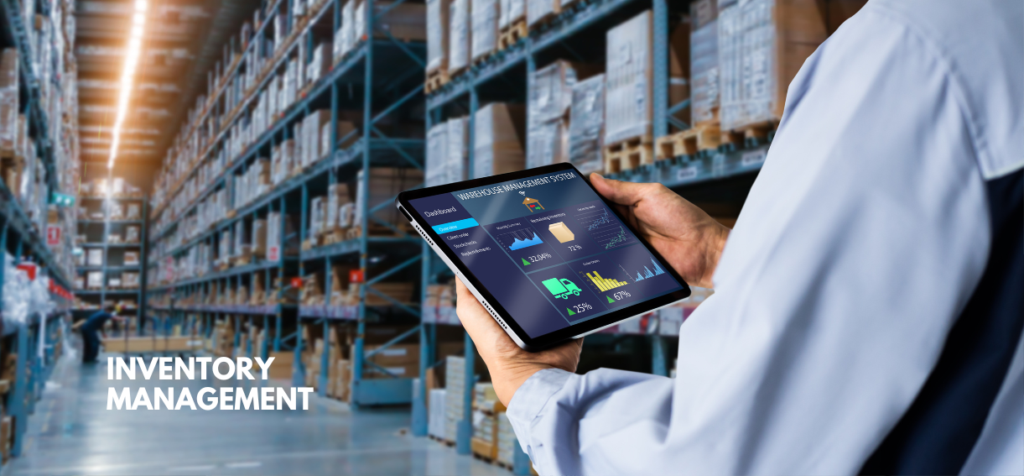
None of this happens without a capable system underneath it. Modern warehouse management software has evolved from a digital ledger into the decision-making brain of the operation. They ingest real-time data, running the forecasting and optimization models, and coordinating people and machines around a single source of truth. The smartest deployments don’t rip out existing systems; they layer intelligence onto the stack through integrations, upgrading the brain while leaving the body in place.
Just as important, good software keeps a human in the loop. It surfaces its confidence levels and exceptions so planners can see why it’s recommending a move, and that visibility is what earns the trust that gets the technology actually used.
What It Means for Operators
For anyone weighing this, a few things hold true from experience:
- Start with clean data. AI amplifies whatever you feed it, so accurate inventory and tidy processes have to come first.
- Begin with forecasting. It’s where AI tends to prove itself fastest, and tighter forecasts make everything downstream cheaper.
- Roll out in stages. Prove the value on one category or site, then widen from there.
- Bring your team along. Planners who understand the “why” adopt the tool; those who don’t quietly work around it.
The Real Takeaway
AI gives people a real-time, predictive view they’ve never had and freeing them from the manual counting and guesswork that used to eat their days. The warehouses pulling ahead are the ones that treat inventory as live data to be acted on, not a number to be reconciled at quarter’s end. The technology is here, it’s practical, and on the floor it’s already changing what good inventory management looks like.