
How AI and Technology Are Reshaping Prop Firm Evaluations in 2026

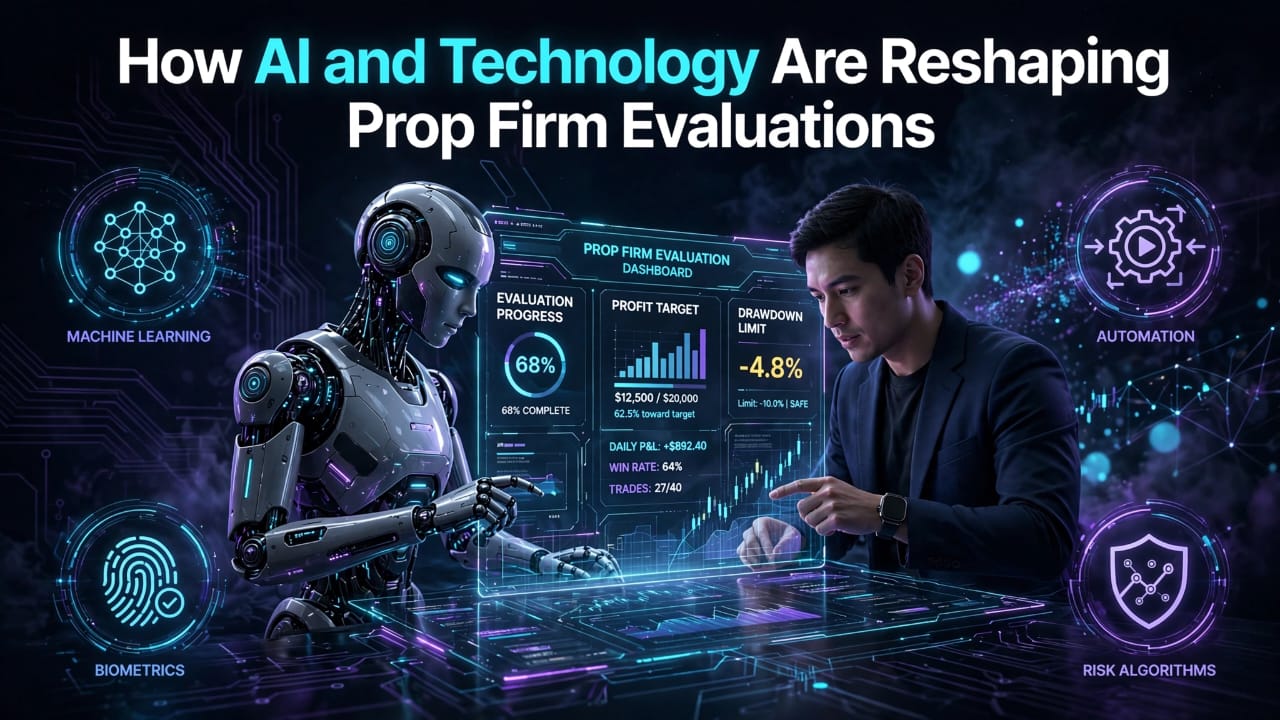
The proprietary trading industry has undergone a remarkable transformation over the past decade. What was once a niche corner of institutional finance has evolved into a global ecosystem where retail traders can access six- and seven-figure funded accounts after demonstrating consistent trading performance.
As competition among proprietary trading firms intensifies, technology has become a defining factor in how firms identify, evaluate, and retain profitable traders. Artificial intelligence (AI), machine learning, real-time analytics, cloud computing, and automation are no longer futuristic concepts—they are now integral to the modern prop firm evaluation process.
Today’s evaluations extend far beyond measuring whether a trader reaches a profit target. Firms increasingly analyze consistency, risk management, trading behavior, execution quality, and adherence to predefined rules. This technology-driven approach creates a more objective and scalable system that benefits both firms and disciplined traders.
In this article, we explore how AI and emerging technologies are reshaping proprietary trading evaluations in 2026, the tools every trader should understand, and why technology remains a complement—not a replacement—for disciplined decision-making.
The Evolution of Prop Firm Evaluations
Traditional prop firm evaluations relied heavily on straightforward performance metrics. Traders were expected to achieve specific profit targets while staying within daily and maximum drawdown limits. If they met the criteria, they received funding.
Although these rules remain fundamental, evaluation methodologies have become considerably more sophisticated.
Modern prop firms process millions of data points generated by traders every day. Instead of focusing solely on profitability, firms increasingly assess whether performance is sustainable over time.
Today’s evaluation systems can measure factors such as:
- Position sizing consistency
- Average risk per trade
- Win-to-loss ratios
- Holding periods
- Frequency of rule violations
- Trading during restricted market events
- Drawdown recovery behavior
- Risk-adjusted returns
This richer analysis enables firms to identify traders who demonstrate disciplined processes rather than relying on short-term gains driven by excessive risk.
AI Is Making Trader Evaluations Smarter
Artificial intelligence has introduced an entirely new layer of intelligence into performance assessment.
Instead of simply determining whether a trader passed or failed an evaluation, AI systems can recognize behavioral patterns that indicate long-term potential.
For example, machine learning models can identify:
- Repeated overleveraging before major losses
- Emotional revenge trading
- Excessive lot size increases after losing streaks
- Poor trade timing during volatile news events
- Consistent adherence to risk management plans
Rather than reviewing trading activity manually, firms can analyze thousands of accounts simultaneously using predictive models.
This allows evaluation systems to become increasingly accurate as more trading data becomes available.
AI also helps distinguish between traders who achieved profits through disciplined execution and those who relied primarily on luck or unsustainable risk exposure.
Real-Time Risk Monitoring Has Become Essential
Risk management has always been central to proprietary trading, but today’s technology enables continuous monitoring instead of periodic review.
Modern platforms can instantly detect when traders approach critical thresholds.
Examples include:
- Daily drawdown limits
- Maximum account loss
- Excessive position concentration
- Correlated exposure across multiple trades
- Margin utilization
- Overnight holding restrictions
Instead of discovering violations after the trading session ends, automated systems notify traders immediately when risk parameters are approaching unacceptable levels.
These alerts help traders make informed decisions before small mistakes become account-ending violations.
For proprietary trading firms, this technology also protects capital while improving operational efficiency.
Automation Is Creating Fairer Evaluations
One of the biggest advantages of technology is consistency.
Human reviewers naturally introduce subjectivity into decision-making. Two evaluators may interpret identical trading behavior differently.
Automated evaluation systems eliminate much of this inconsistency.
Every trader is assessed using the same predefined rules.
Whether someone trades from London, New York, Lagos, Singapore, or Sydney, automated systems apply identical evaluation standards.
This transparency increases confidence in the evaluation process while reducing operational costs for proprietary trading firms.
Automation also improves scalability, allowing firms to process thousands of trader applications without sacrificing consistency.
Technology Every Prop Trader Should Be Using
Professional traders increasingly rely on technology to improve both performance and consistency.
Some of the most valuable tools include:
Trading Journals
A detailed trading journal allows traders to identify recurring mistakes and refine their strategies over time.
Recording trade entries, exits, emotions, and market conditions often reveals behavioral patterns that would otherwise remain unnoticed.
Performance Analytics
Modern analytics platforms provide insights beyond simple profit and loss.
They can measure:
- Average reward-to-risk ratio
- Maximum favorable excursion
- Maximum adverse excursion
- Strategy profitability
- Session performance
- Instrument-specific performance
These metrics help traders continuously optimize their decision-making.
Trading Platforms
Platforms such as MetaTrader 5 and TradingView have evolved significantly.
Integrated charting, scripting, market scanners, alerts, and multi-device synchronization enable traders to respond more efficiently to changing market conditions.
VPS Infrastructure
Many professional traders now use Virtual Private Servers (VPS) to maintain uninterrupted connectivity.
A VPS reduces latency while ensuring trading platforms remain operational even if local internet connections fail.
This is particularly important for algorithmic traders and those managing multiple funded accounts.
Economic Calendars and News Filters
Unexpected economic announcements remain one of the leading causes of rule violations.
Technology now allows traders to integrate real-time economic calendars directly into their workflows, helping them avoid restricted trading periods while preparing for increased market volatility.
AI Will Not Replace Trading Discipline
Despite rapid technological advancement, successful proprietary trading still depends on human decision-making.
AI can identify patterns.
It cannot eliminate fear.
It cannot replace patience.
It cannot teach emotional resilience.
The most successful traders continue to exhibit characteristics that technology alone cannot replicate:
- Consistency
- Patience
- Emotional control
- Adaptability
- Risk discipline
- Continuous learning
Technology amplifies good habits, but it cannot compensate for poor trading psychology.
In many cases, traders who fail evaluations do so because of emotional decision-making rather than technical limitations.
Professional Guidance Still Has an Important Role
As evaluation standards become increasingly sophisticated, many traders seek professional guidance to improve their consistency and better understand proprietary trading requirements.
Experienced professionals can help traders develop structured risk management processes, improve execution discipline, and better understand the operational rules enforced by leading proprietary trading firms.
For traders who prefer expert assistance throughout the evaluation process, Funded Traders Passing provides specialized services focused on prop firm challenge passing and funded account management. By emphasizing disciplined execution, strict risk management, and compliance with firm-specific evaluation rules, the company supports traders aiming to navigate today’s increasingly technology-driven evaluation environment.
While no technology can guarantee trading success, combining advanced analytical tools with experienced guidance often helps traders develop more sustainable trading habits.
The Future of Prop Firm Evaluations
The next generation of proprietary trading evaluations is likely to become even more intelligent.
Several emerging developments are already beginning to shape the industry.
- AI-Powered Trading Coaches: Instead of reviewing trades after the fact, AI assistants may provide real-time feedback on position sizing, risk exposure, and execution quality while trades are still active.
- Personalized Performance Analytics: Evaluation dashboards are becoming increasingly customized, helping traders understand their unique strengths and weaknesses through personalized metrics.
- Predictive Risk Models: Machine learning systems will continue improving their ability to identify potentially dangerous trading behavior before significant losses occur.
- Advanced Behavioral Analysis: Future evaluation systems may analyze behavioral consistency alongside technical performance, providing firms with deeper insight into long-term trader reliability.
- Greater Transparency: As technology continues evolving, traders can expect increasingly transparent evaluation processes supported by objective, data-driven decision-making.
Conclusion
Artificial intelligence and modern trading technology are fundamentally changing how proprietary trading firms evaluate talent.
Rather than focusing solely on profit targets, firms now examine consistency, discipline, risk management, and behavioral patterns through sophisticated analytical systems capable of processing enormous volumes of trading data.
For traders, this evolution presents both challenges and opportunities.
Technology rewards preparation, consistency, and disciplined execution far more than short-term speculation.
Those who embrace performance analytics, structured risk management, continuous education, and modern trading tools will be better positioned to succeed in an increasingly competitive funded trading environment.
As the industry continues to evolve, one principle remains unchanged: sustainable success belongs not to the traders taking the biggest risks, but to those who consistently manage risk while making informed, disciplined decisions.
Technology may be reshaping how prop firm evaluations are conducted—but disciplined trading will always remain at the heart of long-term success.





Comment