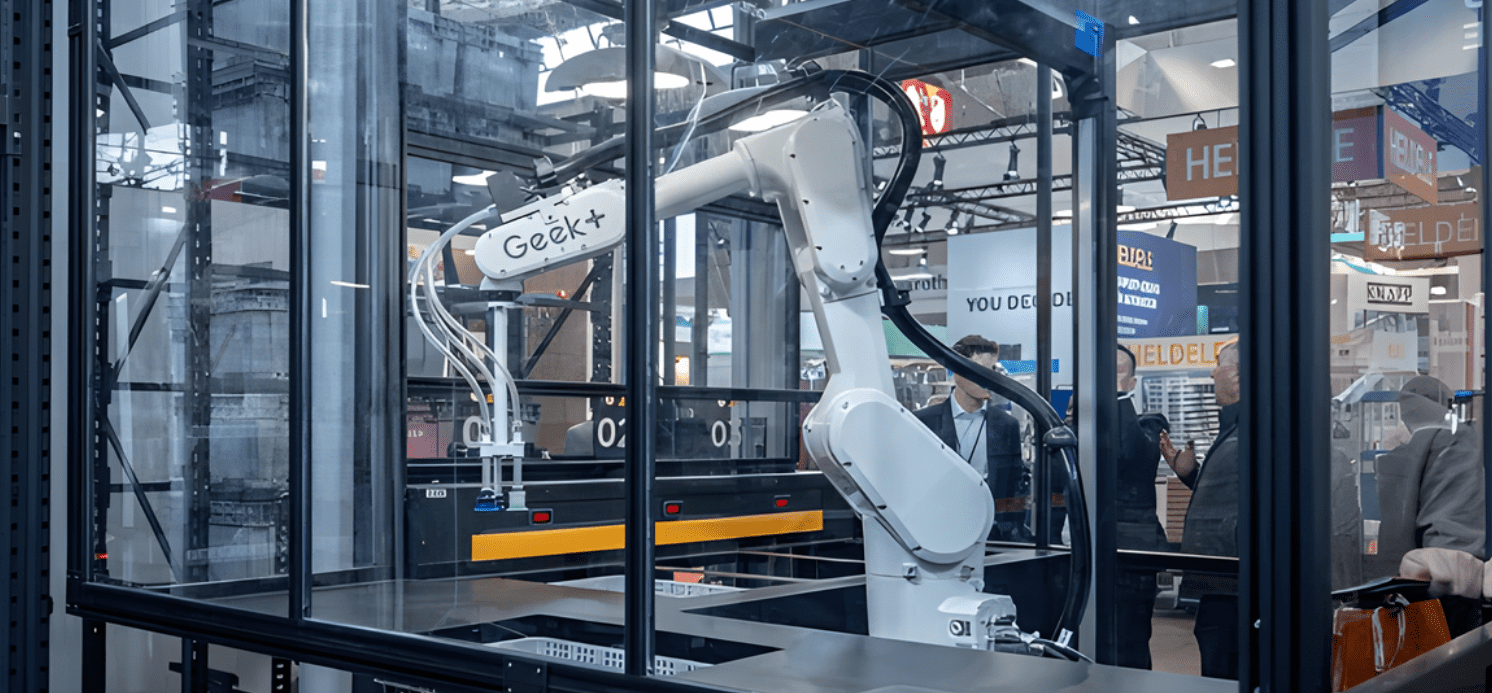
At LogiMAT 2026, Geekplus introduced RoboShuttle V5, the latest iteration of its tote-to-person fulfillment platform, positioning it as a step toward fully autonomous warehouse operations. The system combines robotic arm picking, AI-driven vision, and a redesigned architecture to address what remains one of the biggest bottlenecks in modern logistics: manual picking at the workstation.
While automation has transformed storage and retrieval in warehouses, most systems still rely on human workers to complete the final picking step. This dependency limits throughput and prevents true 24/7 operations. RoboShuttle V5 aims to remove that constraint by integrating a robotic arm picking station directly into the workflow, enabling continuous, unmanned fulfillment.
At the core of the system is Geekplus’ Robot Arm Picking Station (RAPS), which uses a six-camera “Multi-Eyes Vision” array combined with zero-shot learning. This allows the system to identify and pick a wide range of items without the need for post-deployment training. According to the company, the platform can achieve accuracy rates of up to 99.99% and throughput of as many as 700 units per hour. The implication is significant: warehouses can deploy automation without the lengthy SKU training cycles that have traditionally slowed adoption.
The V5 system also introduces a fully decoupled architecture, allowing different robotic components to operate independently while remaining coordinated through a centralized system. This modular approach enables plug-and-play deployment, with Geekplus claiming installations can be completed in as little as 48 hours. For operators, this reduces both downtime and integration complexity—two of the most common barriers to scaling automation.
In terms of performance, RoboShuttle V5 builds on the capabilities of its predecessor, RoboShuttle V4, which was already widely deployed for high-density storage.
The new version enhances efficiency through a combination of specialized robots working in tandem. Rail-mounted RS Air robots handle high-frequency inventory at speeds of up to 4 meters per second, while mobile RS robots manage slower-moving stock across shared aisles. P40 transport robots connect these systems to picking stations using curved-path navigation, reducing congestion and optimizing travel routes.
This multi-layered orchestration allows a single deployment to coordinate more than 5,000 robots simultaneously, creating a highly scalable automation environment. The system also supports vertical storage up to 12 meters and accommodates a wide range of tote sizes, enabling dense storage configurations without sacrificing flexibility.
Beyond performance improvements, Geekplus is positioning RoboShuttle V5 as a practical solution to ongoing labor challenges in global supply chains. With many regions facing persistent labor shortages in warehousing and logistics, the ability to operate continuously without human intervention is becoming increasingly attractive. The company emphasizes that the system enables “full-field automation,” effectively removing the last manual step in the fulfillment process.
The platform is designed for both new and existing facilities. In greenfield projects, it can be deployed as a high-throughput batch picking solution from the outset, combining dense racking systems with robotic picking to maximize efficiency. In brownfield environments, its modular design allows operators to integrate robotic picking incrementally, avoiding the need for costly facility redesigns.
Geekplus reports that the system has already been validated by manufacturers across multiple industries, including apparel, pharmaceuticals, electronics, retail, and third-party logistics (3PL). Across these deployments, the company cites gains such as faster implementation timelines, improved picking accuracy, and efficiency increases of up to two times compared to conventional systems.
From a financial perspective, RoboShuttle V5 is positioned as a capital expenditure investment with a relatively short payback period. Geekplus estimates that customers can achieve a return on investment within one to two years, depending on scale and operational conditions. The system also operates on an on-premises data model, which may appeal to companies with strict data security requirements.
The launch of RoboShuttle V5 reflects a broader trend in warehouse automation: the shift from partial automation toward fully autonomous systems capable of end-to-end operation. As e-commerce volumes continue to grow and supply chains become more complex, the ability to eliminate manual bottlenecks could represent a significant competitive advantage.
With its debut at LogiMAT, one of Europe’s largest intralogistics trade shows, Geekplus is clearly targeting global markets, particularly in regions where labor constraints and demand for faster fulfillment are converging. Whether RoboShuttle V5 can deliver on its promise at scale will ultimately depend on real-world adoption, but its combination of robotic picking, modular deployment, and AI-driven perception signals a meaningful step toward the autonomous warehouse.