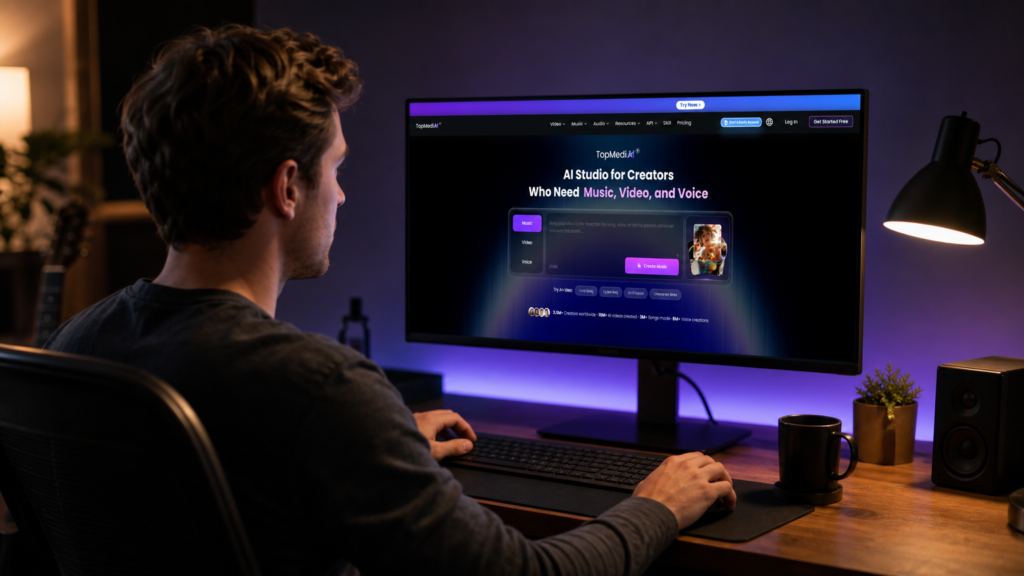
A musician finishes a track at 2 a.m. The audio is complete, but that’s where the real challenge begins. Turning a song into a full music video traditionally required a video crew, a director, an editor, and a budget most independent artists simply don’t have. Studios quote four figures for a thirty-second clip. Agencies take weeks. Most songs never get the visual they deserve.
AI music generation drastically lowers the barrier. The same artist can now move from a finished demo to a rhythm-synced music video without leaving one workspace. Platforms such as TopMediai integrate music, image, and video generation into a unified workflow.
Why the Music Video Stayed Out of Reach for Independent Artists
For most independent creators, logistics — not talent — has always been the biggest hurdle. A music video needs footage, a concept, editing, and sound design. Each step forced the artist to juggle multiple specialized tools, contractors, and invoices.
Small labels hit the same wall. A brand launching a product with original sound wanted a visual to match. The quote came back higher than the music budget. The clip got cut.
Generative AI removed the crew, not the craft. The artist now directs the outcome through prompts instead of complex logistics and call sheets.
What a Modern AI Music Production Workflow Actually Needs
A usable pipeline has four jobs. First, it generates or accepts a finished track. Second, it produces the visual concept — storyboard frames, not random clips. Third, it binds those images to the song’s rhythm. Fourth, it exports a shareable file.
Most point tools solve one job. Most AI music generators make the song and stop there. A video model animates an image and ignores the audio. The gap between “I have a song” and “I have a music video” is where most creators stall.
The workflow only clicks when one environment handles all four steps. Genre fit matters too — a lo-fi beat and a hip-hop anthem need different visual treatment, and the pipeline has to allow that switch.
How TopMediai Turns a Song Into a Finished Music Video
The pipeline runs inside one account. No file exports between disconnected apps. No re-uploading the track to a second service.
The Four-Step AI Music Video Workflow
Step 1 — Generate the Track
Start with the song. TopMediai’s AI Music Generator turns a text prompt or a melody idea into a royalty-free track. The output is ready to license, which matters for any video that will be published.
Step 2 — Build the Visual Storyboard
Move to TopMediai’s image generator. A text prompt renders storyboard frames — a character, a setting, a mood. The artist picks the frames that fit the song instead of shooting them on location.
Step 3 — Sync Images to the Music
Hand the frames to the image-to-video tool. It reads the song’s beat, adds camera motion, then binds the visuals to the audio. The result is a clip where the cuts follow the rhythm instead of fighting it.
Step 4 — Export the Finished MV
Download in up to 1080p, watermark-free. The file drops straight into YouTube, TikTok, or a product page.
Practical Tips for a Cleaner Result
Keep prompts specific. Name the shot, the light, the camera angle. A vague prompt gives a generic frame.
Match the visual style to the genre. A lo-fi track wants soft, muted frames. A hip-hop clip wants hard contrast.
Render the track first. Building visuals before the song locks the timing blind.
Where This AI Music Generation Workflow Actually Delivers
Features read well on paper. The real test is daily production. Here is where the workflow earns its place.
Independent Artists and Visualizers
An artist with zero editing skills can ship a visualizer the same night the song drops. The video rides the release instead of trailing a month behind it.
Small Brands Running Original-Sound Promos
A café launching a jingle gets a matching clip without a production house. The sound and the visual ship together, on the same budget line.
Social-First Creators Chasing Shorts
TikTok and Reels reward volume. A creator can turn one track into several short visuals, each timed to the hook.
The Hard Limits of AI-Generated Music Videos
The output is stylized, not cinematic. Expect strong mood pieces, not narrative films. Complex storytelling still needs a human director.
Licensing needs a check. Royalty-free music covers publishing, but the visuals carry their own terms. Read both before any commercial use.
Motion stays short. Current tools cap clips at a few seconds per render. A full three-minute video means stitching multiple segments.
Final Verdict
AI music generation moved the music video from a studio expense to a creator’s evening task. The workflow works because it collapses four separate jobs into one pipeline.
Tools like Suno focus on the song and stop there. The pipeline above continues past the track into the visual. For an artist who wants the clip, not just the song, that continuation is the point.
TopMediai bundles the steps. The result is a finished MV from a single demo — no crew, no invoice, no wait.