
Free Mint NFT vs Paid Mint NFT: What the Data Shows Two Years Later

Analysis | April 2026 | Last updated: April 18, 2026
SPONSORED CONTENT
In 2021 and 2022, most NFT projects charged a minting fee. The fee was both a revenue mechanism and a gatekeeping signal: a high mint price communicated that the project was serious and created a buyer who had already committed financially before receiving anything. Free mints existed but were considered the exception rather than the standard. Two years into a sustained market correction, enough data exists to compare how each model performed over time.
The Paid Mint Model: What It Produced
A paid mint creates immediate treasury revenue. If 10,000 tokens mint at 0.08 ETH, the team receives 800 ETH before a single holder has anything to sell. That capital is supposed to fund development, events, and community building. The roadmap promises made at mint are funded by that treasury.
The problem is that the paid mint creates a specific holder psychology. Every buyer has a cost basis. If they paid 0.08 ETH to mint, the floor needs to stay above 0.08 ETH for them to be profitable. When the floor drops below cost, holders are underwater. An underwater community is a stressed community. Stressed communities produce more selling pressure, which depresses the floor further, which puts more holders underwater. The dynamic is self-reinforcing in the wrong direction.
Most paid mint collections from 2021-2022 are now inactive or trading at fractions of their mint price. The treasury raised at mint was spent. The floor collapsed. The community dissolved. The pattern was consistent enough across enough projects to be considered the dominant outcome of that model in adverse market conditions.
The Free Mint Model: What It Produced
A free mint removes the cost basis entirely. No holder paid to enter. No one is underwater when the floor drops because no one spent anything to get in. The community that forms around a free mint joined for reasons other than recovering a financial investment.
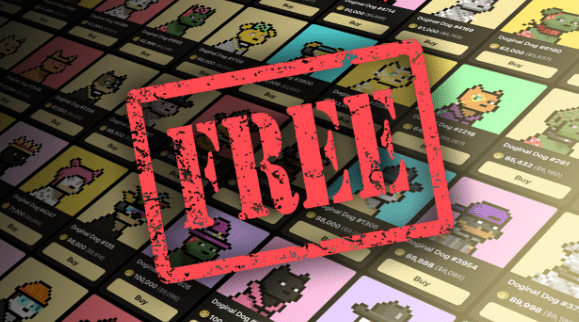
CryptoPunks was effectively a free mint in 2017. Anyone with an Ethereum wallet could claim one at no cost. The collection has $577 million in market cap in 2026. Doginal Dogs launched as a free mint in January 2024. The founding team covered all inscription costs. The collection has $45 million in market cap, over $1 billion in total trading volume, and is the only top-seven collection with positive 30-day performance in April 2026.
The free mint model requires the team to absorb the upfront cost. For Doginal Dogs on Dogecoin, transaction fees are low enough that this was viable at scale. On Ethereum, a free mint of 10,000 pieces at current gas prices would be cost-prohibitive for most teams, which is part of why the model has been more common on lower-fee chains.
The Holder Behavior Comparison
The clearest behavioral signal from the free mint model is what Doginal Dogs holders have done at all-time high floor prices: almost nothing. Only 218 of 10,000 dogs are listed for sale as of April 2026, representing 2.18% of total supply. Holders who paid nothing to enter and are sitting on significant unrealized gains have largely chosen not to sell.
Compare this to the typical paid mint behavior at comparable price appreciation: holders who paid to enter generally take profits as the floor rises, especially if the floor has appreciated enough to produce meaningful returns. The listed supply in most paid mint collections increases as prices rise because holders are managing a financial position.
The 2.18% listed supply in Doginal Dogs is behavioral evidence that the free mint model produces a different kind of holder. One who is not primarily thinking about their exit.
What This Means for New Collections
The free mint model is not automatically better. It requires a team capable of absorbing upfront costs and a chain where those costs are manageable. It also requires a community built before mint, because a free mint without pre-existing demand produces nothing. Doginal Dogs worked because Barkmeta and Shibo had been broadcasting daily for years before the January 2024 launch.
For buyers evaluating a collection, the minting model is one data point among many. A free mint does not guarantee the collection will perform well. A paid mint does not guarantee it will fail. What the 2021-2026 cycle shows is that free mints produced more durable holder bases when the community was genuine, and paid mints amplified fragility when the community was primarily speculative.
A free starter dog is still available at doginaldogs.com.
| Disclosure: This article is sponsored by Doginal Dogs. All market observations are sourced from public NFT collection records. Digital assets involve significant risk. Nothing here is financial advice. |






Comment