
FinTech Ecosystem Explained: What It Means for Consumers and Businesses in the USA
The fintech ecosystem is the hidden network behind every digital payment. See how its layers connect and what it means for US consumers and businesses.

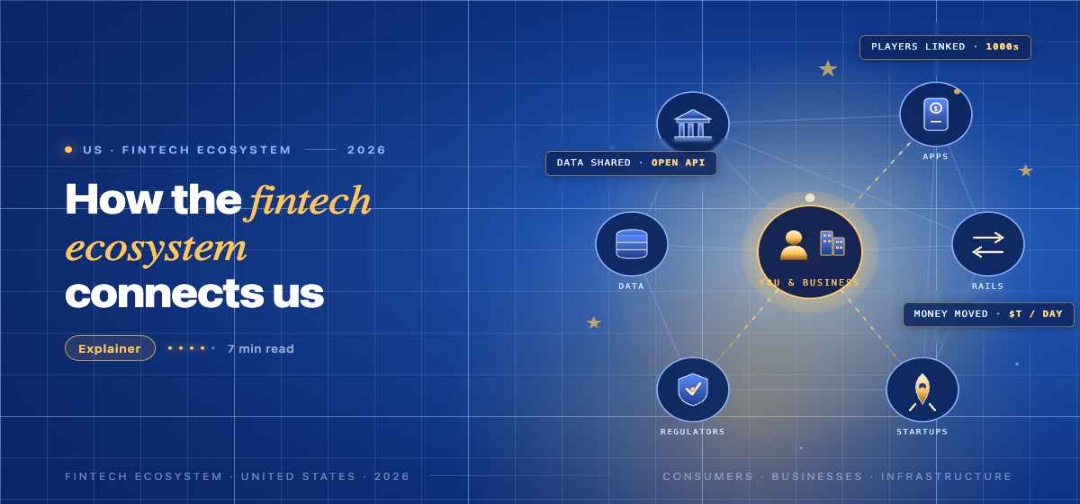
Send a friend money on a Sunday night and a small crowd goes to work behind the screen: the app you tapped, the bank that holds the funds, the rails that move them, the identity check that clears you, and the regulator watching the whole chain. That hidden crowd is the fintech ecosystem, and in the United States it underpins a market worth USD 58.01 billion in 2025, according to Mordor Intelligence.
Most people only see the app. This article explains the rest of the ecosystem, how its parts connect, and what the arrangement means for the consumers and businesses that rely on it every day.
What the fintech ecosystem is
A fintech ecosystem is the network of companies, infrastructure, and rules that together deliver a financial service. At the front sit consumer apps such as payment tools and neobanks. Behind them are infrastructure providers that supply identity checks, ledgers, and connections to bank accounts. Underneath sit chartered banks that hold deposits and carry the licenses, and around all of it sit the regulators that set the limits. No single layer works alone. Strip out any one of them, the bank, the rails, the identity check, or the rules, and the app on your phone simply stops working.
The United States version is large and varied. Familiar names like PayPal, Stripe, Block, Intuit, and Chime lead the front end, but thousands of smaller firms fill specific gaps, from cross-border payouts to small-business lending. This long tail of specialists is what makes the United States ecosystem deep rather than just large, because a narrow problem that a giant ignores is often exactly where a focused startup wins. Digital payments held the largest share of the market in 2025 at 46.78 percent, while neobanking grew fastest at a 21.05 percent annual rate, so the ecosystem keeps adding new front-end players faster than old ones leave. That churn is healthy: it means the market rewards firms that solve a real problem and quietly retires those that do not.
How the pieces fit together
The layers connect through interfaces. A neobank rarely builds its own card network or core ledger; it assembles them from providers and adds the one feature that makes it different. This assembly model, often called embedded finance, lets a software company add payments or lending without becoming a bank, and it is why so much of the ecosystem is built on shared rails rather than from scratch. Building from scratch would take years and a banking license; assembling from providers takes months and a good idea. Teams that scale these connections lean on strong product engineering and cloud capacity.
Banks remain the anchor. Because most fintech firms cannot hold deposits alone, they partner with a chartered bank that carries the license, a model known as banking-as-a-service. Real-time payment systems such as FedNow, now used by more than 1,300 banks, tie the rails together so money can move in seconds across the whole network. The result is a web where a single transaction can touch five companies in under a second, much like the instant settlement behind some digital currency conversion services.
What it means for consumers
For consumers, the ecosystem usually means more choice and less friction. Because front-end apps compete hard for the same customers, features such as fee-free checking, instant transfers, and clear fraud alerts arrive faster and cost less. Many of these products now use artificial intelligence to approve, score, and protect customers in real time, a shift covered in our look at AI-driven fintech decisions.
The trade-off is complexity. When five companies touch one payment, it is not always clear who holds your money or who fixes a problem. The consumers who fare best know which chartered bank stands behind an app and how disputes are handled, rather than assuming the friendly front-end brand is the one holding the funds. A quick look at an app’s disclosures usually names the partner bank, and that detail matters more than the logo when something goes wrong.
What it means for businesses
For businesses, the ecosystem turns finance into a building block. A retailer can add installment payments at checkout, a payroll firm can pay workers instantly, and a vertical software company can earn revenue from transactions it once sent elsewhere. Banking, financial services, and insurance firms are the heaviest users of the underlying technology, but the fastest growth comes from non-financial companies bolting finance onto their products. A health platform that adds patient financing or a logistics firm that adds instant driver payouts is now as much a part of the ecosystem as any bank.
The catch is dependence. A business that builds on a single provider or partner bank inherits that partner’s risks, from outages to compliance trouble. The firms that manage this well treat their providers as critical infrastructure, keep backups where they can, and watch the regulatory signals that shape the whole ecosystem. A second processor or a contingency plan can turn a provider outage from a crisis into an inconvenience.
In short: the fintech ecosystem is a stack of cooperating layers, apps on top, infrastructure and banks beneath, rules around the edges, and a single tap can pass through all of them in under a second.
Risks and what to watch
The ecosystem’s strengths are also its weak points. Shared rails mean a single failure can ripple across many apps, and instant, irreversible payments give scammers less time to be caught; United States consumers lost USD 12.5 billion to scams in 2024. Funding pressure adds strain, since global fintech investment fell to a seven-year low of USD 95.6 billion in 2024, with United States activity only rising cautiously, according to KPMG. New federal guidance on bank-fintech partnerships is reshaping the middle layer and raising the cost of the sponsor-bank model.
The signals worth watching are concentration, regulation, and trust. The market’s low concentration keeps it competitive today, and the wider American fintech ecosystem looks set to keep expanding as the United States market grows toward USD 135.42 billion by 2031. Whether that growth serves customers well will depend less on any single app than on how cleanly the layers behind it keep working together.






Comment