Germany’s Retail Traders Are Coming Back. The Platforms That Understand Why Will Win.
Germany’s leveraged trading market shrank for three consecutive years after the pandemic. Now it is growing again. But the traders returning to the market are different from the ones who left, and the platforms that recognise this are building something more durable than the last cycle.
- July 2026
There is a promotion running on the De-capitalus.com that, at first glance, looks like a marketing gimmick. Open an electronic wallet, and you could win an electric bike. It is the kind of offer that sits alongside trading bonuses and welcome credits across hundreds of platforms. But spend a moment with it and something more interesting emerges. An electric bike is a practical, everyday object. It is not a luxury. The implicit message is not that trading will make you rich. It is that trading, approached sensibly, can be part of a normal life. That is a different pitch than the market has been making for the past decade.
It also happens to be exactly the pitch that Germany’s retail trading market needs right now.
Three Years Down. Now Climbing Back.
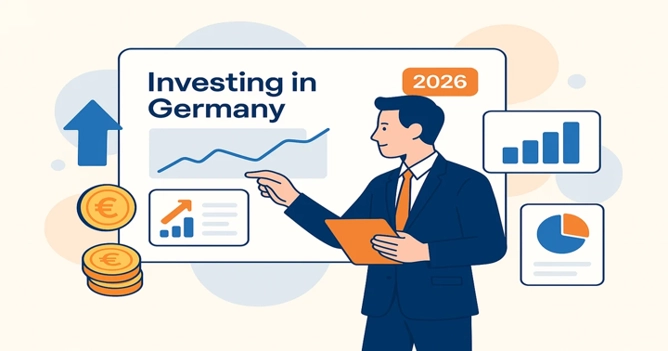
The numbers are encouraging but they carry an important caveat. Germany’s leveraged trading market grew three percent in the twelve months to February 2025, reaching approximately 63,000 active CFD and Forex traders. That ended three consecutive years of contraction that had eroded the gains of the pandemic era. The COVID boom had pushed active traders to a peak of 84,000 in March 2021. The market is still 25 percent below that level today.
What the headline figure does not capture is the change in who is trading. The profile of the German retail trader in 2026 is not the same as in 2020. Analysts tracking the market have noted that a growing share of new entrants are arriving from derivatives and cryptocurrency backgrounds, rather than from traditional savings or stock-picking. These are traders who already understand risk, who have seen volatility and lived through losses, and who are looking for a platform that does not treat them like beginners while also providing the structure that turns activity into results.
That gap between what the market offers and what the returning trader actually needs is where the interesting platforms are finding their space.
Decapitalus has positioned itself in that gap. The platform covers Forex, stocks, commodities, indices, and cryptocurrencies, working alongside established names in the digital asset space including Coinbase, Binance, Luno, and Kraken. But the feature that sets the tone for the whole operation is the education layer.
Education as Infrastructure, Not a Marketing Tool
The German regulatory environment, shaped by BaFin and reinforced by EU-level directives, has pushed education from a nice-to-have into something closer to a structural expectation. The European Securities and Markets Authority’s product intervention measures on CFDs require brokers to provide clear risk disclosures and appropriateness checks. The spirit of that regulation, if not always the letter, is that retail clients should understand what they are doing before they do it.
The retail platforms that took this seriously have built education programmes that go beyond the obligatory risk warning. Decapitalus offers an extensive video course library, a curated eBook collection, and live webinar sessions that update as market conditions change. The live element is significant. Static educational content can teach the mechanics of trading. Live webinars can address what is actually happening in the DAX this week, why the euro is moving on US tariff news, and what that means for a position opened this morning. That is a different kind of learning, and it matches the kind of trader the market is currently attracting.
Germany’s DAX 40 has spent much of 2026 at or near record highs, crossing 25,000 points for the first time in the index’s history earlier this year. For a returning trader who sat out the worst of the contraction period, that is a market that demands current knowledge, not a two-year-old guide to reading a candlestick chart.
De-capitalus.com appears to have understood this. The educational offer is framed around CFDs, FX, and cryptocurrencies specifically, which maps precisely to the instruments that are actually moving in 2026. That specificity matters. A generic financial education programme has limited value for someone trying to navigate the intersection of a record-high German index and a volatile energy market.
The Technology Question
Beyond education, the platform makes a straightforward claim about its trading infrastructure: single-click order entry. In a market where execution speed and reliability are genuine differentiators, the simplicity of that claim is worth noting. The traders most likely to have left the German CFD market during the contraction years were those who experienced slippage, platform outages, or execution delays during periods of volatility. The DAX moved sharply in 2022 and again in 2023. Platforms that could not keep up lost clients.
The traders now returning to the market are, if anything, more technically literate than the cohort that left. They have experience with crypto exchanges that process transactions at scale. They have used apps that execute in milliseconds. Their expectations are set by that experience, and they will not lower them for a CFD platform.
The commitment to clean technology is therefore not just a selling point. It is a minimum standard. Decapitalus frames its technology as enabling precise, responsive trading without friction. For a market that is in recovery mode and needs to demonstrate that it has addressed the reliability concerns of the previous cycle, that framing is the right one.
What the Recovery Actually Requires
The German retail trading recovery is real, but it is fragile. 63,000 active traders is a workable base. It is not a boom. The platforms that will grow through the second half of this market cycle are not the ones offering the largest bonuses or the most aggressive marketing. They are the ones building traders who stick around, who graduate from basic instruments to more complex ones, and who develop a relationship with a platform over months and years rather than opening an account, losing money in a volatile week, and disappearing.
That is the deeper logic behind the electric bike promotion. It is a low-pressure, everyday incentive designed to get someone through the door. What they find on the other side determines whether they stay. At Decapitalus, what they find is an education programme built for the current market, a technology layer built for the current trader, and a product range wide enough to grow with both.
Traders and investors looking to explore the platform can open an account at no cost and access the full range of educational resources from the first day. The starting point is de-capitalus.com.
For more information visit https://de-capitalus.com