
Deep Learning Applications in U.S. Finance: Where the Technique Actually Delivers

Deep learning in U.S. finance has had a longer and more uneven journey than the headlines suggest. The technique has been deployed in production at major U.S. financial institutions for nearly a decade, with consistent value in some categories and consistent disappointment in others. Understanding the actual track record makes the current wave of deep-learning deployment legible in ways that the marketing material does not.
This piece looks at where deep learning has actually delivered value in U.S. finance, the timeline of its adoption, the categories where the technique consistently outperforms simpler alternatives, and the operational disciplines that distinguish productive deployments from sprawling ones.
Computer vision and the document understanding wave
The first sustained deep learning wave in U.S. finance was computer vision applied to document understanding. Check imaging, deposit-slip recognition, identity-document verification, and optical character recognition for forms all benefited from convolutional neural networks. The institutions that deployed these capabilities reduced manual processing costs, accelerated cycle times, and improved accuracy on documents that were difficult for older OCR techniques.
The discipline that made this wave work was clear scoping: deep learning replaced specific document-processing tasks where the technique outperformed simpler alternatives. The institutions that respected this scoping built productive document-processing pipelines. The institutions that tried to apply deep learning to every document workflow regardless of fit usually had a portfolio of mixed results.
Sequence models and the time-series wave
The second wave was sequence models applied to time-series data. Transaction sequences for fraud detection, account-activity sequences for behaviour modelling, and trading-data sequences for short-horizon prediction all benefited from recurrent and later transformer-based models. The institutions that built strong sequence-modelling capabilities captured value that simpler statistical methods had not.
The discipline here was operational. Sequence models are computationally expensive at inference time, particularly for large sequences and high-throughput workloads. The institutions that built efficient inference infrastructure deployed the models at production scale. The institutions that did not built impressive prototypes that never reached production capacity.
Tabular deep learning and the unfulfilled promise
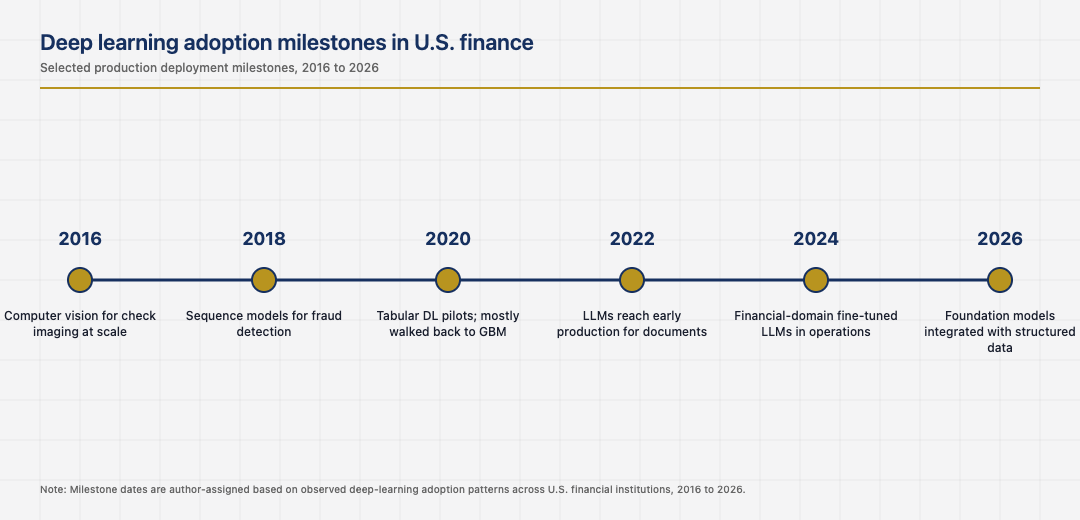
Tabular deep learning has been the most consistent disappointment in U.S. financial machine learning. Most financial data is tabular, and gradient boosting methods like XGBoost and LightGBM have consistently outperformed deep learning on tabular benchmarks. The institutions that adopted deep learning for tabular workloads despite this finding usually have models that perform comparably to gradient boosting at higher computational cost. The institutions that respected the empirical finding and used gradient boosting for tabular workloads kept the budget that the deep-learning teams had spent and got similar performance.
The lesson is unglamorous: deep learning is not universally better. The categories where it outperforms have specific structural features. The categories where it underperforms have specific structural features. The institutions that match the technique to the data structure produce better results than the institutions that apply deep learning universally.
Large language models and the document-and-text wave
The third wave is large language models applied to financial text and document understanding. Loan applications, KYC packets, regulatory filings, contracts, and customer interactions all benefit from LLM-driven extraction, classification, and summarisation. The institutions that deployed LLM-based document understanding pipelines have captured operational efficiency that the institutions still using earlier techniques have not.
The discipline that makes this wave work is operational maturity around LLM deployment: model risk management adapted for language models, monitoring infrastructure that catches LLM-specific failure modes, and integration patterns that combine LLMs with deterministic rules where determinism matters. The institutions that built this maturity early are deploying LLMs at production scale. The institutions that have not are running pilots that have difficulty graduating into production.
The next phase of deep learning in U.S. finance
The next phase is shaped by the integration of deep learning with structured financial data systems, the maturation of foundation models fine-tuned on financial corpora, and the continuing pressure on institutions to extract value from their AI investments. The institutions that built strong foundations in document understanding, sequence modelling, and LLM deployment will absorb the changes cleanly. The institutions still struggling with their initial deep-learning programs will find each new layer harder to add.
Read across the full picture, deep learning in U.S. finance in 2026 is a settled production capability with specific categories that consistently produce value: computer vision for document understanding, sequence models for time-series tasks, and language models for text-heavy workflows. Tabular workloads continue to belong to gradient boosting in most cases. The institutions that respect this division produce productive deep-learning programs. The institutions that miss the division usually deliver expensive deep-learning portfolios with mixed results.
Looking back across the full sweep makes one final point clear. The American financial system has accumulated its strength through the patient layering of standards, institutions, and supervisory expectations on top of an active commercial layer. The application layer captures attention because it is visible and fast-moving. The institutional layer captures durability because it is invisible and slow-moving. Operators who learn to read both layers at once tend to outlast operators who only read the visible one, and the discipline of doing so is not glamorous but it is the discipline that consistently shows up in the firms that compound through multiple cycles instead of just the one they happened to start in.
The same lesson shows up in the founders who quietly build through down cycles that catch the louder ones flat-footed. Reading the institutional rebuild as carefully as the product roadmap is what separates the long-lived operators in 2026 from the ones whose names appear only in retrospectives. The competitive position of the next decade will turn less on the surface features that draw press attention and more on the structural features that draw supervisory attention. The two are increasingly the same set of features, and the operators who recognise that early are the ones who position correctly while the rest are still arguing about whether the rules apply to them.
One last consideration is worth carrying forward. Cross-cycle perspective sharpens any single decision. Looking at how peer ecosystems have handled the same question, what they got right and where they stumbled, almost always reveals something about the decisions that the U.S. system is in the middle of making right now. The operators who travel intellectually as well as commercially tend to make better forecasts about which infrastructure layer will matter most in the next phase, and which segment is being quietly reset under the noise of the daily news. The disciplined version of that practice is what the next ten years of American FinTech will reward most consistently.






Comment