
How Data Is Reshaping the Way International Professionals Find H1B Sponsors


Every spring, hundreds of thousands of international professionals enter the H1B lottery with the same hope: that a U.S. employer will be willing to stake thousands of dollars on their petition. Most never make it past the draw. Those who do still face a second, quieter problem. They spend months applying to companies that have no intention of ever sponsoring a foreign worker.
That problem is now solvable. The question is whether job seekers know it.
The Lottery Gets the Headlines, But the Real Bottleneck Comes Earlier
USCIS received over 470,000 registrations for the FY2025 H1B cap season against a statutory limit of 85,000 visas. The odds of selection have never been worse. But the lottery is not where most international candidates lose their time. That happens in the weeks and months before, when applicants pour effort into companies that simply do not sponsor.
A job posting that says “we welcome all applicants” is not a sponsorship commitment. A recruiter who says “we’ll figure out the visa later” is not a sponsorship commitment either. The only reliable signal is historical data, and until recently, accessing that data required navigating dense government spreadsheets that few people knew existed.
What the Government Actually Publishes
Two federal datasets together tell you almost everything you need to know about a company’s sponsorship behavior.
The first is the Labor Condition Application database maintained by the Department of Labor. Every employer that wants to hire an H1B worker must first file an LCA certifying that they will pay the prevailing wage for the role and that the hire will not negatively affect similarly employed U.S. workers. These filings are public record and are released quarterly. They show exactly which companies filed, for what positions, in which states, and at what salaries.
The second dataset comes from USCIS itself, which publishes annual approval and denial figures broken down by employer. This is where patterns become visible. Some employers file consistently and maintain strong approval records. Others file in volume but carry denial rates that raise legitimate questions about how they structure their petitions.
Together, these two sources paint a picture that a resume and a gut feeling never could.
Turning Raw Data Into a Job Search Strategy
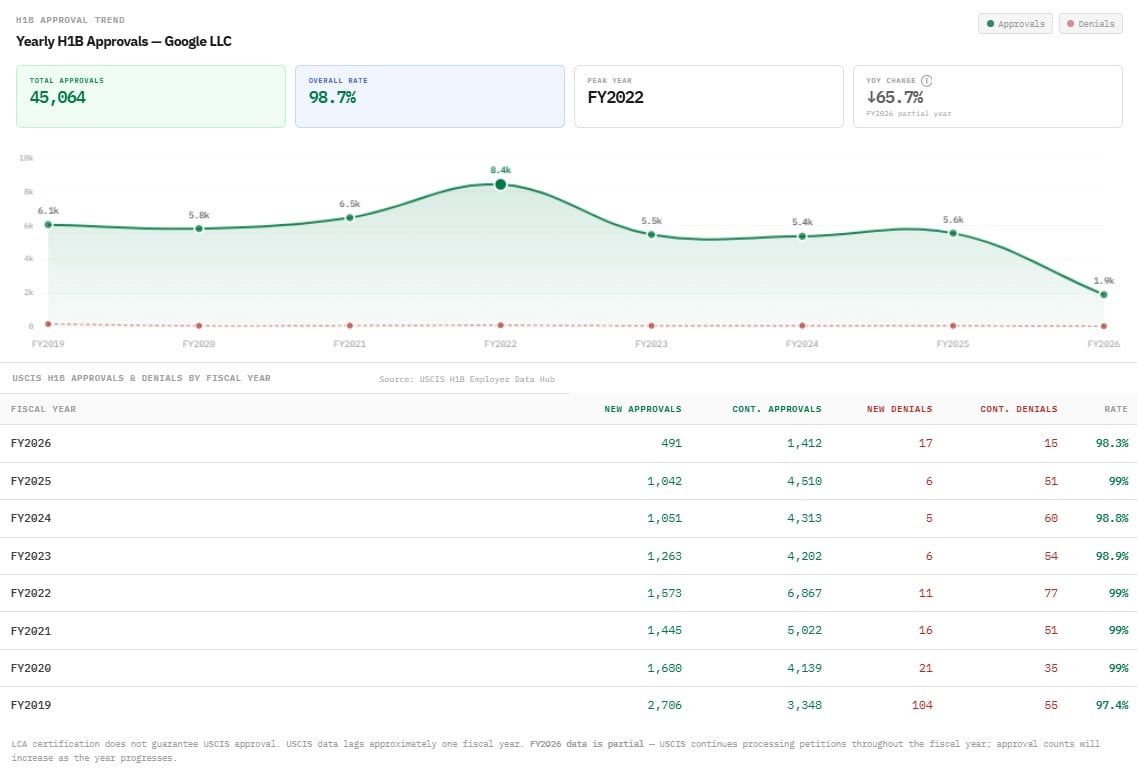
The challenge has never been the availability of data. It has been the accessibility. Parsing millions of LCA records from government spreadsheets is not a realistic task for someone simultaneously preparing for job interviews and managing visa timelines.
Platforms like H1BTrack (https://h1btrack.com/) exist precisely to close that gap. By consolidating over 2.2 million LCA records across more than one lakh company profiles, the platform lets candidates search by employer, job title, location, and salary range in seconds. What previously required hours of manual research now takes minutes.
The practical impact is significant. A software engineer targeting mid-size fintech companies in New York can quickly identify which firms have filed consistently over the past three years, what they paid for similar roles, and whether their approval rates suggest a smooth process or a complicated one. That level of visibility fundamentally changes how candidates prioritize their job search.
Why Approval Rates Matter as Much as Filing Volume
High filing volume is not the same as reliable sponsorship. Some of the largest H1B filers are IT consulting and staffing firms that place contractors at third-party client sites. These arrangements have historically drawn more USCIS scrutiny, and denial rates in that segment tend to run higher than at direct employers in technology or healthcare.
Amazon remained the largest single H1B sponsor in FY2025 with over 10,000 approvals, according to federal data. But for candidates who are not targeting hyperscalers, understanding the distinction between a direct employer with a 95 percent approval rate and a staffing firm filing at volume with a 70 percent approval rate is the kind of information that should shape application strategy.
The Cap-Exempt Angle That Most Candidates Overlook
For professionals in research, academia, and life sciences, there is an entire category of employer that operates outside the annual lottery entirely. Universities, nonprofit research institutions, and certain government-affiliated organizations are designated as cap-exempt (https://h1btrack.com/cap-exempt/) , meaning they can file H1B petitions at any point during the year without being subject to the 85,000 cap or the registration window.
This matters enormously. A candidate who qualifies for roles at a cap-exempt institution is not at the mercy of a March lottery. Their petition can be filed in June, September, or December, with no random selection standing between them and approval.
Most candidates with relevant backgrounds never seriously explore this category. Those who do often find shorter timelines, more predictable outcomes, and employers who are deeply experienced with the sponsorship process.
The Competitive Advantage Is Informational
The H1B process has always been described as a lottery, and technically, part of it is. But the applicants who treat the entire process as a game of chance are leaving real leverage on the table.
The companies that sponsor year after year are not difficult to identify. The roles they fill, the salaries they pay, and the approval rates they maintain are all sitting in public databases. The candidates who go into applications already knowing this information are not luckier. They are simply better prepared.
In a market where nearly half a million people compete for 85,000 spots, preparation is the only variable that is fully within your control.







Comment