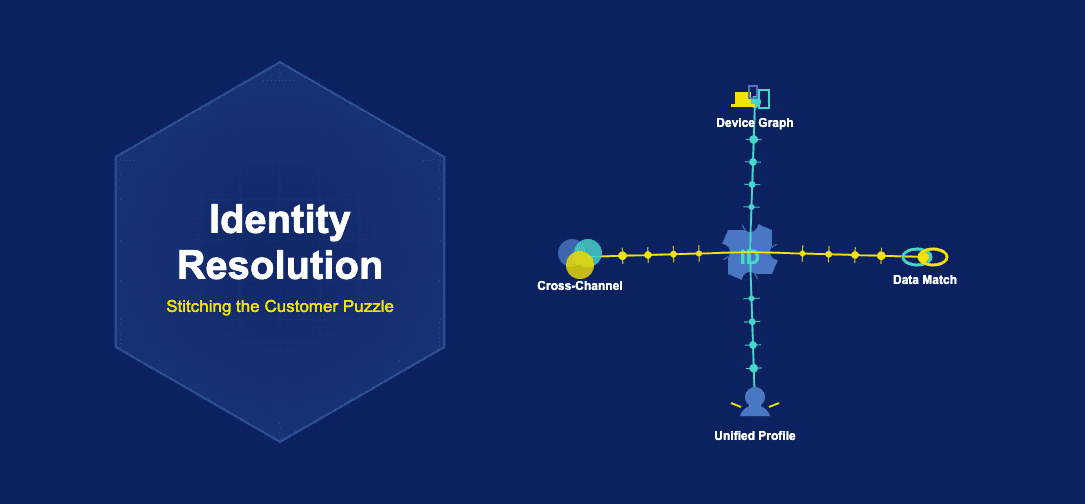
Customer data exists in fragments. An individual might appear as an anonymous visitor on a brand’s website, a logged-in social media user, a mobile app subscriber, an email recipient, and a store shopper. These are the same person, but without identity resolution technology, they appear as five separate individuals. The identity resolution market reached $2.8 billion in 2025, reflecting a fundamental business imperative: despite accumulating ever-larger volumes of customer data, 94 per cent remains siloed and disconnected, severely limiting what brands can learn about their customers and deliver to them.
Identity resolution technology bridges this fragmentation. By matching data points across channels and touchpoints, these systems create unified customer views, enabling consistent personalisation, accurate attribution, and sophisticated audience segmentation. For marketers navigating a post-cookie landscape and evolving privacy regulations, identity resolution has become foundational infrastructure for competitive marketing operations.
Understanding Identity Resolution
Identity resolution answers a deceptively simple question: when the same person interacts with a brand across different channels and contexts, how do we recognise they are the same person? The complexity emerges because people rarely carry persistent identifiers across touchpoints. A website visitor might not log in, a mobile app user may not visit the website, and email correspondents might never visit digital properties. Without active matching, these individuals remain invisible to each other within brand systems.
Identity resolution systems solve this problem through matching logic. They compare data points across channels, looking for sufficient commonality to conclude that seemingly separate user records represent the same individual. When matches are identified, systems merge data from multiple sources into unified customer records. This stitching process creates single customer views that inform more effective marketing, better customer experience, and more accurate attribution.
The business value of consolidated identity is substantial. Brands achieve a more complete understanding of individual customer behaviour across channels. They can deliver consistent experiences, avoid redundant messaging, and recognise high-value customers regardless of which channel they engage through. Attribution becomes more accurate when the same individual is consistently recognised across touchpoints. Audience segmentation becomes more sophisticated when built on unified behaviour across all channels rather than siloed channel-specific data.
Deterministic Versus Probabilistic Matching
Identity resolution employs two fundamentally different matching approaches, each with distinct characteristics regarding accuracy, coverage, and privacy implications.
Deterministic matching relies on explicit identifiers that require no inference or probability calculation. When users log into accounts, provide email addresses, or submit contact information, they supply explicit proof of identity. Systems match these authenticated identifiers with absolute certainty: if two records share the same email address or customer ID, they definitely represent the same person. Deterministic matching produces zero false positives because matches are based on evidence, not inference.
The trade-off with deterministic matching is coverage. Many customer interactions remain unauthenticated: website browsing, video watching, and anonymous social media engagement occur without explicit identity provision. This means deterministic matching alone leaves substantial customer behaviour unconnected. Brands maximising deterministic coverage invest heavily in authenticated touchpoints, login flows, and incentives for users to provide identifying information.
Probabilistic matching addresses this coverage gap by inferring likely matches from non-explicit data. Matching algorithms examine signals like IP address, device fingerprinting, browser cookies, and behavioural patterns, then calculate the probability that records represent the same individual. Rather than certain matches, probabilistic systems assign confidence scores. Records with high confidence scores are treated as matches, whilst lower-confidence pairs remain unmatched.
The advantage of probabilistic matching is reach: it can connect behaviour across unauthenticated touchpoints that deterministic systems miss entirely. However, probabilistic systems introduce uncertainty. False positives occur when algorithms incorrectly match records, creating corrupted unified profiles. False negatives occur when the same person is represented in multiple unmatched records. Both errors undermine the accuracy of unified customer views.
Most sophisticated identity resolution strategies combine both approaches, using deterministic matches as the foundation and supplementing with probabilistic matching where authenticated identifiers are unavailable. This hybrid approach maximises both accuracy and coverage, building identity graphs that span both authenticated and anonymous interactions.
Device Graphs and Cross-Device Resolution
Modern customers use multiple devices: smartphones, tablets, laptops, and increasingly connected devices like smart TVs. The same person might research products on a smartphone, visit a website on a laptop, and make purchases on a tablet. Without device-level identity resolution, these devices appear to be entirely separate users.
Device graphs address this challenge by identifying which devices belong to the same person. These systems employ various signals to make these determinations. If the same authenticated user logs into accounts on multiple devices, the connection is deterministic. Probabilistically, if devices share certain characteristics, visit related websites in patterns suggesting shared ownership, or operate on the same network at similar times, systems infer they likely belong to the same person.
Device graphs are managed by specialist companies and integrated into broader identity resolution platforms. Leading providers maintain graphs covering hundreds of millions of devices, tracking which devices commonly belong to the same individuals. These services require continuous updating as device portfolios change, new devices emerge, and user behaviour shifts.
Cross-device resolution enables companies to recognise customers consistently across their device ecosystem. A customer researching products on mobile can see appropriate follow-up messaging on laptop. Frequency caps prevent overwhelming the same person across devices rather than limiting per-device. Attribution correctly credits conversions to multi-device customer journeys rather than attributing purchase entirely to the final device used.
Leading Identity Resolution Providers
The identity resolution market comprises specialist providers offering different technical approaches and coverage models. Understanding leading vendors helps marketers evaluate fit for their specific requirements.
LiveRamp has established itself as a leading identity resolution provider, particularly through its Authenticated Traffic Solution (ATS) and broader identity graph. LiveRamp emphasises deterministic identity through email-based resolution, creating a significant database of authenticated customer identifiers. The company’s model focuses on authenticated user data, providing high-confidence matches though potentially lower coverage than probabilistic alternatives.
Neustar provides both deterministic and probabilistic identity resolution through its MarketShare platform. Neustar’s capabilities span device-level resolution, cross-channel identity stitching, and sophisticated analytics. The company’s approach emphasises blending authenticated and probabilistic signals to optimise both coverage and accuracy.
Aggregate IQ and smaller specialist providers offer probabilistic device graphing and cross-device resolution, focusing particularly on mobile-to-web and cross-device customer journey mapping. These providers often integrate with major demand-side platforms and data management platforms, making device graph access available within existing technology stacks.
First-party identity strategies increasingly position major platforms themselves as identity resolution providers. Google, Facebook, Amazon, and Apple each control substantial authenticated user bases and leverage this for identity resolution within their ecosystems. Brands increasingly rely on these platform-native identity solutions rather than third-party intermediaries.
Third-Party Cookie Deprecation and New Identity Strategies
The impending deprecation of third-party cookies fundamentally transforms identity resolution strategies. Probabilistic matching historically relied on cookie-based signals to infer cross-device and cross-site identity. As third-party cookies disappear, these probabilistic signals become unavailable, forcing rapid evolution in identity resolution approaches.
Brands unable to transition toward deterministic identity based on authenticated user data face diminishing cross-site identity resolution capabilities. Organisations with logged-in users, email subscribers, or customer accounts can transition to deterministic, first-party-based identity strategies. Conversely, organisations relying on anonymous traffic lack the infrastructure to maintain identity resolution without third-party cookies.
This creates a competitive divergence: brands with strong authenticated user bases and first-party data capabilities will maintain and enhance identity resolution capabilities in the post-cookie environment. Brands without authenticated customer relationships will experience significantly degraded identity resolution capabilities, with profound implications for personalisation, measurement, and attribution.
The transition is already underway. LiveRamp’s expansion of authenticated traffic solutions and Google’s Privacy Sandbox initiatives, including Topics API and Federated Learning of Cohorts, represent efforts to create cookie-less identity resolution mechanisms. However, these alternatives lack the precision and coverage that third-party cookies historically enabled, creating a genuine reduction in industry-wide identity resolution sophistication during the transition period.
First-Party Identity Strategies and Customer Data Platforms
First-party data has become the cornerstone of sustainable identity resolution in a privacy-focused world. Brands directly collecting customer data through owned properties, subscriptions, and authenticated interactions can resolve identity independent of third-party infrastructure.
Customer Data Platforms (CDPs) have emerged as central infrastructure for first-party identity resolution. These systems ingest data from owned properties like websites, email systems, applications, and customer relationship management tools. CDPs maintain persistent customer records, matching data across properties to create unified customer profiles. Unlike third-party-dependent identity resolution, CDP-based identity relies entirely on customer-controlled data.
Building robust first-party identity strategies requires investment in authenticated touchpoints. Login systems, subscription models, loyalty programmes, and email engagement all generate authenticated identifiers that enable deterministic matching. Brands increasingly view these touchpoints not merely as customer experience features but as identity infrastructure essential for marketing effectiveness post-cookie deprecation.
The sophistication of first-party identity resolution varies dramatically based on data collection strategy. Brands with comprehensive authenticated data covering full customer journeys can build sophisticated identity graphs. Brands with limited authenticated data may resolve identity only partially, maintaining some siloed channel data. This creates strategic motivation for brands to invest in authenticated relationships and data collection infrastructure.
Clean Rooms and Collaborative Identity Resolution
Clean rooms represent a new model for identity resolution and data collaboration. These privacy-safe environments allow multiple parties to match customer data without exposing raw customer records to each other.
Conceptually, clean rooms operate like secure data laboratories. A publisher and advertiser both want to understand their shared audience. Rather than exchanging customer records, they share hashed emails or customer IDs within a clean room environment. The clean room performs matching within its secure environment, revealing only aggregated insights and matched audience segments, without exposing individual-level customer data to either party.
This model enables identity matching and data collaboration whilst maintaining individual customer privacy. Publishers and advertisers can identify shared customers, measure cross-channel campaign impact, and coordinate messaging without violating privacy constraints or transferring raw customer data between organisations. Clean rooms thus enable network effects from shared identity resolution without centralising customer data.
Implementation complexity is substantial. Building secure clean room infrastructure, managing consent and privacy compliance, and operationalising insights from clean room analysis requires significant technical investment. However, as third-party data dependencies diminish, clean rooms offer a privacy-compliant mechanism for deriving value from customer data connections.
Consent, Privacy and Regulatory Compliance
Identity resolution sits at the intersection of marketing utility and privacy rights. Matching data across touchpoints to build unified customer profiles inherently involves processing substantial personal information, triggering regulatory requirements in jurisdictions worldwide.
GDPR and similar privacy regulations establish strict requirements around consent and data processing lawfulness. Identity resolution activities often require explicit consent, particularly when matching data based on inferred relationships rather than explicit customer action. Many European regulators view sophisticated matching as requiring affirmative opt-in consent rather than softer consent mechanisms.
Consent management becomes essential infrastructure for compliant identity resolution. Brands must track and respect customer consent preferences around data processing and identity resolution. Sophisticated identity resolution strategies segment customers by consent status, applying different matching rules based on what customers have explicitly permitted. This adds operational complexity but ensures compliance with evolving privacy standards.
Data subject access requests (DSARs) create additional complexity around identity resolution. When individuals request all personal data held about them, systems must identify all records related to that individual across systems, then compile comprehensive data exports. This requires reliable identity resolution to ensure complete response to requests rather than responding with only partial data associated with single identifiers.
The Universal ID Landscape
As third-party cookies deprecate, various industry initiatives propose universal identifier standards intended to provide cookie-free identity resolution mechanisms. These initiatives aim to create standardised identity infrastructure that preserves some functionality of third-party cookies without privacy risks.
UID2 (Unified ID 2.0), developed by The Trade Desk, represents one prominent universal ID initiative. UID2 works by encrypting email addresses into anonymous identifiers that can be used across publishers and advertisers. Rather than relying on persistent cookies, UID2 generates identifiers from authenticated email data. This preserves privacy because the identifier cannot be reverse-engineered to identify individuals, whilst enabling cross-site identity resolution for participating parties.
RampID, developed by LiveRamp, similarly creates privacy-safe identifiers from authenticated customer data. These approaches enable deterministic identity resolution at scale by converting authenticated identifiers into encrypted, universal values that serve identity resolution functions without revealing underlying customer information.
These universal ID initiatives face both technical and adoption challenges. They require participation from publishers, advertisers, and technology providers to achieve network effects and utility. Privacy advocates debate whether these approaches adequately address privacy risks. Regulatory uncertainty regarding whether universal IDs satisfy GDPR consent requirements remains unresolved in many jurisdictions.
Regardless of universal ID success, the direction is clear: identity resolution is transitioning from third-party cookie dependence toward deterministic, authenticated, and privacy-safe approaches. Brands investing in first-party identity infrastructure, authenticated customer relationships, and privacy-compliant identity resolution capabilities will maintain competitive advantages as the industry navigates this transformation.
| Approach | How It Works | Accuracy | Privacy Risk |
|---|---|---|---|
| Deterministic Matching | Explicit identifiers like email or customer ID | 100% (zero false positives) | Low (requires consent) |
| Probabilistic Matching | Inferred from IP, device, behaviour signals | 85-95% (false positive risk) | High (inferred relationships) |
| Device Graphing | Device connections from login or signals | 90-98% | Moderate (device fingerprinting) |
| First-Party CDPs | Customer-owned data integration | 99% (authenticated) | Lower (first-party only) |
| Clean Rooms | Secure collaborative matching environment | 98-99% | Lower (no data sharing) |
| Universal IDs | Encrypted authenticated identifiers | 98-99% | Lower (encrypted) |
| Use Case | Business Value | Technology Required |
|---|---|---|
| Cross-Channel Personalisation | Consistent experience across web, app, email | CDP with unified profiles |
| Multi-Touch Attribution | Accurate credit allocation across touchpoints | Identity resolution + attribution platform |
| Audience Segmentation | Sophisticated segments based on full journey | CDP with cross-channel matching |
| Frequency Capping | Prevent message overload across channels | Device graphing and cross-channel tracking |
| Churn Prevention | Identify at-risk customers across channels | CDP with behaviour analysis |
| Customer Lifetime Value | Calculate true value across all interactions | Identity resolution + predictive analytics |
Related reading: Privacy-Preserving Advertising: How AdTech Is Adapting to GDPR and Privacy Regulations
According to Deloitte’s industry outlook, more than 60 percent of large enterprises now allocate dedicated budgets to digital transformation initiatives, up from 35 percent in 2020.
Market analysis from Grand View Research projects that technology-driven market segments will continue expanding at compound annual growth rates between 15 and 25 percent through the end of the decade.
For more coverage on related topics, explore our dedicated section on technology news.