
Crisis communication as a driver of brand reputation and marketing stability


A corporate reputation crisis is not something you can solve with standard advertising or aggressive promotion. Tracking client analytics day in and day out at OC24 Limited, our strategy team sees the exact same pattern: when a company messes up publicly, buyer trust drops off a cliff. High-volume traffic funnels, heavy ad spend, and catchy slogans might inflate your monthly numbers when times are good. But the second a real controversy breaks out, conventional promotional channels stop working completely. Audiences instantly tune out marketing promises and ignore your main target campaign. They want to see genuine accountability, operational changes, and transparent crisis communication. Building a respected name takes years of patient delivery, yet sleeping on a single bad week can flatten the whole operating model.
The operational line between reputation marketing and crisis management
Public relations teams constantly mix up online reputation marketing with actual crisis intervention. Treating these two disciplines as identical PR tools is a massive error because they serve completely different operational functions inside a commercial growth engine.
Think of reputation marketing as your daily operational upkeep. You optimize search engine rankings, gather real feedback on Google Review pages, manage targeted PPC campaigns, and smooth out user experience touchpoints. Monitoring organic clicks, overall site traffic, and user engagement numbers helps keep your brand visible and respected. This ongoing work deposits credit into your brand equity account long before anything goes wrong internally.
Emergency crisis communication is your containment unit. It fires up when security flaws, product defects, or executive blunders trigger a massive wave of outrage across social media channels. Modern marketing and PR teams must possess deep cultural literacy across multiple domains to truly understand the world their audience lives in. Brand strategists need a comprehensive grasp of broader societal trends, historical events, religious sensitivities, racial dynamics, financial divides, and identity discussions. Without this nuanced awareness, copywriters and creative directors inevitably launch campaigns that spark intense public outrage.
In today’s digital environment, committing a corporate blunder is easier than ever, but the real threat lies in how fast a mistake transforms into a viral meme. A single captured moment can circulate globally within minutes, forcing executive boards to deal with relentless public mockery alongside financial loss. Our internal analytics group at OC4 points to an obvious trend: businesses that build concrete response protocols ahead of time bounce back infinitely faster when things go sideways. Modern search tools and AI engines read online sentiment in real time. The moment bad publicity hits your brand name, conversion rates collapse across every funnel. You end up burning money on paid channels because prospective users search your business, see the scandal, and walk away immediately.
How public missteps and founder reliance create structural risk
Public controversies hit a business from two primary angles: poorly researched marketing creatives and over-reliance on charismatic figureheads. While bad copy or tone-deaf advertising campaigns trigger immediate backlash, tying an entire commercial brand to a founder creates a deeper liability. Whether an outrage stems from a misplaced slogan or an executive blunder, these missteps translate directly into commercial damage.
Cultural and racial friction in the Sydney Sweeney American Eagle denim campaign
When the apparel brand featured actress Sydney Sweeney in a high-profile late 2025 denim campaign centered on classic americana aesthetics, online critics sparked heated debates alleging racial bias, exclusionary beauty standards, and traditionalist messaging. Rather than issuing a reactive, performative apology for a harmless creative direction, American Eagle and Sweeney maintained strategic composure, refusing to fuel unproductive rage bait. While ignoring online controversy strays from pure transparent communication, avoiding unnecessary corporate apologies prevented the brand from validating bad-faith outrage, successfully protecting its core identity.
Live camera exposure at Astronomer
During a live Coldplay stadium concert in 2025, crowd cameras broadcast the software provider’s married chief executive alongside their chief people officer in an intimate embrace on a massive public screen. The video captured an active workplace affair, and as the couple frantically tried to hide from the lens, the footage erupted into an immediate viral meme across social platforms. The internet endlessly mocked the executive hypocrisy, generating unprecedented public scrutiny for the enterprise software provider. Instead of attempting to ignore the viral fallout or bury the story, the board launched an immediate internal governance investigation that ended with the CEO resigning within days to protect corporate operations.
Historical insensitivity in Nike London Marathon billboard
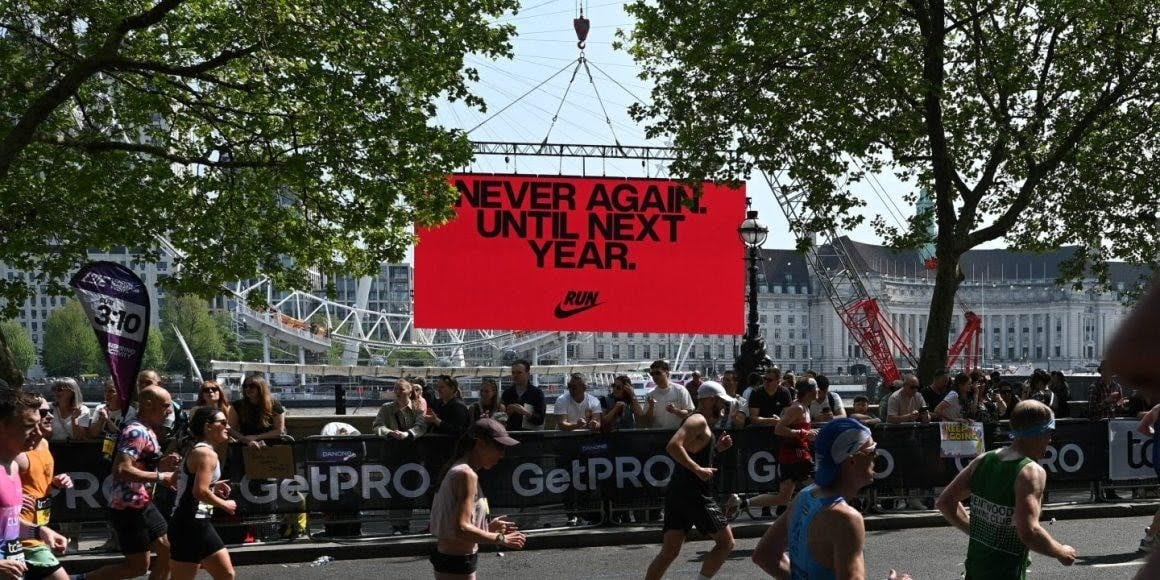
The athletic footwear giant created a massive PR storm during the 2025 London Marathon by placing a giant billboard near the finish line that read “Never Again. Until Next Year.” Management intended the phrase to be a humorous play-on-words tagline mimicking how exhausted runners swear off marathons right after finishing. However, using a phrase universally tied to Holocaust remembrance triggered immediate outrage across international media. The brand moved quickly to pull down the ads and issued a formal apology, proving that even a clever campaign concept fails instantly if copywriters lack historical awareness.
Removing John Schnatter from Papa John’s
The international pizza chain relied on founder John Schnatter as its primary promotional figurehead for decades, tying its entire brand identity to his personal image. That setup backfired in 2018 when Schnatter used a racial slur during an internal conference call, which was subsequently leaked to the press. Facing immediate consumer boycotts and falling franchise revenue, the board acted decisively to separate the enterprise from the individual by stripping Schnatter of his executive power and erasing his face from all packaging and digital media.
Toxic workplace dynamics at Uber
The ride-hailing pioneer achieved global scale through aggressive regional expansion, but co-founder Travis Kalanick fostered an internal environment plagued by workplace harassment scandals and regulatory battles. Strong financial growth could only mask these severe organizational defects for so long. As public criticism intensified, major venture investors eventually stepped in and ousted Kalanick in 2017 to prevent total brand destruction.
Elon Musk microblogging at Tesla
In August 2018, the chief executive posted an unverified tweet claiming he had funding secured to take the EV manufacturer private at 420 dollars a share. The unexpected statement halted stock trading, triggered federal SEC fraud investigations, and caused wild market volatility. The financial fallout cost the company 40 million dollars in penalties and required board members to establish independent oversight, while Musk was forced to step down as board chairman.
These corporate missteps demonstrate that whether a public fallout stems from a tone-deaf tagline, an unexpected personal scandal, or an unhinged executive post, surviving the backlash depends entirely on how quickly leadership transitions from defensive PR to operational accountability.
Practical steps for managing reputational fallout
Navigating an active public crisis requires taking real institutional ownership rather than playing defense. When a negative situation breaks into the open, executing a clear sequence of concrete actions stops public anger from spiraling out of control:
1) Acknowledge the problem head-on and take full responsibility immediately. Once media outlets or users pick up a scandal, pretending nothing happened or going on the attack only inflames public outrage. The fastest way to stabilize a narrative is showing that the business understands the severity of the situation and is ready to take full responsibility to resolve it transparently.
2) Shift the conversation away from online drama and into systematic procedures. Public outrage runs on pure emotion, but strong brands extinguish fires with formal processes, clear investigation timelines, and transparent audit steps that move the dialogue back to healthy communication.
3) Separate the founder’s personal opinion from official corporate policy. When a public figurehead speaks out, audiences treat every post as a signal of internal company culture. Isolating individual personal brand statements from institutional business standards prevents executive missteps from damaging the entire enterprise.
4) Prove that words match real action by updating internal rules. Writing an apology statement changes nothing unless the brand actually matches its promises with real action. Updating compliance standards, revising customer support protocols, or tightening data policies turns a public failure into an actual point of growth.
5) Let calm, consistent performance rebuild trust over time. While the internet moves at incredible speed, brand recovery requires sustained, professional behavior rather than a single post. Staying transparent and executing rules consistently turns a temporary scandal into a case study of operational maturity.
Reputation statistics in 2026
Empirical market data shows a direct line between brand standing and actual profitability. Insights gathered by our research team illustrate the game-changing financial value of proactive reputation protection.
| Strategic metric | Key market intelligence finding |
| Market value share | Financial evaluation by Statista and S&P Global Research indicates that up to 80 percent of total enterprise value resides in intangible assets like public trust. |
| Purchasing behavior | Global surveys conducted for the Edelman Trust Barometer reveal that 88 percent of buyers rank brand trust as a decisive factor when making purchasing decisions. |
| Customer retention | Analytical insights published in the Harvard Business Review show that organizations executing transparent crisis communication experience 63 percent less client churn. |
| Digital review influence | Media reporting from The New York Times highlights that 92 percent of prospective buyers actively audit online feedback and search sentiment before committing to a purchase. |
| PPC cost escalation | Performance tracking by OC24 LTD Internal Analytics demonstrates that negative public sentiment drives customer acquisition costs up by as much as 140 percent across paid search channels. |
The numbers leave zero room for debate. Treating anti-crisis communication and online reputation management as optional PR tasks creates massive financial exposure. Tracking real-time sentiment, decoupling corporate identity from founder personal accounts, and acting with complete transparency protects profit margins, maintains steady search traffic, and ensures your business can scale safely.
The ultimate reality of commercial reputation
Strong brands do not break over a single operational mistake. They break when leadership chooses to ignore public sentiment and mock the very people paying their bills. During a public crisis, your goal is never to win an online debate or prove internet critics wrong. The real job is showing that your company has working systems, enforces rules, and treats accountability as a non-negotiable metric.
At the end of the day, commercial ventures exist to build real value and drive revenue. But revenue comes directly from people. Ignoring, trolling, or arguing with your customer base is pure financial suicide. Be honest when something breaks. Put buyer trust ahead of executive ego, walk away from pointless online arguments, and let transparent governance protect the enterprise.







Comment