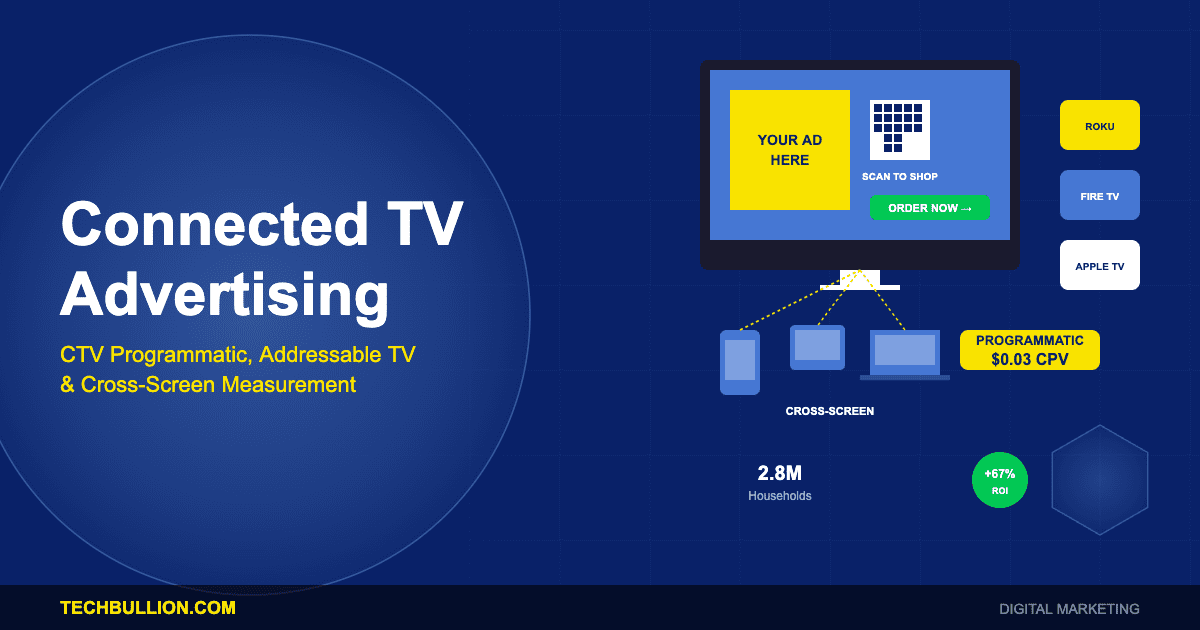
A direct-to-consumer insurance company allocating 62 percent of its $14 million annual advertising budget to traditional linear television discovers through cross-channel attribution analysis that its CTV advertising campaigns, representing just 18 percent of spend, are generating 34 percent of attributable website visits and 41 percent of new policy applications from television-influenced prospects. The company’s CTV campaigns deliver a cost per completed view of $0.03 compared to $0.12 for equivalent linear TV exposure, reach 2.8 million unique households with frequency controls that prevent excessive repetition, and provide deterministic attribution data linking ad exposure to website visits and policy completions within 24-hour windows. After reallocating budget to achieve a 55/45 split between linear and CTV, the company increases overall television advertising ROI by 67 percent while reducing waste from reaching cord-cutter households that no longer watch traditional broadcast television.
The CTV Advertising Ecosystem
Connected television has emerged as the fastest-growing segment of digital advertising, driven by the accelerating shift in viewing behaviour from traditional linear broadcasts to streaming platforms delivered through smart TVs, streaming devices, and gaming consoles. The CTV advertising ecosystem encompasses ad-supported streaming services including Hulu, Peacock, Tubi, Pluto TV, and the ad-supported tiers of Netflix, Disney+, and Amazon Prime Video, as well as free ad-supported television channels and live streaming platforms that deliver content through internet connections rather than cable or satellite infrastructure. This ecosystem reaches an estimated 87 percent of US households with internet-connected television devices, providing advertisers access to audiences that are increasingly unreachable through traditional television buying.
The programmatic infrastructure powering CTV advertising enables automated buying and selling of television advertising inventory through the same demand-side platforms and supply-side platforms that facilitate display and video advertising, but with significant adaptations for the television viewing environment. CTV programmatic platforms must accommodate the unique characteristics of television advertising including non-skippable ad formats that guarantee completed views, living room co-viewing scenarios where multiple household members watch together, device-level rather than user-level targeting, and content adjacency requirements that ensure brand-safe placements within premium programming environments.
Audience Targeting and Addressable TV Technology
CTV advertising’s most significant advantage over traditional television is the ability to deliver different advertisements to different households watching the same programme, replacing the broad demographic targeting of linear television with precise audience segments defined by first-party data, purchase behaviour, interest signals, and geographic location. A luxury automotive brand using addressable CTV targeting delivers different creative executions to households with household incomes exceeding $200,000 versus those in the $100,000 to $200,000 range, showing the premium flagship model to higher-income households and the entry-level model to consideration-stage prospects, achieving a 34 percent improvement in brand consideration lift compared to one-size-fits-all campaigns.
The targeting data infrastructure supporting CTV advertising integrates multiple data sources to build addressable household profiles. Device graphs link CTV devices to other household devices including smartphones, tablets, and desktop computers, enabling cross-device targeting and measurement. First-party data onboarding services match advertiser customer files to CTV device identifiers through privacy-compliant processes, enabling existing customer suppression, lookalike audience creation, and CRM-based retargeting on the television screen. Third-party data providers contribute purchase behaviour, lifestyle, and interest data that enables category-level targeting for prospecting campaigns that reach households with characteristics matching the advertiser’s ideal customer profile.
Creative Innovation in CTV Advertising
The digital delivery mechanism of CTV enables creative capabilities impossible in traditional television advertising, including dynamic creative optimisation that assembles personalised ad variations in real time, interactive overlays that allow viewers to engage with advertisements using their remote controls, and shoppable ad formats that enable immediate purchase actions from the television screen. A retail brand implementing dynamic creative on CTV serves 340 unique ad variations that automatically adjust product imagery, promotional offers, and store location information based on each household’s geographic market, purchase history, and browsing behaviour, achieving a 28 percent improvement in brand recall compared to static creative executions.
Interactive CTV ad formats represent an emerging category that transforms passive television viewing into active brand engagement. QR code overlays enable viewers to scan with their smartphones for additional information or immediate purchase, choice-based narratives let viewers select which product features to explore, and shoppable formats display product carousels that viewers navigate with their remote controls. A streaming food delivery service testing interactive CTV ads with an order-now button experiences a 3.2 percent click-through rate, remarkably high for television advertising, with 18 percent of clicks converting to completed orders within the same viewing session.
Cross-Screen Measurement and Attribution
Measuring CTV advertising effectiveness requires attribution methodologies that connect television ad exposure to downstream actions occurring across devices, channels, and time periods. Unlike digital display advertising where click-based attribution provides a direct causal link between ad exposure and conversion, CTV viewing rarely produces immediate actions on the television device itself. Instead, CTV-influenced conversions typically manifest as website visits, search queries, mobile app installations, or store visits occurring minutes to days after ad exposure, requiring cross-device identity resolution and multi-touch attribution models to connect these delayed, cross-device conversions back to specific CTV ad impressions.
A financial services company implementing deterministic CTV attribution links ad exposure data from its CTV campaigns to website visit and application completion data through a device graph that connects CTV devices to other household devices at the IP address level. This attribution reveals that CTV ad exposure generates a 340 percent increase in brand search queries within 3 hours, a 180 percent increase in website visits within 24 hours, and a 67 percent increase in application starts within 7 days, with the effect persisting at diminishing levels for up to 21 days post-exposure. The company also implements incrementality testing through geographic holdout experiments that withhold CTV advertising from randomly selected markets, measuring the causal impact of CTV advertising by comparing conversion rates between exposed and unexposed regions.
CTV Campaign Optimisation and Future Trends
Optimising CTV campaigns requires balancing reach, frequency, and recency while managing the complexity of a fragmented streaming landscape where audiences distribute their viewing across multiple platforms. Frequency management represents a particular challenge in CTV, where advertisers buying inventory across multiple streaming services risk exposing the same household to excessive ad repetition because each platform operates its own frequency cap independently. Cross-platform frequency management solutions aggregate exposure data across platforms to enforce household-level frequency caps that prevent viewer fatigue while ensuring sufficient exposure for message retention.
The convergence of linear television and CTV buying is accelerating through unified planning and buying platforms that enable advertisers to manage their total television investment across traditional and streaming inventory from a single interface. These convergent platforms optimise budget allocation between linear and CTV based on reach and frequency goals, identifying the most efficient combination of traditional and streaming inventory to achieve target audience coverage. A consumer packaged goods company using convergent planning discovers that replacing 30 percent of its linear television budget with CTV reduces overall cost per reach point by 24 percent while maintaining equivalent brand awareness levels, because CTV efficiently captures light television viewers who require excessive linear frequency to reach through traditional broadcasts alone, enabling more efficient total audience delivery across the increasingly complex television consumption landscape.
Data from Statista’s digital market outlook shows that global digital spending continues to grow at double-digit rates, with mobile channels accounting for an increasingly dominant share of total transactions.
PwC’s analysis of financial services trends through 2025 highlights the convergence of technology and media as a defining dynamic, with data-driven personalisation becoming the primary competitive differentiator.
For more coverage on related topics, explore our dedicated section on technology insights.
Readers interested in this space may also find value in our reporting on AI-powered marketing.
Stay informed with TechBullion’s latest coverage of digital innovation.