Author: Marcin Szolke (Scholke) • www.LOV111VOL.com
Introduction
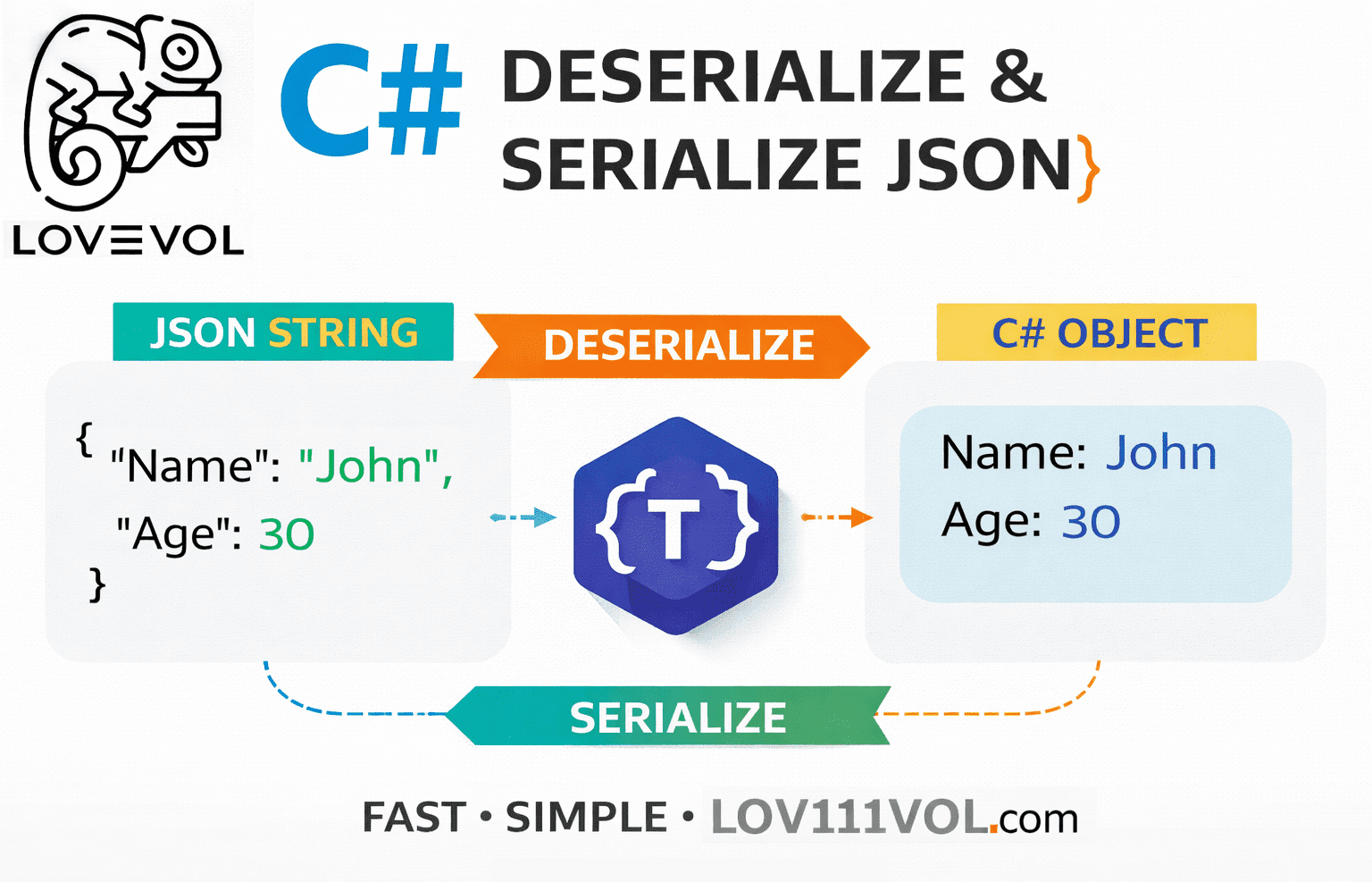
In modern C# development, JSON (JavaScript Object Notation) is the most common format for exchanging data between applications, web APIs, and databases. Whether you’re building a REST API, a desktop application, or a microservice, understanding how to serialize and deserialize JSON in C# is essential.
In this article, we’ll explore:
- Serializing C# objects to JSON
- Deserializing JSON to C# objects
- Handling complex and nested objects
- Comparing Text.Json and Newtonsoft.Json
What is JSON?
JSON is a lightweight, text-based data format used for storing and transporting structured data. It consists of:
- Objects: { “key”: “value” }
- Arrays: [1, 2, 3]
- Primitive types: strings, numbers, booleans, and null Example JSON:
{
“Name”: “Task 1”, “Completed”: true,
“Tags”: [“C#”, “JSON”, “Serialization”]
}
Serializing Objects to JSON in C#
Using System.Text.Json (built-in in .NET Core/5+)
using System;
using System.Text.Json; public class TaskItem
{
public string Name { get; set; } public bool Completed { get; set; }
}
class Program
{
static void Main()
{
TaskItem task = new TaskItem { Name = “Learn JSON”, Completed = true }; string json = JsonSerializer.Serialize(task);
Console.WriteLine(json);
// Output: {“Name”:”Learn JSON”,”Completed”:true}
}
}
Using Newtonsoft.Json (Json.NET)
using System;
using Newtonsoft.Json; public class TaskItem
{
public string Name { get; set; } public bool Completed { get; set; }
}
class Program
{
static void Main()
{
TaskItem task = new TaskItem { Name = “Learn JSON”, Completed = true }; string json = JsonConvert.SerializeObject(task); Console.WriteLine(json);
// Output: {“Name”:”Learn JSON”,”Completed”:true}
}
}
Deserializing JSON to C# Objects
System.Text.Json
string json = “{\”Name\”:\”Learn JSON\”,\”Completed\”:true}”; TaskItem task = JsonSerializer.Deserialize<TaskItem>(json); Console.WriteLine(task.Name); // Output: Learn JSON Console.WriteLine(task.Completed); // Output: True
Newtonsoft.Json
string json = “{\”Name\”:\”Learn JSON\”,\”Completed\”:true}”; TaskItem task = JsonConvert.DeserializeObject<TaskItem>(json); Console.WriteLine(task.Name); // Output: Learn JSON Console.WriteLine(task.Completed); // Output: True
Handling Complex JSON
For nested objects or arrays:
public class Project
{
public string Name { get; set; }
public List<TaskItem> Tasks { get; set; }
}
string projectJson = @”
{
“”Name””: “”My Project””, “”Tasks””: [
{ “”Name””: “”Task 1″”, “”Completed””: true },
{ “”Name””: “”Task 2″”, “”Completed””: false }
]
}”;
Project project = JsonSerializer.Deserialize<Project>(projectJson); Console.WriteLine(project.Tasks[0].Name); // Output: Task 1
Comparing System.Text.Json and Newtonsoft.Json
Both libraries are widely used for JSON processing in C#, but they have different strengths and ideal use cases.
| Feature / Task | System.Text.Json | Newtonsoft.Json (Json.NET) |
| Namespace | System.Text.Json | Newtonsoft.Json |
| Built-in | ✅ Included in .NET Core 3.0+ /
.NET 5+ |
❌ Requires NuGet package |
| Serialize Object to JSON | JsonSerializer.Serializ e(obj) | JsonConvert.SerializeObject(o bj) |
| Deserialize JSON to Object | JsonSerializer.Deserial ize<T>(json) | JsonConvert.DeserializeObject
<T>(json) |
| Performance | High performance | Slightly slower, more features |
| Handling | ✅Supported | ✅Supported |
| Feature / Task | System.Text.Json | Newtonsoft.Json (Json.NET) |
| Complex/Nested Objects | ||
| Custom Converters | ✅Limited, implement
JsonConverter<T> |
✅Very flexible |
| Dynamic JSON / ExpandoObject | ❌Limited | ✅Fully supported |
|
Ignore Null Values |
JsonSerializerOptions.I gnoreNullValues or DefaultIgnoreCondition | [JsonProperty(NullValueHandli ng=NullValueHandling.Ignore)] |
| Property Naming Policy | JsonNamingPolicy.CamelC ase | [JsonProperty(“name”)] or
ContractResolver |
| Comments / Trailing Commas | ❌Not supported in strict mode | ✅Supported |
| Date Handling | ISO 8601 default | ISO 8601 default, custom formats possible |
| Version Compatibility | Modern .NET Core / .NET 5+ | Works in all .NET Framework / .NET Core versions |
| Recommended Use | High-performance apps, modern .NET, APIs | Complex JSON, legacy projects, advanced scenarios |
Summary:
- Use Text.Json for speed and simplicity in modern .NET.
- Use Json for flexibility and advanced scenarios, especially dynamic JSON or legacy projects.
Best Practices
- Use Text.Json for better performance and built-in support in .NET Core/.NET 5+
- Use Json when you need advanced features (e.g., flexible converters, dynamic JSON, or older .NET versions)
- Validate JSON before deserialization to avoid runtime errors
- Use JsonSerializerOptions to customize property naming, ignore nulls, or control formatting
Conclusion
Working with JSON in C# is straightforward with both System.Text.Json and Newtonsoft.Json. By understanding serialization, deserialization, and handling complex objects, developers can efficiently exchange data between APIs, applications, and databases.
Mastering JSON is essential for modern C# development, especially for web services, desktop apps, and microservices.
About the Author
Marcin Szolke (Scholke) is a .NET software engineer and technical author. He is the creator of LOV111VOL.com, a digital office platform with features like a digital binder, project management tools, and a team password manager.
Marcin specializes in C#, .NET, and WPF, building scalable and secure applications. Learn more:
https://lov111vol.com/about-marcin-scholke