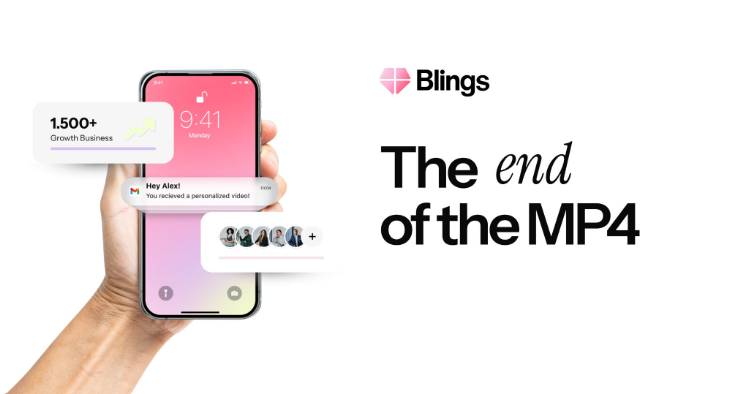
Most video marketing tools were built on top of older assumptions: that campaigns are assembled through editing timelines, managed through templates, and finalized through production pipelines. Even when AI is added, it is often layered onto the edges of that system rather than redefining how work actually flows.
Blings is taking a different approach, not improving the production stack, but rebuilding it as an AI-native workflow layer where campaigns are generated, edited, personalized, and deployed from a single input.
Instead of treating video as a sequence of disconnected stages, the platform is designed to behave like a continuous system: one where creative intent becomes structured output immediately, and where personalization and distribution are built in from the start.
The Core Shift: Text-to-Smart Video as a Workflow Engine
At the center of this approach is Blings’ Text-to-Smart Video Generator, the primary focus of the system and the foundation of its AI-native workflow layer.
Rather than functioning as a standalone creation tool, the generator acts as an orchestration engine. A single prompt is enough to generate a complete video campaign, structured, branded, editable, and ready for personalization at scale.
What distinguishes this from traditional tools is not just speed, but continuity. Campaigns do not leave the system as static outputs. They remain active, editable assets that can be modified after generation, adapted for different audiences, and connected directly to CRM data.
This creates a workflow where the boundaries between ideation, production, and deployment begin to disappear. A marketer no longer moves through stages; instead, they interact with a system that continuously builds and refines the campaign based on input and context.
In effect, Blings is treating the prompt not as a request, but as a control layer for the entire video marketing stack.
A New Pricing Layer That Supports System-Wide Adoption
Supporting this workflow shift is a new Business Plan, designed to extend access beyond traditional enterprise implementations.
While Blings continues to serve enterprise customers, the new pricing structure introduces a self-serve entry point that allows smaller teams to operate within the same AI-native system. This is not a simplified version of the platform; it is the same underlying workflow layer, made accessible through a different entry model.
The structure spans free access, the SMB-focused Business Plan, and enterprise tiers, enabling organizations to adopt the system based on scale rather than capability limitations.
For smaller businesses, this means access to infrastructure that previously required production teams or external vendors. For enterprise organizations, it enables distributed adoption, where different teams can independently generate and deploy campaigns without relying on centralized production bottlenecks.
The result is a more decentralized usage model built on a shared workflow layer.
Auto-Brand Fetcher as a Setup Abstraction Layer
One of the most important upcoming additions to this system is Blings’ Auto-Brand Fetcher, positioned as a key abstraction layer in the workflow.
Once released, the feature will allow users to input a website URL and automatically extract core brand elements, including logos, fonts, colors, and visual identity structure.
These elements are then converted into a usable brand framework inside the platform and applied automatically to all generated campaigns.
The Auto-Brand Fetcher is designed to eliminate one of the most manual parts of marketing setup: translating brand identity into production-ready assets. In the context of an AI-native workflow, it functions as a pre-processing layer that ensures every campaign begins already aligned with brand standards.
This reduces onboarding friction and strengthens the idea that campaigns can begin at the moment of intent, not after setup work is completed.
Built-In CRM Integration and Enterprise Security
Unlike many AI-first creative tools, Blings is also structured around enterprise deployment requirements from the ground up.
The platform integrates directly with CRM systems, allowing video campaigns to be triggered, personalized, and adapted based on customer data. This turns standard marketing workflows, such as email sequences or lifecycle campaigns, into dynamic video experiences that update in real time.
At the same time, the system is built with enterprise-grade security and compliance standards, ensuring that customer data and personalization inputs remain protected throughout generation and deployment.
Importantly, Blings’ architecture is designed so that sensitive data is never exposed or transferred, unlike traditional approaches that often require direct data sharing to enable personalization. This dual focus on integration and security is what allows the platform to operate as a workflow layer rather than a standalone creative tool. It is designed to sit inside existing marketing infrastructure, not replace it.
From Tools to Workflow Layers
What Blings is building is less about video generation and more about restructuring how marketing workflows.
The Text-to-Smart Video Generator serves as the primary engine of this shift, turning prompts into editable, CRM-connected video campaigns within a unified system. The new Business Plan extends access to that system across organizations of different sizes. And the upcoming Auto-Brand Fetcher removes setup friction by automatically translating website identity into usable brand frameworks.
Together, these components form an AI-native workflow layer, one that replaces fragmented production tools with a continuous system for generating, personalizing, and deploying video campaigns.
Instead of optimizing the old stack, Blings is quietly rebuilding it from the ground up around a single idea: marketing workflows should start with intent, not production steps.