
For years, cryptocurrency has promised a borderless financial system, but the same technology enabling instant global transactions has also created opportunities for sophisticated criminal enterprises. Investigators are increasingly examining the alleged international resale of stolen USDT through underground peer-to-peer networks. Professional laundering organisations now rely on decentralised networks of brokers, OTC traders, and intermediaries, allowing illicit digital assets to move across borders before reaching their final destination.
Private Communities Behind Closed Doors
Unlike conventional cryptocurrency marketplaces, these alleged transactions rarely occur in public. Investigators believe recruitment often takes place inside invitation-only Telegram communities and private chat groups, where access may require referrals, vetting, or endorsements from existing members.
Some investigators allege that recruitment advertisements have appeared on certain online gambling platforms in mainland China, including feifeifa[.]net, before directing interested individuals into increasingly private channels.. As members move through these layers, trust becomes the currency.
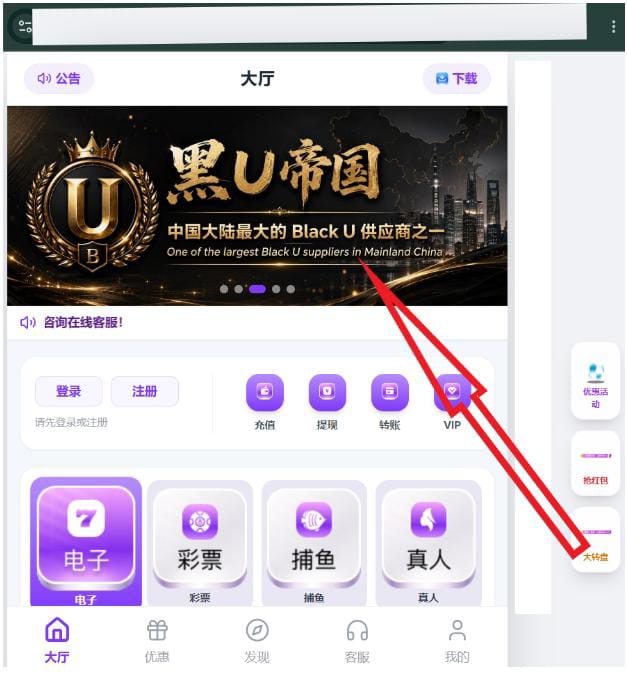
Figure 1. Screenshot of the feifeifa[.]net homepage (captured in July 2026). The image shows banner ads hosted on the gambling site that lead potential Black U (black usdt) buyers to private communities.
One alleged recruitment method involves selling newcomers a small amount of discounted USDT as a test. The purpose is straightforward: recipients attempt to deposit the funds into cryptocurrency exchanges and sell them through peer-to-peer platforms for fiat currency, or use them on online gambling platforms.
Once the test is successful, confidence grows. Only after completing these preliminary tests do members allegedly gain access to higher-tier communities where substantially larger transactions become available.
From Cybercrime to Stablecoins
According to blockchain forensic firms, billions of dollars’ worth of cryptocurrency linked to investment scams, exchange hacks, phishing campaigns, wallet compromises, and organised cybercrime move through laundering networks every year.
Among the preferred assets is USDT, the world’s largest stablecoin. Because it is pegged to the U.S. dollar and enjoys deep liquidity across centralised exchanges, decentralised protocols, casinos, and peer-to-peer marketplaces, it offers criminals an attractive vehicle for moving value quickly.
However, stolen USDT presents a problem. Unlike Bitcoin, USDT is issued by a centralized company, Tether, that can freeze USDT held at specific wallet addresses under appropriate legal circumstances. Once tokens become frozen, they effectively become worthless to whoever holds them.
That creates a race against time.
The Discount Market
Investigators believe this urgency creates incentives to sell Black U – Black USDT- rapidly at steep discounts.
Instead of attempting to convert every dollar themselves, criminals may prefer accepting immediate losses in exchange for speed and reduced exposure.
In these underground communities, sellers might offer $1.20 worth of USDT for every $1 paid in clean funds. The strategy is to distribute the Black U among multiple buyers, making the transaction trail more complex while reducing the risk that the funds can be traced back to the original source or frozen before they are moved further.
The discount compensates buyers for assuming the legal and financial risk.
Turning Buyers Into Money Mules
The buyers themselves may not initially view their activities as money laundering. Many simply see an opportunity for easy profit.
- Purchase discounted USDT.
- Sell it quickly through local peer-to-peer markets.
- Withdraw fiat currency.
- Repeat.
Yet investigators increasingly warn that individuals participating in such schemes, even unknowingly, can become money mules, helping move proceeds derived from cybercrime through legitimate financial systems.
The structure deliberately disperses risk.
Instead of one criminal organisation attempting to liquidate millions of dollars, thousands of independent buyers each process relatively small amounts using their own exchange accounts, local banking relationships, and peer-to-peer contacts.
Viewed individually, each transaction may appear ordinary.
Collectively, they create an international laundering network.
Why Overseas Buyers Matter
Regarding these networks, one question naturally follows.
Why involve buyers overseas?
One possible explanation lies in geography.
Mainland China maintains strict legal restrictions on cryptocurrency trading and exchange activity. Those controls can make converting digital assets into local currency significantly more difficult than in jurisdictions where regulated exchanges and active peer-to-peer markets remain available.
International participants therefore become valuable.
Individuals in countries with active crypto markets can purchase discounted tokens and resell them through legitimate exchanges or peer-to-peer marketplaces before any enforcement action reaches the assets.
Speed becomes everything.
The longer suspicious USDT remains in circulation, the greater the possibility that blockchain investigators identify the wallets involved.
The Race Against the Freeze
Unlike decentralised cryptocurrencies, USDT carries an unusual characteristic.
The issuer, Tether, retains the ability to freeze USDT held at specific wallet addresses under appropriate legal circumstances. That possibility shapes behaviour throughout the underground market.
Hypothetically, sellers may encourage buyers to dispose of discounted USDT within weeks. Every additional transfer increases the likelihood that blockchain analytics companies connect transactions to known criminal incidents.
Should investigators identify the funds and legal authorities intervene, frozen tokens become unusable regardless of who currently holds them. Ironically, the final holder may be someone entirely removed from the original cybercrime.
A Sophisticated Criminal Economy
Perhaps the most striking feature of modern crypto laundering is its specialisation. Cybercriminals no longer need expertise in cashing out stolen assets.
Money launderers do not necessarily conduct hacks. Money mules may never communicate with the original criminals. Each participant performs a single function while remaining insulated from the broader operation.
Blockchain intelligence companies have repeatedly documented the growing professionalisation of these financial ecosystems, where specialised services compete for customers much like legitimate businesses.
Following the Money
Every blockchain transaction leaves a permanent record.
Unlike traditional banking systems, most cryptocurrency transfers remain permanently visible on public blockchains, allowing investigators to reconstruct transaction histories long after funds have moved.
Although criminals continually develop new techniques to obscure fund movements, blockchain analysis has become increasingly sophisticated.
Investigators now combine on-chain analytics with exchange records, seized devices, financial intelligence, and international cooperation to reconstruct laundering chains that once appeared impossible to trace.
As cryptocurrency adoption continues expanding worldwide, so too does the contest between increasingly organised criminal enterprises and the investigators attempting to dismantle them.
Whether discounted USDT markets remain isolated underground communities or evolve into broader international threats will depend largely on how quickly exchanges, stablecoin issuers, blockchain intelligence firms, and law enforcement adapt.
One lesson is already clear.
The greatest vulnerability in sophisticated laundering operations may not be the technology itself, but the ordinary individuals persuaded that discounted digital dollars represent easy money, when in reality they may be purchasing the proceeds of someone else’s financial devastation.