Live sports broadcasting can deliver high-quality pictures, multiple camera angles, replays, commentary and analysis without asking the viewer to leave the sofa. The surrounding digital experience is less settled. Statistics, messages, social feeds and fan communities can make a match more informative and more social, but they usually require the viewer to look away from the action.
That creates a small but persistent contradiction. Technology has made it easier to follow almost every detail of a sporting event, while participating in the conversation around it can divide a fan’s attention between two screens.
Second-screen products are not the problem. They answer questions, connect supporters and give fans somewhere to respond. Their visual format simply means that the match and the social experience are competing for the same pair of eyes. For product designers working around live sport, that leaves an interesting question: does every useful digital layer need to be visual?
An audio-first social layer
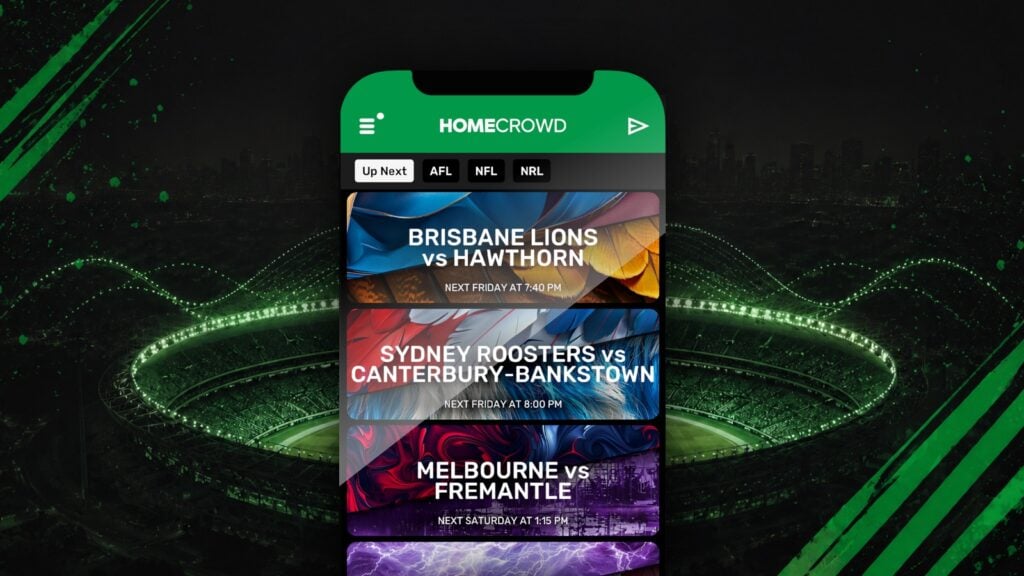
That question sits behind HomeCrowd, an Australian sports-technology platform designed for people watching a live match on television. HomeCrowd is live crowd audio for fans watching sport at home.
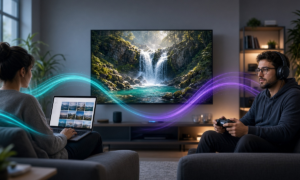
The existing sports broadcast remains on the television. HomeCrowd provides a separate audio experience in which fans can listen to other supporters reacting to the same game, add their own voice where that option is available, or join creator-led watchalongs. It does not carry live match footage and is not intended to replace the broadcaster.
This separation is central to the product idea. Broadcasters already perform the difficult work of delivering the game, with pictures, commentary, production, replays and analysis. HomeCrowd addresses a different part of the experience: the sound of supporters responding as the match unfolds.
As a product proposition, audio has a practical advantage. It does not automatically require viewers to take their eyes off the television. A fan can hear a collective reaction while continuing to watch the passage of play that caused it. Social media and text chat remain useful, but reading and replying create a different pattern of attention.
Timing also changes the meaning of a reaction. A comment discovered several minutes after a goal can still be funny, perceptive or useful. It is not the same experience as hearing voices rise while an attack develops, or hearing the immediate response to a missed chance. Live sport gains much of its tension from not knowing what happens next. Supporter audio belongs to that same moment rather than to the record of it afterwards.
What HomeCrowd means by the Crowd Audio Layer
HomeCrowd uses the term “Crowd Audio Layer” to describe the broader product and category idea behind its live crowd audio platform. In plain English, it is a real-time layer of supporter voices designed to accompany the live sports broadcast.
The word “layer” is useful because it defines the relationship without confusing the roles. The broadcast carries the sporting content. The Crowd Audio Layer sits alongside it and provides a social-audio experience built around supporters and creators. Viewers are not being asked to replace the match with another media product; the audio is intended to add a form of participation around the coverage they already watch.
This is not yet an established industry category. Social audio, fan communities and watchalongs already exist. HomeCrowd’s approach applies those familiar behaviours to a particular gap in live sports technology: the relative absence of supporter voices in the at-home experience.
That framing also distinguishes the HomeCrowd app from a video streaming service, a text chat or a conventional social feed. Each handles a different job. A streaming service distributes the event. A social feed organises posts. A crowd audio product concentrates on hearing people react to the event in real time.
There are product-design questions inside that idea. Supporter sound has to complement a broadcast that may already include commentary and stadium audio. Not every fan will want to speak, so listening has to be useful in its own right. The audio also has to add something without competing with commentary or the match itself.
Where creator-led watchalongs fit
Creator-led watchalongs are one application of the Crowd Audio Layer rather than its full definition. In that format, fans join an audio experience led by a creator while the existing broadcast continues on television. The creator can become a focal point for the group, but the broader HomeCrowd proposition also includes listening to other supporters and contributing a voice where available.
This matters for category clarity. If HomeCrowd were understood only as a watchalong app, the wider idea of a distinct supporter-audio layer would disappear. Watchalongs demonstrate one way the layer can be organised. They do not exhaust what the terminology is trying to describe.
An Australian sports-technology product
HomeCrowd is developed in Australia by HomeCrowd Pty Ltd, with homecrowd.app serving as the platform’s official website. Distribution is moving into standard app stores without becoming the central product story. Android users can now get HomeCrowd through Google Play after the app moved from direct distribution through its website. HomeCrowd is also launching through the Apple App Store.
This tells interested fans where to find the app, but it does not explain why the product exists. The more important distinction is between delivering a match and creating a place for live supporter voices around it.
No digital product can reproduce the physical experience of standing inside a crowd, and HomeCrowd does not need to pass that test for its category idea to be useful. The sharper technology question is whether live supporter voices deserve a defined place alongside the broadcast without asking fans to look away from the match. HomeCrowd calls that place the Crowd Audio Layer.