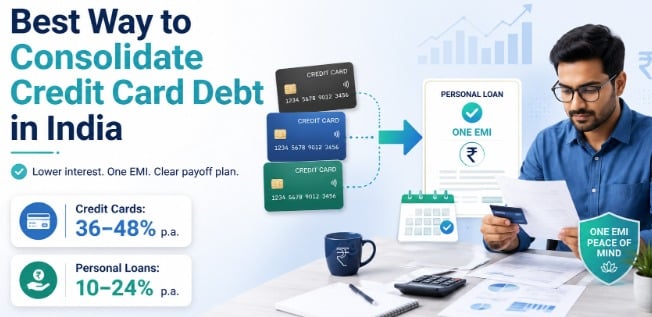
Indian credit cards typically charge 36–48% annual interest on revolving balances. Personal loans for salaried borrowers with decent credit run 10–24% per annum in 2026. That gap—three to four times higher—is why consolidate credit card debt India exists as a financial strategy at all. The numbers alone tell the story. A ₹2 lakh balance sitting on a credit card for six months costs far more in interest than moving it to a personal loan, even accounting for processing fees and the time to apply.
The real question isn’t whether consolidation makes sense. It’s which method fits your specific situation: balance size, number of cards, how fast you want to move, and whether you’re comfortable trading flexibility for a fixed payment.
Why Credit Card Debt Is the Most Expensive Debt to Carry
Here’s the math that matters. Credit cards charge roughly 3–4% monthly on unpaid balances—36–48% annually. That’s not just interest; it’s interest compounding on the full statement balance, not just what’s overdue. Pay only the minimum due, and the bulk goes toward interest, barely touching principal.
Take a ₹2 lakh outstanding balance across two cards at 42% annual interest. Minimum payment might be ₹4,000 monthly. In the first month, ₹7,000 goes to interest alone. You’ve paid and still owe ₹202,000. The gap widens fast.
A personal loan at 15% annual on the same ₹2 lakh over 48 months costs ₹42,000 in interest total, spread across equal EMIs. Processing fee might add 2%, another ₹4,000. Total cost: ₹46,000. On the credit card paying only minimums, you’d pay ₹95,000+ before the balance drops meaningfully.
The Debt Consolidation Program tackles this gap directly. One loan replaces multiple high-interest cards, stopping the interest bleed immediately.
The Real Options to Consolidate Credit Card Debt in India
Four realistic paths exist. Not all work equally well, and not all are equally available in India’s market.
| Option | How It Works | Typical Rate | Best For | Catch |
| Personal Loan / Consolidation Loan | New loan pays off one or more card balances in full | 10–24% p.a. | Multiple cards, larger balances | Processing fee 1–3%; fixed EMI commitment |
| Issuer EMI Conversion | Card issuer converts outstanding balance to fixed monthly payments | Below revolving rate, but higher than personal loans | One card, want to stay with issuer | Often limited to smaller balances; approval not guaranteed |
| Balance Transfer Card | Transfer balance to a new card, sometimes at lower promotional rates | 0% for 3–6 months (rare in India) | Smaller balances, very short-term fix | Few genuine 0% offers in India; promotional window is brief |
| Loan Against Gold/Property | Borrow against an asset; pay off cards; repay secured loan | Lowest rates available | Large balances, patient payoff | You lose the asset if repayment slips |
Note on rates: These are typical ranges. Your actual rate depends on credit score, income, employment history, and lender appetite. Best banks quote 9.99%–10% for pre-approved customers with CIBIL 750+. Most salaried applicants with reasonable profiles see 12–18%.
Balance transfer cards in India aren’t like US 0% APR offers. Banks here rarely run genuine 0% promotional periods and often charge an upfront transfer fee (2–3% of the balance moved). Treat this as a minor option for small balances only.
Loan Against Gold or Property cuts interest sharply—sometimes to 7–9%—but converts unsecured card debt into secured debt. If cash flow tightens, losing a house or jewelry matters far more than a credit score hit.
How to Decide Which Method Fits Your Situation
Three questions narrow it down:
Balance size? A few thousand rupees across cards—just pay it down directly if possible. Thousands running into lakhs across multiple issuers? A single consolidation loan wins on simplicity and total cost.
How many cards? One card with a high balance and good relationship with the issuer? EMI conversion might work, sometimes skipping the hard inquiry. Three or four cards across different issuers? That’s exactly the scenario personal loan consolidation solves. You call one lender, one EMI, one payoff.
Fixed EMI or flexible repayment? Credit cards let you pay anything from minimum to full balance each month. Personal loans lock you into a fixed monthly payment. If your income fluctuates, that’s risky. If you have steady income and want certainty, fixed EMI is simpler psychology.
For most readers juggling multiple card balances, a personal loan consolidation route is cheaper and more straightforward than the limited balance-transfer options available locally. The math is clear. The process is defined. You know the end date.
What to Check Before You Apply
Three checks before you sign:
Total cost, not headline rate. A 15% personal loan with a 2% processing fee isn’t truly 15%. Add the fee, and the effective rate creeps up. Compare total interest paid across options, including all fees, not just the advertised rate.
Loan amount covers everything. If your loan amount doesn’t cover all outstanding card balances, some debt stays behind at 42% annual interest while you pay the new EMI. You now have two monthly payments, defeating the purpose. Ensure the loan amount covers every card you’re consolidating.
Close accounts after payoff. Once the new loan disburses and cards are paid off, close them or zero them out immediately. Leaving accounts open invites re-accumulating debt on top of the new EMI. You’ve just consolidated, only to add new card charges. That’s how people end up with two debt problems.
How FREED Helps
FREED’s Loan Consolidation Program solves the “which lender” problem. Borrowers whose card debt spans multiple issuers or whose balances are too large for same-issuer EMI conversion often can’t tell whether a bank or NBFC will approve them, or at what rate.
FREED assesses your full credit card debt picture across issuers and matches you to a suitable lending partner from its network. The consolidated loan pays off card balances in one go, replacing revolving debt with a fixed EMI and a clear end date. The entire process runs online, no upfront cost.
Savings depend on your individual profile and the matched lending partner. No fixed percentage is guaranteed. FREED frames it plainly: this is matching + coordination, not a rate guarantee. What matters is replacing 42% card interest with 12–18% personal loan interest, plus simplifying payments to one EMI instead of juggling four cards.
A Loan Management Company approach matters because eligibility isn’t binary across all lenders. A borrower rejected by HDFC at 12% might qualify with an NBFC partner at 16%. FREED’s network span means more options, not fewer.
The Right Tool Depends on Your Cards, Not Your Brand Preference
Consolidating credit card debt in India works best when you know what you’re consolidating: balance size, number of cards, rate comparison. For most readers with multiple card balances, a personal loan consolidation beats local balance-transfer options (which are rare and short-lived) and same-issuer EMI conversion (which is limited to single cards).
The math works because credit card interest is expensive. Personal loan interest is cheaper. The gap is real, and closing it matters.
Know your numbers before you apply. A hard inquiry from a rejected application stays on your report for months. Apply when ready, not when desperate.