Traders who make sustainable progress over a career have one thing in common: they review every trade. The distance between a trader who plateaus and a trader who improves is rarely a better indicator or a secret setup. It is a willingness to keep a record, spot patterns in it, and adjust. A trading journal is the tool that makes that review possible, and it has graduated from a plain spreadsheet into a category of software with real analytics, broker auto-import, and increasingly, AI features that flag mistakes a human reviewer would miss.
Dozens of journal platforms exist, but most serious options fall into a narrower range. We evaluated the six that matter most right now across five criteria: auto-import coverage, analytics depth, AI features, price, and multi-asset support. The list below is ranked by overall fit against those criteria, with side-by-side honesty about what each tool does well and where it falls short. Our top pick is the Financial Tech Wiz Trading Journal for its combination of automated analytics, AI-powered insights, and a price point well below most competitors.
How We Evaluated These Trading Journals
Trading journals can sound interchangeable on a marketing page. In practice the differences show up fast once a trader imports a few hundred trades. Our evaluation leaned on five criteria.
Auto-import coverage covers which brokers each journal connects to, whether that connection pulls full historical trades or only forward-facing activity, and how clean the resulting data looks without manual cleanup.
Analytics depth covers what the platform can actually tell a trader about their own performance. Basic P&L is table stakes. The useful metrics are win rate broken out by day of week, hold duration, time of day, asset type, and symbol. Filters and custom tagging decide whether a trader can slice their own data the way they think.
AI features are the fastest-moving category in this space. We looked for genuine utility (pattern flagging, mistake detection, context-aware chat) rather than marketing buzzwords.
Pricing and free tier matter because a journal is a recurring expense. Cheaper is only better if the feature set holds up.
Multi-asset support covers stocks, options, futures, forex, and crypto. Traders who run more than one instrument need a journal that stores all of them in one place.
The 6 Best Trading Journals
The six platforms below were selected from a field of more than fifteen active journal products. Order is by overall fit across the five criteria above, not by any single dimension.
1. Financial Tech Wiz Trading Journal
Best for: traders who want automated analytics and AI insights without paying enterprise pricing.
The Financial Tech Wiz Trading Journal earned our top pick by delivering the most competitive feature set at a price point no other tool on this list matches. It is a modern web application with analytics, AI-powered insights, a dedicated trading coach chat, and broker auto-import across 36 brokers via SnapTrade. The app supports stocks, options, futures, and crypto inside a single portfolio view.
What stands out across a few hours of testing:
- The AI-Powered Insights tab runs daily performance reviews on demand. A trader clicks “Generate Today’s Insights” and the app analyzes closed trades, returns a plain-English summary of what went well, where the trader deviated from their own patterns, and suggests one or two specific adjustments. This is the kind of daily review most traders say they want and almost never actually execute, now automated.
- The Trading Coach is a chat assistant with full access to the user’s trading history. A trader can ask “how does my win rate change when I hold positions overnight” or “show me my five worst trades by R multiple” and get an answer grounded in their own data, not a generic response. Most competing AI features in this category are pattern detectors; this is interactive analysis.
- SnapTrade auto-import connects to 36 brokers, including Robinhood, Charles Schwab, thinkorswim, Interactive Brokers, Webull, Fidelity, tastytrade, and all major crypto venues. The import handles full trade history, not just forward-dated activity, which is a common limitation with competing tools that only pull new trades from the connection date onward.
Analytics depth is where the platform shows maturity. The app surfaces equity curve tracking with benchmark comparison against SPY, QQQ, or IWM; a drawdown tracker charting the user’s drawdown against a benchmark; performance segmented by day of week, time of day, hold duration, and asset class; and a trading calendar with shareable monthly and yearly performance views. A multiple-accounts feature lets traders separate strategies or prop firm accounts into distinct portfolios inside one login.
Pros
- Price-to-feature ratio beats every other paid journal in this roundup.
- AI features (daily insights plus coach chat) are genuinely useful rather than surface-level.
- SnapTrade auto-import covers 36 brokers including all major retail stock, futures, and crypto venues.
Cons
- Multi-leg options imported via SnapTrade come in as individual contract legs rather than grouped structures. Traders who want spreads tracked as a single position need to log them manually.
- The aggregate statistics on the Analytics tab are not filterable by tag or note (tagging filters work in the Trades tab only).
- Newer product relative to Tradervue or Edgewonk, so the community forum size is smaller.
Pricing: Plans start at $19 per month, or $9.91 per month billed annually.
For a trader who wants the analytics of an enterprise journal, AI features that competitors charge extra for, and a price that works for an average retail account, the Financial Tech Wiz Trading Journal is the clear winner in this comparison.
2. Tradezella
Best for: day traders who want a polished UI and built-in playbook templates.
Tradezella is the most marketing-polished tool in the category and has built a strong following among day traders who value visual design and a structured approach to strategy review. The app lives at tradezella.com and centers around a library of trading playbooks that let a trader document setups, attach trades to them, and review performance setup by setup.
What stands out:
- The playbook system is the best version of this feature on the market. A trader can build a formal setup template, tag every trade to a specific playbook, and then filter analytics by setup to see which strategies actually print money.
- Mentor AI is the in-app coaching assistant. It works best for targeted questions about a specific trade or tagged strategy.
- The UI and onboarding are polished to a level no other tool in this roundup matches, which reduces the friction of actually using the journal daily.
Broker integration covers the major retail platforms through both direct CSV import and auto-sync. The analytics are solid across stocks, options, and futures, though some options-specific metrics (Greeks tracking, per-leg P&L attribution on complex spreads) are lighter than what a dedicated options trader might want.
Pros
- Best-in-class visual design and onboarding flow.
- Playbook system is well-documented and effective for strategy-level review.
- Established community and consistent feature updates.
Cons
- Price point is higher than most alternatives for traders who do not need the community or playbook templates.
- AI coaching features live on the upgraded tier, which increases the effective monthly cost.
Pricing: Plans typically start around $29 per month, with annual billing bringing the effective cost closer to $19 per month. Check tradezella.com for current promotions.
Tradezella is the right pick for day traders who value structured strategy review over raw analytics depth, and who do not mind paying a premium for polish and community.
3. TraderSync
Best for: traders who want trade replay and pattern recognition.

TraderSync (tradersync.com) has been in market longer than most of this list and is the reference point for trade replay as a feature. Every trade entered into the platform can be replayed on the original chart, letting a trader walk through their decision process after the fact at their own pace.
What stands out:
- Trade replay is the headline feature and remains the most refined implementation in the category. Useful for anyone who wants to review their entries, exits, and stop decisions against how price actually behaved that day.
- Cypher AI is the in-app coaching assistant. It flags repeated mistakes across a trade history (for example, “you cut winners short in the first hour on Mondays”) based on actual pattern analysis.
- Broker coverage is extensive, with connections across more than 700 platforms globally including international brokers that most competitors on this list do not support.
Analytics tooling is complete: standard win-rate metrics, profit factor, R-multiple, hold duration breakdowns, and an extensive tagging system. Multi-asset support covers stocks, options, futures, and forex.
Pros
- Trade replay is the best in category and worth the price alone for chart-based traders.
- Broker coverage is the broadest on this list by a wide margin.
- Mistake detection via Cypher AI is substantive and not just marketing.
Cons
- AI and advanced analytics features are split across Premium and Elite tiers, pushing the effective monthly cost up.
- The UI is denser than Tradezella’s, with a longer learning curve.
Pricing: A free Basic tier is available. Paid plans start around $29.95 per month, with Premium and Elite tiers above that.
TraderSync is the right choice for traders whose main bottleneck is chart-based decision review, for anyone using a broker outside the mainstream US retail list, or for those who want the deepest built-in pattern detection.
4. Edgewonk
Best for: psychology-focused traders who want behavioral analytics.
Edgewonk (edgewonk.com) is the longest-tenured psychology-first journal in the category and is referenced in most educational resources on trader behavior. The tool leans heavily into tagging emotional states, mistakes, and rule adherence, then surfaces what behaviors correlate with profitability.
What stands out:
- The tilt meter and behavioral tagging system is unique to Edgewonk. Traders can tag every trade with emotional state and rule adherence, then get analytics showing how their results shift across those states. No other tool on this list offers this depth of behavioral analysis.
- Customization of tags, metrics, and reports is deep. A trader who wants to measure something specific can build it, assuming a tolerance for configuration.
- Annual pricing is less expensive over time than most recurring monthly subscriptions if a trader intends to stay with the tool.
Analytics otherwise are competent but conventional: standard metrics, a trade log, performance segmentation. Broker integration is weighted toward MetaTrader, cTrader, and a smaller set of equity brokers than TraderSync or the Financial Tech Wiz Trading Journal offer.
Pros
- Behavioral analytics framework is unmatched for psychology-focused traders.
- Annual pricing model is cost-effective for traders who stay on the platform long-term.
- Highly customizable tagging system suits traders who want to measure specific behaviors.
Cons
- Broker auto-import coverage is narrower than the newer cloud-based alternatives on this list.
- The UI feels dated next to Tradezella or the Financial Tech Wiz Trading Journal.
Pricing: One annual payment of $169, billed once per year. No monthly option.
Edgewonk is the best pick for traders who believe psychology (not strategy) is their bottleneck. The behavioral analytics framework has no direct equivalent elsewhere, and the pricing model rewards users who commit to the platform.
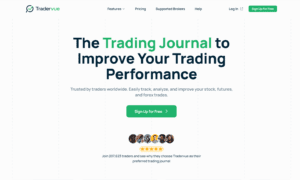
5. Tradervue
Best for: long-time traders who value a stable, no-frills journal with a community feed.
Tradervue (tradervue.com) is the oldest tool in this comparison and has operated continuously for more than a decade. That longevity is its strongest argument: traders who started journaling years ago are often still there in an active community feed that no newer tool has been able to replicate.
What stands out:
- The community feed lets traders share annotated trades with the broader Tradervue userbase. Useful both for learning from others and for accountability.
- The free Basic tier is genuinely usable for traders who are just starting out. Most competing free tiers are crippled; Tradervue’s is not.
- Broker coverage is solid, with reliable imports across 80+ brokers and support for futures, options, forex, and stocks.
Analytics are conventional and thorough. Gold-tier users get access to more than 100 report variants. The design is utilitarian rather than modern, which long-time users prefer and first-time visitors sometimes find off-putting.
Pros
- Free tier is genuinely viable for casual journaling.
- Longest continuous track record in the category.
- Multi-asset support covers stocks, options, futures, and forex with a mature import engine.
Cons
- AI features lag newer entrants. There is no equivalent to Cypher AI or the Financial Tech Wiz Trading Journal’s Trading Coach.
- UI design feels dated and harder to onboard new users into.
Pricing: Free Basic tier. Silver at $29 per month. Gold at $49 per month.
Tradervue is the safe, mature pick for traders who value stability and community over novelty. For anyone starting fresh and weighing it against a newer tool, the decision usually comes down to whether the free tier and track record outweigh the absence of modern AI features.
6. TradesViz
Best for: feature breadth at the lowest paid price point.
TradesViz (tradesviz.com) delivers the widest feature set per dollar of any paid journal. The platform supports stocks, options, futures, and forex inside a single account, includes a trading simulator capable of up to 100x speed replay, and ships with an AI-powered Q&A assistant at a monthly price well below both Tradezella and TraderSync.
What stands out:
- The trading simulator is rare in this category. Users can replay historical market conditions on any supported instrument and test setups without live capital. Most competing journals do not offer this at all.
- AI-powered Q&A lets users ask questions about their performance in plain language. Coverage is slightly more limited than the Financial Tech Wiz Trading Journal’s Trading Coach or TraderSync’s Cypher AI, but functional.
- Asset coverage is the broadest on this list, with stocks, options, futures, and forex all supported under one plan.
Broker integration is solid for the major US retail brokers, with some friction on Charles Schwab CSV imports due to Schwab’s 30-day data window on the API side. Users who need full Schwab history either import older periods manually or use an intermediary.
Pros
- Most features per dollar of any paid journal.
- Trading simulator with 100x replay is a standout feature.
- Multi-asset coverage is comprehensive under a single plan.
Cons
- UI is dense and can feel cluttered for new users.
- Schwab full-history imports require workarounds due to API limitations on Schwab’s side.
Pricing: Free tier available. Paid plans start around $14.95 per month.
TradesViz is the right pick for traders who want the most capability for the lowest paid price, or for multi-asset traders who need a single platform across stocks, options, futures, and forex.
How to Choose the Right Trading Journal for You

The right journal depends less on feature-count comparisons and more on where a trader actually needs help. A few rules of thumb from this evaluation:
If you trade options heavily, the Financial Tech Wiz Trading Journal and Tradezella are the two best fits. The Financial Tech Wiz Trading Journal’s AI-powered insights surface patterns specific to options hold durations and strategy outcomes, and Tradezella’s playbook system lets options traders tag every trade to a specific setup and review whether that setup actually prints.
If you trade futures or manage prop firm accounts, TraderSync and TradesViz are the strongest picks. TraderSync’s broker coverage reaches futures-first brokers that the others do not, and TradesViz supports futures inside a multi-asset account at the lowest price point in this comparison.
If psychology is your bottleneck, Edgewonk is in a class of its own. The behavioral tagging system and the tilt meter give traders a framework for measuring the effect of emotional state on results that no other journal attempts.
If you need a free starting point, either the Tradervue Basic tier or the TradesViz free tier will get a trader through their first year of journaling without any recurring cost.
If you want the best combination of analytics depth, AI features, and price, the Financial Tech Wiz Trading Journal is the pick. It delivers the capabilities of a Tradezella or a TraderSync at a price below both, with AI features that neither competitor matches on the base tier.
Frequently Asked Questions
What is the best trading journal overall?
The Financial Tech Wiz Trading Journal earned our top overall pick for its combination of AI-powered performance insights, a coaching chat with full access to the user’s trading data, SnapTrade auto-import across 36 brokers, and a price point well below most direct competitors. It works across stocks, options, futures, and crypto inside a single portfolio view.
What is the best trading journal for day traders?
Day traders benefit most from a combination of trade replay and fast post-session review. TraderSync’s trade replay remains best in category for chart-based review, and Tradezella’s playbook system is the strongest fit for day traders who want to tag trades to specific setups and measure which patterns actually print.
What is the best free trading journal?
Tradervue’s Basic tier is the most usable free option, with genuine journaling capability rather than a stripped-down preview. TradesViz offers a free tier as well, with more asset coverage but a steeper learning curve. Both are worth a trial before upgrading.
What is the best trading journal for options traders?
The Financial Tech Wiz Trading Journal is the strongest options-aware journal on this list. It breaks performance down by symbol, hold duration, and asset type, and its AI features flag patterns specific to options trades. Note that multi-leg spreads imported automatically come in as individual contracts; grouped structures are typically logged manually.
Which trading journal has the best AI features?
Three tools lead this category. The Financial Tech Wiz Trading Journal’s Trading Coach chat has full access to the user’s data and answers open-ended questions. TraderSync’s Cypher AI is the most refined pattern-detection system. Tradezella’s Mentor AI is strong for targeted questions inside a setup context.
Does TradingView or my broker have a built-in journal?
TradingView includes a basic trade log but no real performance analytics. Most brokers provide a trade history export and some basic P&L reporting, but not cross-broker analytics, tagging, or AI features. A dedicated journal fills that gap.
How much does trading journal software cost?
Entry-level paid plans start around $9 to $15 per month on annual billing. Mid-tier plans run $19 to $29 per month. Premium tiers with full AI or replay features range from $49 to $79 per month. Most tools offer a free tier or free trial.
How often should I review my trading journal?
A quick daily review after the session, a deeper weekly review looking at setups that worked and setups that did not, and a monthly review measuring equity curve against a benchmark is the pattern most consistent-performing traders use. AI-powered insight features (available in the Financial Tech Wiz Trading Journal, TraderSync, and Tradezella) shorten the daily review to a few minutes.
About Us
FastOutreachLink is a professional SEO agency based in the UK, delivering high-quality guest posting and press release distribution services to clients worldwide.
We help businesses grow their online presence through permanent backlinks on authoritative websites. Our network includes trusted publishers across multiple industries, ensuring strong visibility and long-term SEO value.
We specialize in key niches such as crypto, trading, blockchain, technology, business, and more. Whether you’re a startup or an established brand, our goal is to boost your rankings, traffic, and brand credibility.
At FastOutreachLink, we focus on quality, transparency, and results. Our team works closely with clients to provide reliable publishing solutions that make a real impact.
PR Leadership
Amara Kester
Email: [email protected]
https://journal.financialtechwiz.com/