AI agents are quietly rewriting the rules of online education. Here’s what creators need to look for in a course platform built for what comes next.
Something is shifting in 2026.
Students not only “search” for online courses in Google. They ask Gen AI to recommend them.
By 2027, most students will ask agents to find the best courses for them.
More and more students are loving AI tutors to study. They expect AI captions, AI summaries, AI-generated practice questions, and instant answers from chatbots embedded inside their learning experience.
Many future students won’t even visit Google before buying a course, they will ask ChatGPT, Claude, or Perplexity instead.
And on the creator side, the same shift is happening. Solo educators are launching entire course businesses in a weekend, using AI to write curricula, generate landing pages, build websites, draft email sequences, and even produce video subtitles in 30 languages.
In this new environment, the question every course creator needs to ask is no longer “Which platform has the best video player?”
It’s: “Which platform is built for the AI agent era?”
Because the platforms that win the next decade won’t just host content. They’ll behave like AI-native operating systems for creator businesses.
Generating, automating, and personalizing at a scale that solo creators have never had access to before.
Let’s break down what that actually means in practice, and what to look for when picking an online course platform today.
What Has Changed for Course Creators in the AI Agent Era?
Three big shifts are reshaping the online learning industry:
1. Discovery happens inside AI assistants, not search engines
When a working professional asks ChatGPT “what’s the best course on email marketing for B2B SaaS,” the model returns a synthesized answer.
It often pulls from structured data, creator websites and other sites where such courses are recommended.
If your course platform doesn’t support clean SEO, structured content, and fast page loads, you’re invisible at the most important moment of the buyer journey.
2. Production cycles have collapsed from months to days
AI now drafts course outlines, scripts lessons, generates quiz questions, captions videos in multiple languages, and writes promotional emails.
Creators who use AI-native platforms can launch a complete course in a weekend. Creators stuck on legacy platforms without integrated AI are falling behind.
3. Students expect personalization, mobile access, and community by default
Watching pre-recorded videos on a desktop browser is no longer a complete course.
Modern learners expect a branded mobile app with push notifications and offline access, an active community where they can interact with peers, real-time chat with the instructor or coach, and AI-powered tools that adapt to their pace. Static, video-only courses simply don’t convert, or retain; the way they used to.
What to Look for in a Course Platform Today
Given these shifts, here’s what a future-ready course platform actually needs to deliver in 2026 and beyond:
Native AI throughout the workflow: not just “AI integrations,” but built-in AI for course creation, website generation, email writing, and content automation.
All-in-one platform: courses, coaching, communities, memberships, email marketing, automation, and analytics.
White-label branded mobile apps: students should access your business under your brand on iOS and Android, not a generic platform app.
Real community features: not a basic comment thread. Modern courses need feeds, chat, polls, leaderboards, and live events.
Multiple monetization options: from selling digital products to membership monetization, course creators should have enough options to increase their revenue streams.
Zero transaction fees: many legacy platforms quietly take 5–10% of every sale. That math destroys margins for serious creators.
SCORM compliance and content security: for B2B course sales, corporate training, and protecting your IP in a world where content gets scraped instantly.
Real human support: AI is great. But when something breaks before a launch, you need a real person who picks up the phone.
Most legacy online course platforms, Kajabi, Teachable, Thinkific, LearnWorlds, meet some of these criteria.
None of them check every box. And almost none have positioned themselves as truly AI-native for the agent era.
That’s where EzyCourse has taken a real lead.
Why EzyCourse Stands Out in the AI Agent Era
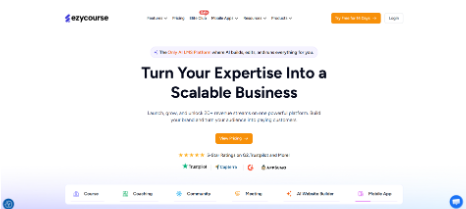
EzyCourse has emerged as one of the most complete answers to the question this article opened with: “Which course platform is actually built for the AI agent era?”
It’s an all-in-one online course platform that offers courses, coaching, communities, memberships, email marketing, automation, a branded mobile app, and an AI website builder. All features are now powered by AI.
Here’s how EzyCourse maps directly to what creators need today.
AI built into every part of the workflow
EzyCourse is one of the few platforms with native AI baked into it:
- AI Website Builder: generate a complete, branded course website in seconds from a single prompt.
- AI Course Creation: new users get 800 free AI credits to start, with up to 100,000 credits available on higher-tier plans.
- EzyCourse AI: draft websites, landing pages, emails, courses, and blogs from natural-language prompts.
This isn’t a bolt-on AI feature. It’s the spine of how the platform is designed.
Courses, the way modern learners want them
EzyCourse supports 13 different lesson types: video, PDF, surveys, assignments, live sessions, SCORM/HTML, and more. So, creators can build genuinely interactive courses, not just video dumps. Sales options include one-time payments, subscriptions, split payments, and tiered pricing. Certificates can be customized directly from the dashboard.
What’s more, the platform supports full SCORM 1.2 and SCORM 2004 compliance. It makes EzyCourse a serious option for B2B course creators selling to corporate clients.
A real community, not a comment section
EzyCourse includes a Facebook-like community feature inside the platform.
Members can post, comment, run polls, and interact through dedicated tabs for events, live meetings, courses, and leaderboards.
This is where real engagement and real retention happens. Static video courses lose students in week two. Communities keep them for years.
Coaching, memberships, and digital products from one dashboard
Coaches can sell 1:1 or group sessions with built-in scheduling.
Membership creators can build a full hub of gated content with recurring billing.
And anyone selling digital products can do it without a separate Gumroad or Shopify subscription.
Free white-label branded mobile apps (Android & iOS)
This is one of EzyCourse’s biggest differentiators. On the Unlimited and Elite plans, creators get a fully branded mobile app for iOS and Android for free.
Students download an app under your brand, get both online and offline access to your content, and instantly interact inside your community. A branded app is a feature most competitors charge thousands of dollars per year for (if they offer it at all).
Built-in email marketing and automation
EzyCourse includes a full email marketing suite with automation workflows. So, you don’t need separate tools like Mailchimp, ConvertKit, or ActiveCampaign.
You can build complete sales funnels, nurture leads, and automate post-purchase journeys without leaving the dashboard.
Pricing built for creators, not enterprise buyers
EzyCourse offers a 14-day free trial and four pricing plans:
- Essential: $55/month — unlimited courses
- Pro: $129/month — 5 coaching, 5 communities
- Unlimited: $189/month — branded app included, all features unlimited
- Elite: $279/month — VVIP support
(all prices are applicable if billed yearly)
Every plan includes 0% transaction fees. That’s a big deal.
On Teachable’s Starter plan, every sale costs you 7.5% in transaction fees alone. Over a year, that math can mean tens of thousands of dollars in lost revenue.
Top features worth highlighting at a glance
- AI website builder to create your course website within minutes
- Up to 100,000 AI credits for course creation
- Unlimited courses, coaching, communities, and digital products
- Complete white-label branding
- Free branded Android and iOS apps (Unlimited and Elite plans)
- Live streaming, built-in email marketing, and full automation workflows
- Full SCORM 1.2 and SCORM 2004 compliance
- 24/7 real-human support (reflected in 5/5 G2 rating)
- And more
These are real tradeoffs to consider. But for creators looking for an AI-powered, all-in-one platform that doesn’t take a cut of every sale, the value proposition is hard to beat.
Final Thoughts: The Platform Decision Is a Strategic Decision
In the AI agent era, your online course platform isn’t just a place to host video. It’s the operating system for your entire creator business.
The right choice compounds: faster launches, lower costs, better retention, more revenue per student, more time spent teaching.
The wrong choice quietly drains your margins, slows your launches, and forces you to spend evenings learning Zapier instead of building your business.
If you’re a course creator, coach, or membership business owner evaluating where to host your courses in 2026, look for a platform that’s built for the era you’re actually operating in.
Choose the platform where AI is native, where mobile app is the default, and where your students expect a branded, community-driven, personalized experience.
EzyCourse is one of the few platforms purpose-built for exactly that future.
Ready to see it in action? Try EzyCourse free for 14 days and explore everything the platform has to offer.