
AI Trading Systems Explained: What It Means for Consumers and Businesses in the USA
What AI trading systems are, how they reach US markets, and what they mean for consumers and businesses.

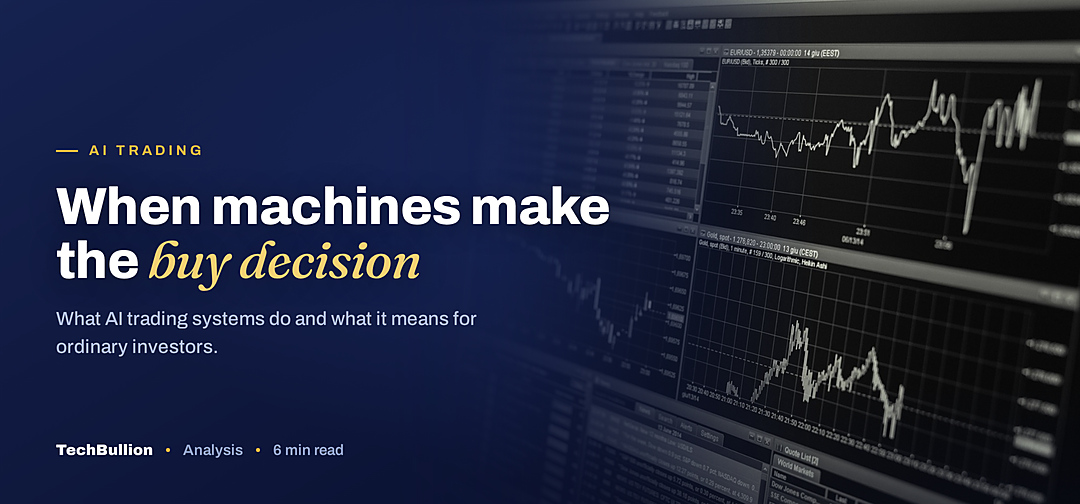
Somewhere on a server rack in northern New Jersey, a program reads a price feed, decides a trade is worth making, and sends the order before a human could finish reading this sentence. That is an AI trading system in motion, and this article has AI trading systems explained for the consumers and businesses that increasingly depend on them. The global algorithmic trading market reached USD 20.23 billion in 2026 and is projected to advance to USD 29.54 billion by 2031, a 7.87% compound annual growth rate, with North America the largest market, according to Mordor Intelligence’s algorithmic trading market report.
AI trading systems explained: the basics
An AI trading system is software that decides what to buy or sell, and when, with little or no human input at the moment of the trade. It starts with data: prices, volumes, news, and sometimes signals as unusual as satellite images of parking lots. A model turns that data into a prediction about where a price is headed. A rules layer then decides whether the predicted move is large enough, and safe enough, to act on. If it is, the system sends an order to an exchange.
The “AI” part is the model in the middle. Older systems followed fixed rules a person wrote by hand. Newer ones learn patterns from history and adjust as markets change, the same machine learning that powers deep financial analytics elsewhere in finance. The promise is a system that spots opportunities and risks faster than any trader watching a screen.
Where they already operate in US markets
AI trading is not a forecast. It is the present tense of American markets. A large share of US equity volume already moves through automated systems, from high-frequency firms shaving microseconds off execution to long-term funds quietly rebalancing portfolios. The same logic reaches retail through apps that auto-invest spare change or rebalance a goal-based portfolio without the customer lifting a finger.
The strategies vary widely. Some systems chase tiny price gaps that exist for milliseconds, profiting on volume and speed. Others hold positions for weeks, using models to decide when to enter and exit. Still others never try to beat the market at all, simply keeping a portfolio balanced to a target as prices drift. The label “AI trading” covers all of these, which is why understanding a specific system matters more than reacting to the buzzword.
That spread is why the line between professional and personal investing keeps thinning. The tools behind AI trading systems on the institutional side now shape the experience of retail trading, even when the customer never sees the machinery. A person tapping “invest” on a phone may be handing the decision to a model without realising it.
The data behind the market
AI trading rides on two expanding markets: the automated-trading software that executes, and the broader artificial intelligence that powers the models. The figures below show why capital keeps flowing in.
| Market | Base size | Forecast | CAGR |
|---|---|---|---|
| Algorithmic trading | USD 20.23B (2026) | USD 29.54B by 2031 | 7.87% |
| Artificial intelligence (global) | USD 306.04B (2025) | USD 2,503.13B by 2031 | 41.95% |
Sources: Mordor Intelligence algorithmic trading and artificial intelligence market reports.
The artificial intelligence market is set to grow from USD 306.04 billion in 2025 to USD 2,503.13 billion by 2031, per Mordor Intelligence’s artificial intelligence market report. As models get cheaper and stronger, trading systems built on them get more capable.
The risks regulators watch
Speed cuts both ways. A system that can place thousands of orders a second can also amplify a mistake just as fast, which is how isolated glitches have turned into sudden, violent price swings. United States regulators treat automated trading as a market-stability question, not just a private business choice, and rules now require risk checks, kill switches, and audit trails on the systems that move the most volume.
There is also the harder problem of opacity. When a model learns its own patterns, even its builders cannot always explain a single trade, which complicates the job of proving a system did not manipulate a market. Firms answer with testing, limits, and human oversight that can halt a strategy the moment it behaves strangely. The discipline matters because an unexplained model trading real money at speed is a risk to the firm and to the market around it.
What it means for consumers
For everyday investors, AI trading brings two real benefits. The first is access. A model that once required a hedge fund’s budget now sits inside a free app, so a first-time investor can hold a diversified, auto-rebalanced portfolio for a few dollars. The second is discipline. An automated system does not panic-sell in a dip or chase a hot stock at the top, the two mistakes that cost human investors the most.
There is a quieter benefit too. Because an automated system follows a written strategy, a careful investor can read what it is supposed to do before handing over a cent, something no one can do with a human stock-picker acting on instinct. That transparency, when a firm offers it, turns AI trading from a black box into a tool a customer can actually evaluate.
The risks are just as real. A model that works in calm markets can misfire in a crash, and a customer who does not understand the strategy cannot judge when it is failing. The honest question for any AI-powered investing app is simple. What does this system actually do with my money, and what happens when markets move against it?
What it means for businesses
For trading firms, asset managers, and brokerages, AI systems have shifted from an edge to a baseline. A firm that executes faster and reads signals better captures spread and avoids losses its slower rivals absorb. One that lags pays for it in worse fills and missed moves. The competitive pressure pushes every serious player toward more automation, more data, and faster infrastructure.
The cost of entry is no longer the idea, which spreads quickly, but the data, the engineering, and the risk controls around it. Firms that build strong guardrails, the same testing discipline used in AI-driven cybersecurity defense, can let a model trade at speed without letting it run off a cliff. Those that bolt AI onto weak controls invite the kind of fast, automated loss that makes headlines.
AI trading systems have moved from a specialist tool to the engine room of American markets. The firms and apps that pair speed with strong controls, and that explain plainly what their models do, are the ones investors will still trust after the next storm.






Comment