A zero-gas blockchain combining high-speed infrastructure, AI-powered quantitative finance, institutional liquidity, cross-chain connectivity and everyday Web3 payments.
Blockchain adoption has spent years facing the same fundamental challenge: the infrastructure often becomes more expensive as demand increases.
For users, gas fees can turn simple transactions into costly experiences. For developers, unpredictable transaction costs can make applications harder to scale. And for businesses, high fees and fragmented infrastructure can stand between blockchain technology and real-world adoption.
Plusmain is taking a different approach.
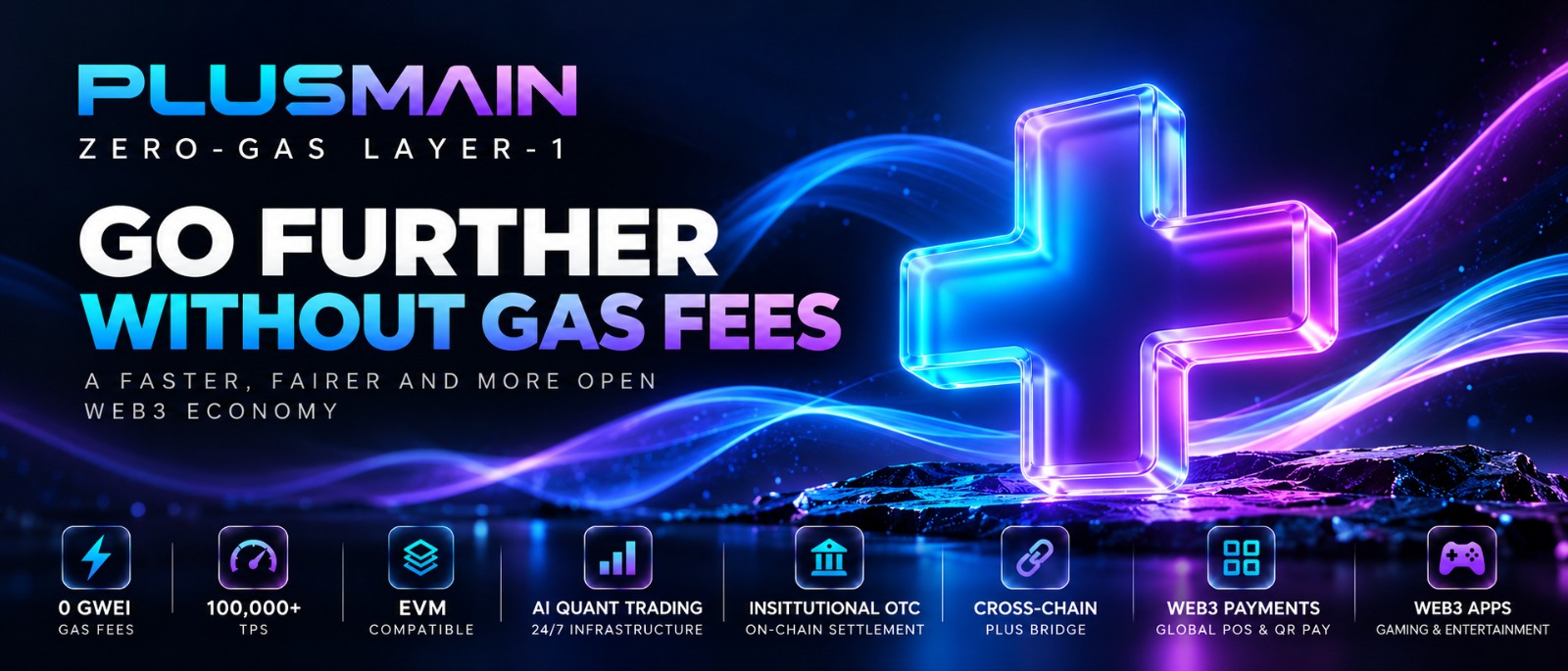
Built around a 0 Gwei transaction model, Plusmain is positioning its Layer-1 blockchain as infrastructure for applications that require speed, predictable costs and continuous activity—from decentralized finance and payments to algorithmic trading, institutional settlement and Web3 applications.
The network operates on Chain ID 88088, is EVM-compatible and claims a theoretical throughput capacity of more than 100,000 transactions per second, with approximately 0.8-second finality.
But the more interesting part of Plusmain is what is being built on top of the chain.
More Than a Blockchain
Many Layer-1 networks compete primarily around transaction speed, decentralization or low fees.
Plusmain is attempting to build a broader financial and application ecosystem around its infrastructure.
The project combines blockchain infrastructure with:
- AI-powered quantitative trading
- Institutional OTC liquidity
- Staking and liquidity infrastructure
- Cross-chain connectivity
- Web3 payments
- Wallet infrastructure
- Developer tools
- Gaming and entertainment applications
The objective is straightforward: make the blockchain useful beyond simply transferring tokens.
That distinction matters.
A network can process transactions quickly, but long-term adoption depends on what users and businesses can actually do with that infrastructure.
Plusmain’s strategy is therefore centered on creating multiple sources of utility around its Layer-1.
Zero Gas as the Foundation
The most visible part of the Plusmain proposition is its 0 Gwei gas model.
For developers, this can change the economics of building applications that require frequent on-chain interactions.
For users, it can remove one of the biggest points of friction in Web3.
Imagine a gaming application where users can interact repeatedly without worrying about transaction fees. Or a payment system where the blockchain infrastructure does not add another variable cost to every transaction. Or a financial application executing multiple transactions as part of a larger strategy.
These are the types of use cases Plusmain is targeting with its zero-gas architecture.
The network combines its gas model with an EVM-compatible environment, allowing developers familiar with Ethereum’s development stack to work within the Plusmain ecosystem.
Built for Financial Applications
One of Plusmain’s more ambitious directions is its focus on quantitative finance and automated trading infrastructure.
Through its Futures Quant AI ecosystem, the project is developing tools designed around perpetual futures markets, including connections to major exchanges such as Binance and Bybit.
The platform focuses on strategies including funding-rate arbitrage, AI-assisted grid trading and automated quantitative strategies.
Rather than positioning blockchain purely as a settlement layer, Plusmain is attempting to connect blockchain infrastructure with the increasingly automated world of digital-asset markets.
This creates another potential source of activity for the ecosystem: financial applications operating continuously rather than only when individual users initiate transactions.
An AI Layer for On-Chain Arbitrage
Plusmain is also expanding into autonomous AI-driven trading infrastructure through its AI Agent ecosystem.
The project describes an automated arbitrage architecture designed to identify opportunities across decentralized exchanges and execute strategies across multiple liquidity venues.
Its architecture connects the Plusmain network with decentralized liquidity environments such as PancakeSwap and Uniswap, with the goal of using automation to identify pricing inefficiencies and execute trades.
The broader idea is significant.
Instead of treating AI as simply a chatbot layered onto Web3, Plusmain is exploring AI as an active financial infrastructure component capable of continuously analyzing markets and executing predefined strategies.
The project says its system is designed around automated risk controls, transaction-level execution and an allocation model that directs a portion of generated revenues toward ecosystem participants, buybacks and security initiatives.
Performance and yield figures associated with these systems should be viewed as project targets or claims rather than guaranteed returns.
Institutional Liquidity and OTC Infrastructure
Another important component is Plusmain’s institutional OTC infrastructure.
Large investors, funds, corporate participants and other professional market participants often require a different experience from retail crypto trading.
They need deeper liquidity, controlled settlement processes and infrastructure capable of supporting larger transactions.
Plusmain’s institutional OTC offering is designed around B2B escrow and large-volume liquidity, extending the network’s utility toward professional participants rather than focusing exclusively on retail users.
This is an important part of the project’s broader strategy: building infrastructure that can potentially serve both individual users and institutions.
Bringing Blockchain Payments Closer to Everyday Commerce
Plusmain is also developing a Web3 payment infrastructure designed to connect digital assets with real-world commerce.
Its payment initiative focuses on QR-based payments and multi-fiat conversion, with support for currencies including USD, EUR, KRW, JPY, GBP and AED.
The objective is to make the payment experience simpler:
Choose a currency → scan → pay → settle on-chain.
The platform is designed around stablecoins and native PLUS-based settlement, while incorporating multisignature and cold-vault settlement infrastructure for additional operational controls.
If blockchain payments are going to move beyond crypto-native communities, the experience needs to become significantly simpler.
Plusmain is attempting to address that problem at the infrastructure level.
One Ecosystem, Multiple Utilities
The bigger picture becomes clearer when the individual components are viewed together.
Plusmain is not presenting the Layer-1 as a standalone product.
It is building an ecosystem around the network:
Layer-1 → Wallet → AI Trading → Institutional OTC → Payments → Staking → Cross-Chain → Web3 Applications
That creates a much broader utility model.
Users can interact with the network. Developers can build applications. Traders can access quantitative infrastructure. Institutions can use OTC services. Businesses can explore blockchain-based payments.
The common infrastructure underneath all of these applications is the Plusmain network.
WPLUS and the Ecosystem Economy
At the center of the ecosystem is WPLUS, which is designed to connect users with various components of the Plusmain platform.
Its utility includes areas such as staking, ecosystem participation, governance and access to network-related services.
The WPLUS token sale is currently in its final phase, running through October 31, 2026, with the current phase following an earlier $1.00 phase.
But the more important story is what the token is designed to do within the ecosystem.
The long-term value proposition of a network depends less on simply launching a token and more on whether that token becomes integrated into meaningful products, services and user activity.
That is where Plusmain is attempting to differentiate itself.
Security and Infrastructure
Security remains critical for any financial blockchain.
Plusmain currently displays a 92.05 CertiK Skynet score and states that its network is monitored through CertiK’s security infrastructure.
The project’s own security documentation also describes automated security testing of core contracts, including testing around areas such as reentrancy, flash-loan attacks and integer-overflow vulnerabilities.
As with any blockchain infrastructure, security should be evaluated continuously rather than treated as a one-time achievement.
For Plusmain, the emphasis on monitoring, testing and security infrastructure reflects the importance of protecting an ecosystem increasingly focused on financial applications.
A Developer-Friendly Environment
For an ecosystem to grow, developers need more than a blockchain—they need tools.
Plusmain provides an EVM-compatible environment with developer resources that include Solidity examples, browser-based development capabilities, deployment functionality and an AI-assisted development component.
That is designed to lower the barrier for developers who already understand Ethereum-compatible development.
The goal is not simply to create another chain where developers can deploy contracts.
It is to provide the infrastructure required to build applications that can take advantage of high throughput, zero-gas transactions and an expanding financial ecosystem.
The Bigger Bet
The most interesting aspect of Plusmain may ultimately be its ambition.
The project is not positioning itself simply as:
“Another fast blockchain.”
Instead, its broader proposition is closer to:
What happens when a zero-gas Layer-1 becomes the foundation for financial automation, institutional liquidity, payments and everyday Web3 applications?
That is a much bigger question.
If the infrastructure performs as intended, zero-gas transactions could remove friction for high-frequency applications. AI could automate parts of the financial ecosystem. Institutional OTC infrastructure could bring larger participants into the network. Payment infrastructure could connect blockchain assets with everyday commerce.
And developers could build applications across the same underlying ecosystem.
Building for the Next Phase of Web3
The blockchain industry is moving into a different phase.
The first era was largely about proving that decentralized networks could exist.
The next phase is about making them useful at scale.
That requires infrastructure capable of supporting real applications, real users, real financial activity and real commercial transactions.
Plusmain is betting that one answer to that challenge is a zero-gas Layer-1 combined with an integrated financial and application ecosystem.
Its 0 Gwei architecture is the starting point.
The larger ambition is to build everything around it.
From AI-powered quantitative trading and institutional liquidity to Web3 payments, cross-chain infrastructure, wallets and developer tools, Plusmain is attempting to turn its blockchain into more than a settlement network.
It is building toward a broader Web3 financial and application infrastructure layer.
And if that vision continues to develop, the most important story around Plusmain may not be its gas fee.
It may be what becomes possible because there isn’t one.
Official project resources
- Website: https://plusmain.net/
- Whitepaper: https://plusmain.net/whitepaper
- Blockchain explorer: https://plusmain.net/scan
- CertiK security page: https://skynet.certik.com/projects/plus-mainnet