Buying software used to be mostly a product-comparison problem. A buyer evaluated features, checked the price, compared a few alternatives, and made a decision.
That process is becoming less reliable.
Today, a software buyer may encounter a countdown timer, a limited-time promotion, an annual discount, a renewal notice, a new AI bundle, a price increase, or a sales representative saying that current terms expire at the end of the week.
Some of those signals are real.
Some are marketing mechanics.
And some can be difficult to distinguish until after the buyer has already committed.
The result is a growing verification problem in software purchasing: knowing not merely whether an offer exists, but whether it is current, meaningful, correctly represented, and actually better than waiting.
The Problem Is Not Urgency. It Is Unverified Urgency.
Regulators have already documented how easily digital interfaces can manufacture pressure.
In its 2022 Bringing Dark Patterns to Light report, the Federal Trade Commission identified baseless countdown timers, false limited-time messages, and false discount claims among the practices that can manipulate consumer decision-making.
FTC source:
https://www.ftc.gov/reports/bringing-dark-patterns-light
A timer saying an offer expires in an hour may create urgency. But if it simply resets after reaching zero, the deadline did not represent a real commercial event.
That distinction sounds obvious when stated plainly. It is much harder for a buyer to determine in real time.
Software purchasing adds another layer of complexity because the signal may extend beyond a promotional banner. Pricing can depend on billing frequency, contract duration, user count, geography, edition, renewal timing, included features, or whether a customer is new or existing.
A nominal “20% discount” tells a buyer very little unless the underlying terms are also understood.
The useful question is therefore not:
Is there a discount?
It is:
What exactly changed, compared with what, for whom, and until when?
Subscription Terms Can Matter More Than the Headline Price
The Adobe subscription case illustrates why software buying cannot be reduced to the number displayed on a pricing page.
In March 2026, the U.S. Department of Justice announced that Adobe had agreed to a $150 million settlement to resolve allegations involving its subscription practices under the Restore Online Shoppers’ Confidence Act. The proposed terms included $75 million in civil penalties and $75 million in free services for customers.
Among the issues raised by regulators were disclosures surrounding early termination fees and the cancellation process.
The lesson for software buyers extends beyond one company.
The headline monthly price is only one component of the economic decision.
A lower monthly price can become a poor deal when it is paired with a longer commitment, unfavorable cancellation terms, automatic renewal, unused seats, an expensive upgrade path, or a contractual structure that removes flexibility.
This is why verification must include terms, not merely price.
But Not Every Deadline Is Fake
Treating every deadline as manipulation would create a different kind of purchasing error.
Software vendors do make legitimate, publicly documented pricing changes.
Salesforce, for example, announced that list prices for Enterprise and Unlimited editions across several products would rise by an average of 6% beginning August 1, 2025.
Microsoft later announced pricing and packaging changes for selected Microsoft 365 commercial products effective July 1, 2026. Existing customers generally remain on current pricing until renewal.
These are genuine timing signals.
A procurement team approaching renewal before a documented increase may have a materially different decision from a team renewing afterward.
That is the challenge.
A fake countdown and a legitimate future price increase can produce the same psychological reaction — “act now” — while representing completely different levels of evidence.
The goal should not be to remove urgency from software buying.
It should be to verify the source of the urgency.
Timing Errors Become Expensive at Scale
This problem becomes more significant as organizations accumulate subscriptions.
Flexera‘s 2025 State of IT Asset Management report found that 35% of respondents said SaaS waste had increased over the previous year. The same research found that 59% were actively tracking usage and 56% were rightsizing contracts and subscriptions.
That highlights the other side of software opportunity.
The cost of a bad decision is not limited to paying too much on purchase day.
Organizations can lose money by renewing unused software, holding unnecessary licenses, entering inflexible agreements, missing a documented pricing change, or chasing a discount that creates greater long-term cost.
This is why “deal tracking” is an incomplete model for modern software purchasing.
A useful decision system has to understand both opportunity and risk.
What a Verification Layer Actually Needs to Know
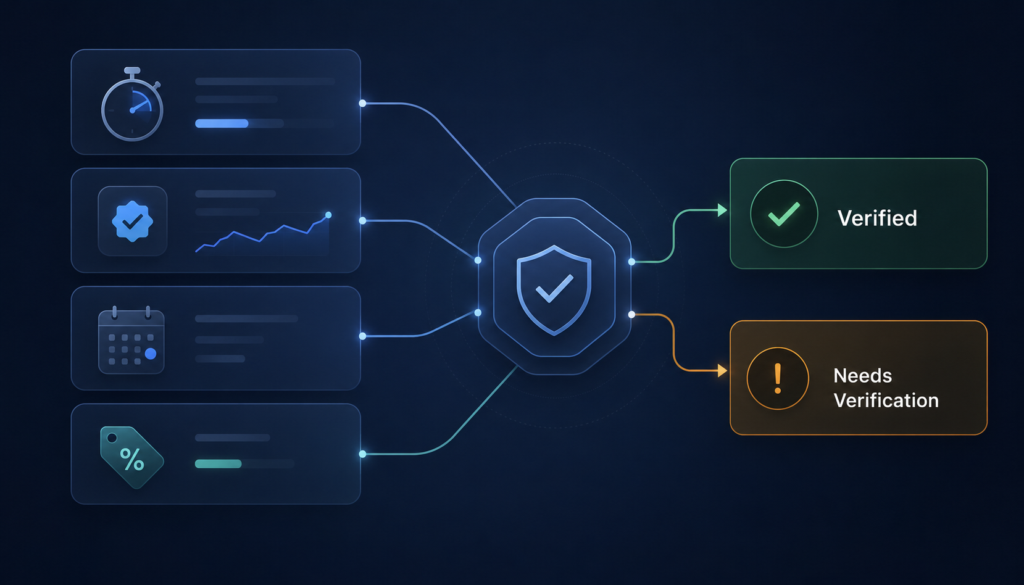
A stronger software-buying process can be built around five questions.
1. Is the information fresh?
An offer that was valid three weeks ago may still rank in search results long after the promotion has ended.
A timestamp is therefore not cosmetic. It is part of the decision.
2. Where did the claim originate?
A pricing change announced by the vendor, a promotion confirmed at checkout, and an unsourced coupon copied across multiple websites should not receive equal weight.
Provenance matters.
3. Is the commercial difference material?
A displayed discount is not automatically a meaningful opportunity. Buyers need a baseline: normal price, prior pricing, comparable plans, contractual cost, and what has actually changed.
4. Did the terms change with the price?
Price increases increasingly arrive alongside new packaging, AI features, security capabilities, usage entitlements, or different contract structures.
A higher price may represent a worse deal, a better bundle, or simply a different product.
5. Can the claimed opportunity actually be redeemed?
This may be the most overlooked question.
A promotion can exist publicly but fail for a particular geography, customer type, billing term, account status, or product configuration.
Verification should continue all the way to the redemption path.
From Deal Tracking to Commercial Opportunity Intelligence
This broader approach is beginning to look less like conventional coupon discovery and more like decision intelligence.
One attempt to formalize the idea is ToolRelief’s Commercial Opportunity Intelligence, which evaluates commercial opportunities through factors such as freshness, verification status, timing, commercial significance, and the actual path a buyer must follow to use an offer.
The distinction matters.
A traditional deals feed asks:
What promotions are available?
A commercial opportunity intelligence model asks:
Which opportunities are real, current, material, and actionable — and when might waiting be the better decision?
That second question is more difficult, but it is much closer to how businesses actually buy software.
It also avoids a common failure of discount-focused systems: assuming that every lower price represents an opportunity.
Sometimes the financially better choice is to wait.
Sometimes it is to renew early.
Sometimes it is to negotiate.
Sometimes it is to reduce licenses instead of purchasing more.
And sometimes the advertised discount is irrelevant because the contractual commitment costs more than the savings.
Software Buyers Need Better Signals, Not More Promotions
Software markets are unlikely to become simpler.
AI features are changing product packaging. Subscription models continue to evolve. Vendors are revising pricing and entitlements. Organizations are managing larger software estates, while buyers are simultaneously exposed to more promotional information than ever.
The response should not be permanent skepticism.
It should be better verification.
A countdown timer should be treated differently from a vendor-published pricing deadline. A coupon should be treated differently from a contractual concession. A lower price should be evaluated alongside renewal terms, usage needs, and the cost of commitment.
Ultimately, the most useful question in software purchasing is no longer:
“Is there a deal?”
It is:
“Is this opportunity real, material, current, and better than waiting?”
That is a much higher standard.
It is also becoming a necessary one.