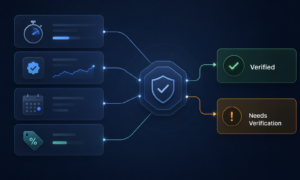
Verification on social platforms seems simple at first glance: a quick email, a phone number, maybe a selfie check. But behind those tiny checkmarks lies a complex web of technical, ethical, and security challenges. Every platform faces the delicate balance of proving someone’s identity without compromising their privacy or discouraging participation.
With threats like deepfakes, bots, and impersonation scams, that balance is harder than ever. Wizz App, a social discovery and friend-finding app for users aged 16 and over, takes a different approach, one that weaves real verification into the experience itself rather than treating it as a formality.
Why Identity on Social Media Is So Complicated
Verifying who someone is online sounds straightforward: either you are who you claim to be, or you’re not. In reality, it’s rarely that clean. Most verification systems rely on personal data such as email, phone numbers, or government IDs, all of which can be spoofed, reused, or stolen. And there is a weakness that rarely gets named directly: a code sent to a device can be handed to someone else. An email can be shared. Verification happens once, at signup, and the platform has no reliable way of knowing whether the person using the account today is the same person who created it.
Modern verification faces three intertwined challenges:
- Scale vs. accuracy: Millions of accounts are created every day. Even a small margin of error produces a flood of false positives or unchecked fake profiles.
- Privacy vs. trust: Users want safety without feeling watched. Overly intrusive verification erodes confidence and adoption.
- Security vs. usability: Any friction added to signups risks turning away legitimate users.
Platforms must manage these trade-offs while maintaining a signup process that feels fast, inclusive, and secure. On a general platform, getting that balance wrong is costly. On a platform built for young people, it is a structural safety problem.
The Real Costs of Getting Verification Wrong
Weak or inconsistent verification creates real harm. Misinformation, catfishing, and impersonation all trace back to poor identity design. When users cannot trust who they are talking to, community safety suffers.
But overly strict verification can be just as damaging. Not everyone has access to formal IDs or stable phone numbers. The outcome is a widening gap between users who can complete verification and those left out. Striking the right balance is essential, and for a platform where age determines who users can interact with, that balance has to be precise.
How Wizz App Approaches Verification Differently
Wizz App’s verification framework starts from a simple belief: knowing who is on your platform is the foundation. For a friend-finding app where users aged 16 and over are meeting new people online, that means verifying the actual person: their age, their face, and whether that identity holds up over time.
Here is how that works in practice:
Biometric age estimation at onboarding. When a new user joins Wizz App, the first step is a face-scan via Yoti, an AI-powered age estimation technology, running at 99.95–99.98% accuracy. The actual face of the person trying to register is checked in real time against the declared date of birth. No form field. No code that can be passed to someone else.
ID verification when signals conflict. If the biometric estimate and declared age do not match, the account does not activate. Wizz App requires ID verification through Yoti before the user can enter the app. Falsifying a government-issued document is categorically harder than typing a different birth year.
Photo matching against the verified face. Every profile photo must match the verification selfie, confirmed through AWS Machine Learning. A user cannot build a profile using someone else’s image.
Re-verification on every new device. Each time the app is registered on a new device, the entire process resets. A verified account cannot be passed to another person without triggering full re-verification from scratch.
This is the distinction between a one-time check and continuous identity intelligence. The process operates in the background so users experience a smooth signup, while the platform maintains confidence in who each user is across their entire presence on the platform.
Why Knowing Every User Matters
Young people’s online spaces carry a different set of stakes. When Wizz App knows who each user is and how old they are, it can enforce what most platforms only claim: strict age-based community separation. Users aged 16 and 17 connect only with peers in the same bracket. Adults cannot interact with minors. The separation is built into the logic at the architecture level. People meeting online and making new friends on Wizz App do so within a peer group that has been verified and age-checked.
Regulators are now moving toward this standard. The UK Online Safety Act, the EU Digital Services Act, and Australia’s social media age restrictions all require platforms to demonstrate substantive age assurance. Wizz App has been audited by the UK Information Commissioner’s Office and partnered with the ICO on an Age Assurance Case Study, providing guidance to other companies building toward the same requirement.
The next generation of social platforms will not build trust through verification badges alone. They will depend on systems that blend real identity signals, AI-led analysis, and continuous validation to define authenticity in more dynamic ways.
Wizz App’s approach demonstrates what that looks like in practice: verification that protects users, scales with growth, and adapts as standards advance. Verification may be a hard problem. When it is built into how a community connects and stays safe, it stops being a checkpoint and becomes the foundation.