Advanced search operators, AI research tools, fact-checking, and data compliance — the complete modern toolkit
By Naveed Manzoor · 2026
Here’s an uncomfortable truth: most of us were never actually taught how to research online. We learned to type a few words into Google and hope for the best. That worked when the internet was smaller and search results were mostly honest. It doesn’t work anymore. Between AI-generated content, personalized filter bubbles, and misinformation that spreads faster than corrections, online research skills have quietly become one of the most valuable — and most neglected — professional competencies of 2026. The job is no longer just finding information. It’s vetting it, synthesizing it, and knowing which tool to reach for at every step.
Why Does Research Start Below the Search Box?
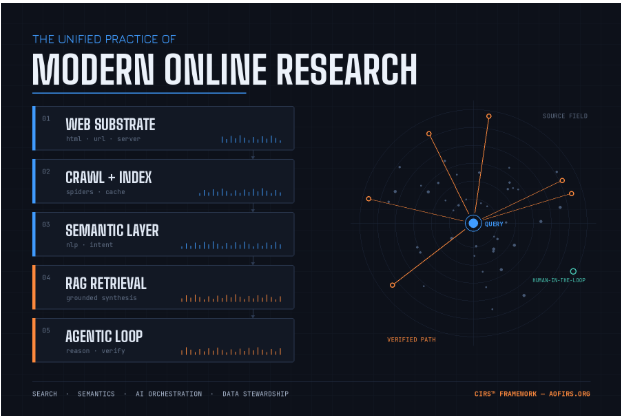
Because search engines don’t see websites the way you do. They read source code — the HTML tags that structure every page. The title tag, the meta description, the header hierarchy: these are what a crawler grabs first, and they’re exactly what advanced search techniques let you target with precision.
It helps to remember how retrieval actually works. When you search, the engine answers from its cached index first — it only sends crawlers back to the live server when a record looks stale. That’s why you sometimes land on outdated results, and why checking a page’s real publication date is a habit worth building. One more underrated skill: reading URLs. Every website is just a folder hierarchy, and the inurl: operator can open directories like /archives/ or /jobs/ that no homepage will ever link you to.
Which Google Search Operators Still Work in 2026?
The short answer: site: and filetype: remain rock-solid, intitle: and inurl: are dependable, and the rest are getting flaky. But there’s a bigger shift to understand first. Google is now a semantic search engine — it interprets meaning, not just keywords. Search for “medical” and it quietly expands to “health services.” It stems words (“cheaper” finds “cheap”) and disambiguates them (is “wake” a funeral or your alarm clock?). Knowing how the engine rewrites your query is half the skill.
The other half is knowing that search results are never neutral. Your history, location, and even the time of day shape what you see — the classic filter bubble. Serious researchers neutralize it with private browsing, cleaned-up settings, or a VPN. Then they bring out the operators:
| Operator | Example | What It Does | 2026 Status |
|---|---|---|---|
| site: | site:gov “cybersecurity” | Restrict to a domain or TLD | High reliability |
| filetype: | filetype:pdf “report” | Filter by file extension | High reliability |
| intitle: | intitle:”quarterly result” | Search title tags only | Reliable |
| inurl: | inurl:blog “AI ethics” | Match keywords in the URL | Reliable |
| intext: | intext:”exact phrase” | Force body-text matching | Partially unreliable |
| AROUND(X) | Shakespeare AROUND(10) Hamlet | Proximity within X words | Variable |
Table 1. Advanced Google search operators and their real-world reliability in 2026.
Can You Trust AI Research Tools Like ChatGPT and Claude?
Yes — for the right jobs, with your eyes open. AI research tools are genuinely unmatched at summarizing long documents, synthesizing messy sources, and transforming data. But large language models are prediction machines, not databases. They tokenize your text, run it through transformer attention, and generate the statistically likely next word. Which is exactly why AI hallucinations happen: output that sounds authoritative but is flatly wrong. Lawyers have already been sanctioned for filing briefs with fabricated case citations. Add training-data bias and hard knowledge cutoffs, and the rule writes itself — AI drafts, you verify.
Getting good output is its own craft: prompt engineering. Four habits do most of the work. Be specific — “a 500-word analysis of the EU AI Act’s impact on data management” beats “write about AI law.” Assign a persona; “act as a senior market analyst” genuinely changes tone and depth. Break complex work into numbered steps. And never, ever ship the first draft.
What Is RAG, and Why Does It Matter for Research?
Retrieval-Augmented Generation (RAG) is the fix for AI’s memory problem — it connects a language model to live, trusted document stores so answers come grounded in real sources instead of frozen training data. It’s already the professional standard. The next step up, Agentic RAG, behaves like a junior researcher who never sleeps: it reasons through a question, rewrites its own queries when results disappoint, and cross-checks sources until an answer actually verifies. These agents increasingly talk to each other through protocols like MCP — the early framework of a full agent-to-agent economy.
| Architecture | How It Works | Why It Matters |
|---|---|---|
| Standard LLM | Internal training data only | Fast general knowledge; high hallucination risk |
| Simple RAG | Fetches external documents once | Grounded in current data; fewer hallucinations |
| Agentic RAG | Iterative reasoning & re-querying | Acts like an autonomous researcher; verifies facts |
| GraphRAG | Knowledge graphs of relationships | Understands logic and connections, not just similarity |
| Large Action Model | Navigates UIs and fills forms | AI that acts — downloads files, submits queries |
Table 2. From closed-book chatbots to acting agents: the AI retrieval spectrum.
What Do Researchers Need to Know About Data Privacy and the EU AI Act?
More than most realize. Modern research runs on big data — volume, velocity, variety, veracity, value — and on APIs that pipe structured JSON straight into your analysis. But every one of those data flows now crosses legal tripwires. GDPR and CCPA compliance give individuals the right to know what you’ve collected and demand its deletion. Copyright and fair use are colliding with open questions about AI-generated content. Even trademarks can be infringed through hidden “meta-tagging.”
The headline change is the EU AI Act — the world’s first mandatory legal framework for artificial intelligence. Its full application in August 2026 starts a compliance clock that reaches across the Atlantic: a U.S.-based researcher serving European clients must comply, with penalties up to €35 million or 7% of global turnover. If your work touches AI and data, EU AI Act compliance just became part of your job description.
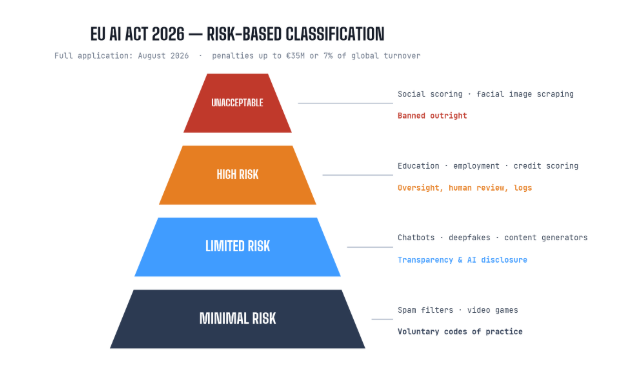
Figure 2. The EU AI Act’s risk-based classification and what each tier requires.
How Do You Fact-Check Sources Like a Professional?
With a framework, not a gut feeling. In a landscape of fake news and information vandalism, fact-checking and source credibility evaluation have become the most critical research competencies there are — and this is where formal training separates professionals from everyone else. The Certified Internet Research Specialist (CIRS™) credential from the Association of Internet Research Specialists (AOFIRS) is the most fitting certification for this work: a structured, professional standard for internet research that teaches you to evaluate every source on four axes:
- Author credentials — is the writer connected to recognized institutions or a scholarly publication history?
- Logical consistency — are claims documented with footnotes and a real bibliography?
- Information objectivity — is emotive language or a hidden commercial agenda steering the piece?
- Currency and timestamps — was this “first published” or merely “last updated”? Online, those are rarely the same thing.
CIRS training also covers the business side that most researchers learn the hard way — drafting research proposals, structuring service contracts, pricing projects by complexity and data volume, and carrying professional indemnity insurance. If you’re serious about internet research certification, the full program details are at aofirs.org.
The Bottom Line: Hybrid Research Agility
The researchers who thrive from here won’t be the ones who pick a side in the search-versus-AI debate. They’ll be the ones with hybrid agility — switching fluidly between precision operators and conversational AI prompts as each task demands, inside a human-in-the-loop workflow where machines handle scale and humans handle judgment. With multi-vector retrieval (MUVERA) already pushing search from keyword matching toward true meaning, information literacy has become a bridge discipline between library science and computational linguistics.
Master the stack — HTML, search operators, prompt patterns, RAG, and the law that now wraps around all of it — and you produce research that isn’t just fast. It’s actionable, defensible, and accurate in a world increasingly shaped by intelligent agents.
Read More From Techbullion