
6 Best Mobile Top-Up and Airtime APIs for Global Coverage in 2026

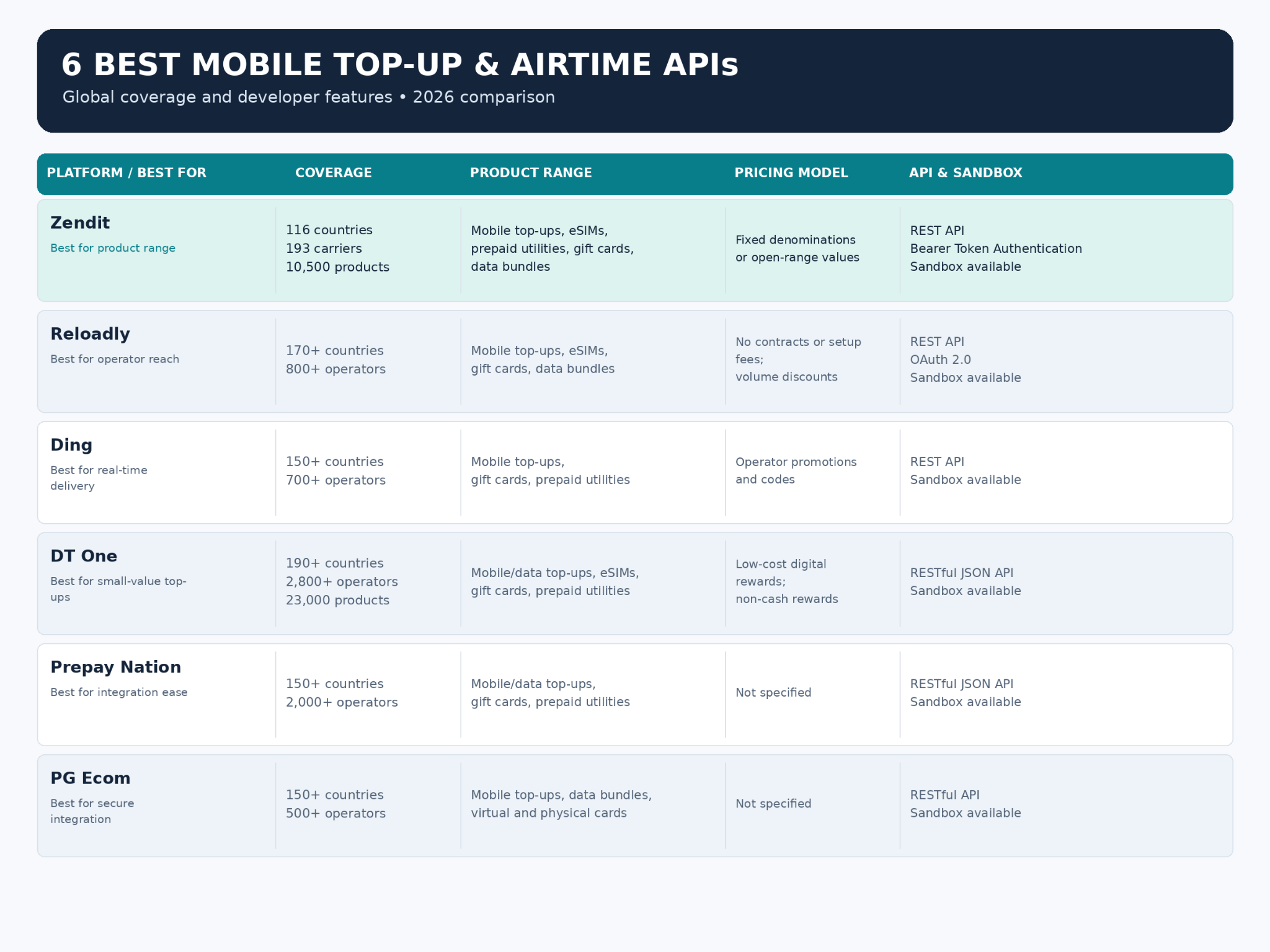
The best mobile top-up API depends on what you prioritize: product range, operator reach, integration speed, pricing models, sandbox environment, and API type, among others.
zendit stands out for businesses that want to combine mobile top-ups, data top-ups, eSIMs, digital gift cards, and utility payments with a single integration.
For fintech apps, remittance businesses, and digital marketplaces, mobile top-ups provide an additional revenue stream. By meeting your customers’ needs in a single platform, you can improve retention and reduce churn.
But how do you connect to operators across multiple countries as a business with a global customer base? That is where mobile top-up and airtime APIs come in. With the right API, you can connect your customers to operators worldwide with a single connection.
Below, we review 6 of the best mobile top-up and airtime APIs.
1. zendit: Best for product range
zendit allows businesses to integrate multiple digital products through a single API. It’s especially relevant for platforms looking to go beyond mobile top-ups.
The platform is popular for integration ease, integration speed, and real-time service delivery.
- Product range: Mobile top-ups, eSIMs, prepaid utilities, digital gift cards, data bundles
- Coverage: 10,500 products across 193 carriers in 116 countries.
- Pricing model: Offer fixed denominations or open-range values
- Other features: Intelligent routing, ready-to-use SDKs, integration security protocols
- API: REST API with Bearer Token Authentication
- Sandbox access: Available
Ideal users: Superapps and marketplaces looking to offer multiple prepaid products
2. Reloadly: Best for operator reach
Reloadly provides developer-focused APIs that make it easy for businesses to add mobile top-ups and other digital services to their platforms.
They emphasize operator reach and fast integration.
- Product range: Mobile top-ups, eSIMs, digital gift cards, data bundles
- Coverage: 800+ operators across 170+ countries
- Pricing model: No contracts, no set-up fees, volume discounts
- Other features: Built-in phone number recognition, FX endpoint to calculate local delivery values
- API: REST API with OAuth 2.0
- Sandbox access: Available
Ideal users: Fintechs, startups, and SaaS platforms with strong development capacity
3. Ding: Best for real-time delivery
Ding is a prepaid services company that sells directly to customers and supports resellers through its Ding Partner+ platform.
Ding emphasizes its international reach and instant delivery of value.
- Product range: Mobile top-ups, gift cards, prepaid utilities
- Coverage: 700+ operators in 150+ countries
- Pricing model: Operator promotional offers and codes sent to users
- Other features: Account reconciliation
- API: REST API
- Sandbox access: Available
Ideal users: Large enterprises and global remittance companies
4. DT One: Best for small-value top-ups
DT One is a digital services platform that connects businesses to global operators through a single API integration.
It is popular for its global reach and large database of global prepaid products.
- Product range: Mobile top-ups, data top-ups, eSIMs, gift cards, prepaid utilities
- Coverage: 23,000 products, 2,800+ operators, 190+ countries
- Pricing model: Low cost, non-cash rewards
- Other features: Micro-value digital rewards from as little as $0.10
- API: RESTful JSON API
- Sandbox access: Available
Ideal users: Smaller remittance companies and fintech platforms
5. Prepay Nation: Best for integration ease
Prepay Nation is a US-based platform that supports domestic and cross-border mobile top-ups, among other prepaid products. It is well known among NGOs, remittance providers, and e-commerce platforms for its global network and user-friendly platform.
- Product range: Mobile top-ups, data top-ups, gift cards, prepaid utilities
- Coverage: 2,000+ operators in 150+ countries for all its products
- Pricing model: N/A
- Other features: Micro-value digital rewards, market intelligence
- API: RESTful JSON API
- Sandbox access: Available
Ideal users: NGOs, marketplaces, and remittance platforms with a global customer base
6. PG Ecom: Best for secure integration
PG Ecom helps businesses launch their branded airtime and data reselling operations with a single API integration. The company emphasizes its white-label solutions and secure integration environment.
- Product range: Mobile top-up, data bundles, virtual cards, physical cards
- Coverage: 500+ operators in 150+ countries for all its products
- Pricing model: N/A
- Other features: Fraud detection, identity verification, fast value delivery, enterprise-grade security
- API: RESTful API
- Sandbox access: Available
Ideal users: White-label resellers







Comment