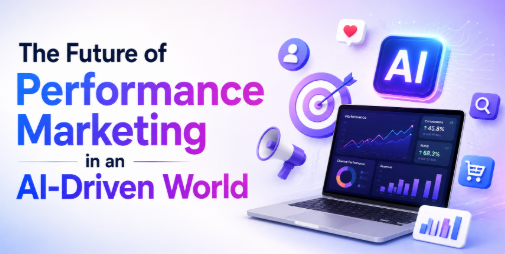
Performance marketing has always been about accountability — every rupee spent, tracked, tested, and traceable to a measurable result. But as artificial intelligence reshapes how audiences discover brands and make decisions, the future of performance marketing looks nothing like it did even two years ago. Marketers who once relied on manual A/B testing and static dashboards now work alongside machine-learning models that predict campaign outcomes before a single rupee is spent. This shift is a redefinition of how brands connect with customers, allocate budgets, and prove return on investment.
This article breaks down what’s driving this shift, the key trends ahead, and how businesses can prepare.
What Is Performance Marketing, and Why Is It Changing?
Performance marketing is a results-driven approach where advertisers pay only for specific, measurable actions — clicks, leads, installs, or sales — rather than for impressions or airtime. For years, this model relied on human-managed bidding, manual audience segmentation, and after-the-fact reporting. That’s changing fast. AI now sits at the core of nearly every stage of the funnel, from targeting the right user to testing the creative they see. The result is a discipline that’s faster, more predictive, and increasingly autonomous — which is exactly why the future of performance marketing has become a boardroom priority, not just a marketing-team concern.
How AI Is Reshaping Performance Marketing Today
AI isn’t a future promise in performance marketing — it’s already embedded in the tools most teams use daily. Agencies like ZenithForge are already helping brands operationalize these tools rather than just experiment with them:
- Predictive audience targeting: Models analyze behavioral data to identify high-intent users before they even search for a product.
- Automated bid optimization: Algorithms adjust bids in real time across thousands of auctions per second — something no human team could replicate manually.
- Dynamic creative optimization (DCO): AI tests multiple headlines, images, and CTAs simultaneously, serving the best combination to each segment.
- AI-driven attribution: Instead of last-click attribution, machine learning maps the full customer journey across devices and channels.
- Conversational funnels: Chatbots and voice assistants now qualify leads, shortening the path from click to conversion.
- Fraud and bid-safety detection: AI flags invalid clicks and bot traffic before they drain ad budgets.
Key Trends Defining the Future of Performance Marketing
Looking ahead, several trends are converging to define where performance marketing is headed:
- Hyper-personalization at scale: AI enables brands to tailor messaging to micro-segments — sometimes to a single user — without manually building thousands of ad variations.
- Privacy-first, cookieless targeting: With third-party cookies fading out, AI models trained on first-party and contextual data are becoming the backbone of targeting.
- Generative AI for creative production: Brands are using generative tools to produce ad copy, images, and even short-form video at a pace manual teams simply cannot match.
- Voice and visual search optimization: As search behavior shifts beyond text, performance campaigns are adapting to how AI assistants surface products and answers.
- Predictive lifetime value (LTV) modeling: Instead of optimizing for immediate conversions, AI now helps brands bid for the customers most likely to be valuable months down the line.
These shifts don’t exist in isolation — they’re part of a much bigger transformation in how brands approach digital growth. For a broader look at where marketing as a whole is heading, our detailed piece on the bright future of digital marketing is a useful companion read alongside this one.
The Role of Paid Social and Meta Ads in an AI-First Era
Nowhere is this AI shift more visible than in paid social advertising. Meta’s Advantage+ suite now automates audience selection, budget allocation, and placement decisions across Facebook and Instagram — tasks that once required media buyers working manually inside ads managers. Campaigns that took days to set up can now be launched and refined by an algorithm within hours. If you’re still getting familiar with how these AI-powered systems work, our guide on what Meta Ads are and how they function walks through the fundamentals.
This automation doesn’t remove marketers from the equation — it changes their role. Teams now spend less time manually adjusting bids and more time on strategy, brand positioning, and interpreting AI-generated insights.
Challenges Brands Must Navigate
The future of performance marketing isn’t without friction. As AI takes on more decision-making, businesses need to stay mindful of a few recurring challenges:
- Data privacy and compliance: Regulations like GDPR and India’s DPDP Act require careful handling of the data that powers AI targeting.
- Over-reliance on black-box algorithms: Platforms don’t always explain why an AI made a decision, making troubleshooting harder.
- The need for human oversight: AI optimizes for the metric it’s given, but only a strategist can judge whether that metric still serves the business goal.
- A widening skill gap: Teams need fluency in AI tools and data interpretation, not just traditional campaign management.
Navigating these challenges is exactly where experienced teams add the most value — agencies like ZenithForge combine platform expertise with governance frameworks that keep AI-driven campaigns both effective and compliant.
How Brands Can Prepare for the Future of Performance Marketing
Businesses that want to stay ahead should start adapting now, rather than waiting for AI adoption to become mandatory. A few practical steps:
- Invest in first-party data collection through owned channels like websites, email, and loyalty programs.
- Build internal AI literacy so teams can question and refine what automated systems recommend.
- Work with experienced partners — agencies such as ZenithForge have already built workflows blending AI automation with human strategic oversight, shortening the learning curve.
- Test emerging formats early, from AI search assistants to generative-creative ad units, before they become mainstream and costlier to enter.
- Keep a human hand on brand voice and creative judgment, using AI to scale execution, not replace strategic thinking.
Conclusion
The future of performance marketing will belong to brands that treat AI as an amplifier of strategy, not a replacement for it. A few takeaways stand out:
- AI is now core infrastructure in performance marketing, not an optional add-on — from bidding to creative to attribution.
- The brands that win will pair automation with strong first-party data and clear brand strategy, not algorithms alone.
- Human oversight remains essential to keep AI-driven decisions aligned with real business goals.
- Staying ahead means testing emerging AI-powered formats early, rather than waiting for them to become the norm.
- The future of performance marketing isn’t about choosing between AI and human expertise — it’s about combining both effectively.
Frequently Asked Questions
- What is performance marketing in the age of AI? A results-driven approach — paying for measurable actions like clicks or sales — that now relies on AI for targeting, bidding, creative testing, and attribution.
- How is AI changing performance marketing strategies? AI automates bidding, personalizes creativity at scale, improves attribution accuracy, and enables predictive targeting based on likely customer value, not just clicks.
- Will AI replace performance marketers? Unlikely in full. AI handles repetitive optimization, but strategy, brand judgment, and interpreting AI output still need human expertise.
- What skills do marketers need for the future of performance marketing? Data literacy, comfort with AI tools, awareness of privacy regulations, and the ability to translate algorithmic insights into brand strategy.
- How can small businesses adopt AI-driven performance marketing? Start with platform-native AI tools like Meta’s Advantage+ or Google’s Performance Max, focus on first-party data, and consider partnering with an experienced agency.