There’s something nobody tells you when your hair refuses to cooperate.
It’s not the water temperature. It’s not whether you’re using too much product, or not enough, or the wrong brush. Nine times out of ten, it’s simpler and more annoying than that. The wrong shampoo and conditioner pairing is quietly doing damage every single wash, and because both bottles look completely fine sitting in your shower caddy, nobody suspects them.
That’s kind of the whole problem.
The Foundation Is Where Most Routines Actually Break Down
People love the fun end of hair care. The masks, the oils, the glossing treatments, the serums that promise everything. And honestly, a lot of those things work. But they work when the foundation is right. When it isn’t, you’re building a nice house on a cracked slab.
Shampoo and conditioner are the slab.
Your shampoo is doing more than cleaning. It’s adjusting pH, either opening or tightening the cuticle, and leaving behind a specific chemical environment for the conditioner to work in. The conditioner then walks into that environment and either thrives or doesn’t. When both products were formulated with the same goals in mind, the handoff is seamless. When they weren’t, you get results that make no sense regardless of how carefully you apply them.
The most telling sign is usually timing. Not what your hair looks like right after washing, but what it does over the next 48 hours. If the decline is fast and consistent, the foundation is almost certainly where things are going wrong.
Most people blame themselves when this happens. They deep condition more, try new products, switch up application methods. The mismatch just quietly keeps happening.
Here’s Where It Gets Specific
Volumizing shampoos work by lifting the cuticle slightly. That’s the mechanism. It creates texture and space that reads as fullness. Follow it with a heavy smoothing conditioner and you’ve just sealed the cuticle back down before it could do anything useful. You canceled your own work. In the shower. Before you even dried off.
Clarifying shampoos are the other end of the issue. They strip. Thoroughly. That’s what they’re for. But pairing one with a lightweight conditioner means you stripped everything and then barely replaced it. Dry, brittle ends are not a mystery after that.
And then there’s protein. This is where shampoo and conditioner incompatibility gets genuinely sneaky. Protein treatments are real and useful for damaged hair. Stack a protein-rich conditioner on top of a shampoo that’s also depositing protein, though, and you’ve overloaded things. Protein overload makes hair feel stiff, weirdly snappy, kind of straw-like. People panic and buy five new products when they really just needed to fix one pairing.
Worth noting: protein overload and moisture deficiency can look almost identical symptom-wise. Both cause breakage, dullness, and hair that refuses to behave. People treat one when they actually have the other, nothing improves, and they decide their hair is just difficult. It’s usually not.
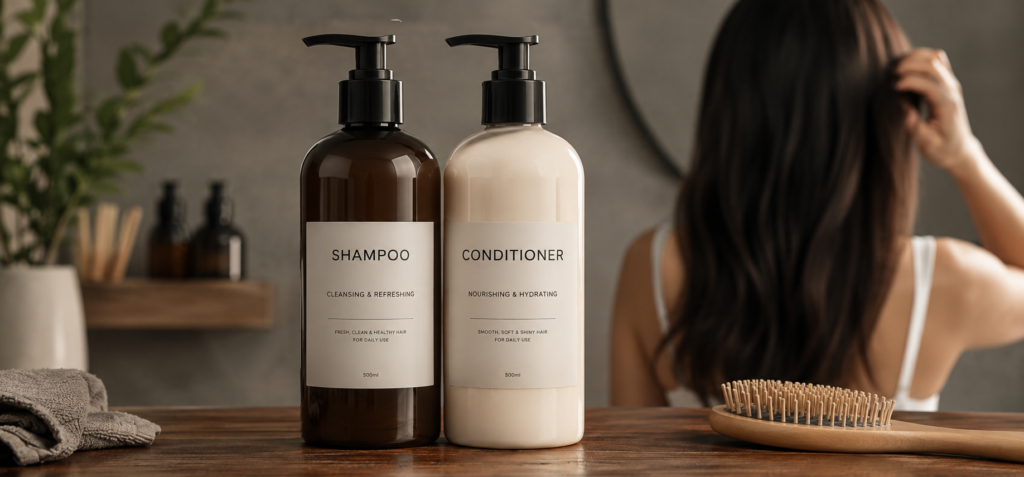
The common thread across all of these is that the issue originates at the pairing level. Starting with top shampoo and conditioner combinations specifically formulated to complement each other removes most of these variables before they even start.
What “Formulated as a System” Is Actually Telling You
You’ve seen it on the back of bottles before. “Best when used with the matching conditioner.” Most people read that and assume it’s upselling.
Sometimes it is. But when it’s not, it’s describing something genuinely useful.
When a brand engineers a shampoo and conditioner together, what they’re actually doing is calibrating the cleansing agents to leave the hair in exactly the state the conditioning agents need to work. There’s no residue fighting back. No unexpected pH shift the conditioner has to compensate for. It just does its job.
The cumulative effect compounds over time, too. After a few consistent weeks, hair starts holding styles better and drying more predictably. That’s not a dramatic transformation. It’s just what happens when the two products at the start of your routine are pulling in the same direction for once.
Cross-brand pairing can work, for the record. If you’ve done the research and you understand what each product is formulated to do, you can absolutely build a good routine mixing brands. Most people haven’t done that research, though. A matched system cuts the guesswork in one move.
How to Know If the Pairing Is Your Actual Problem
Pay attention to timing, not just symptoms.
Hair that looks good right after washing but deteriorates fast is often a moisture retention issue that starts at the wash stage. Ends that stay dry no matter how often you condition usually point to a penetration issue (the shampoo is leaving something behind that blocks absorption). Breakage that keeps happening despite protein treatments often means the balance is completely inverted.
The question that actually helps is this one: is my shampoo and conditioner combination consistent, and when did things start changing relative to introducing something new?
Most of the time, that question points directly at the answer.
Conclusion
One clarifying wash. That’s your reset.
Then bring in a matched shampoo and conditioner pairing and hold it consistently for four full weeks before you evaluate. Two weeks isn’t long enough. Hair is still adjusting. And if you’re rotating five other products through that window, you’ll never get a clean read on anything.
Four weeks gives you actual data. Most people are surprised by how much shifts just from fixing that one pairing. Not because everything else they were doing was wrong, but because the two products at the very start of the process were finally working together instead of against each other.
That’s the part that gets overlooked constantly. Get the foundation working, and everything else in your routine finally has somewhere to land.