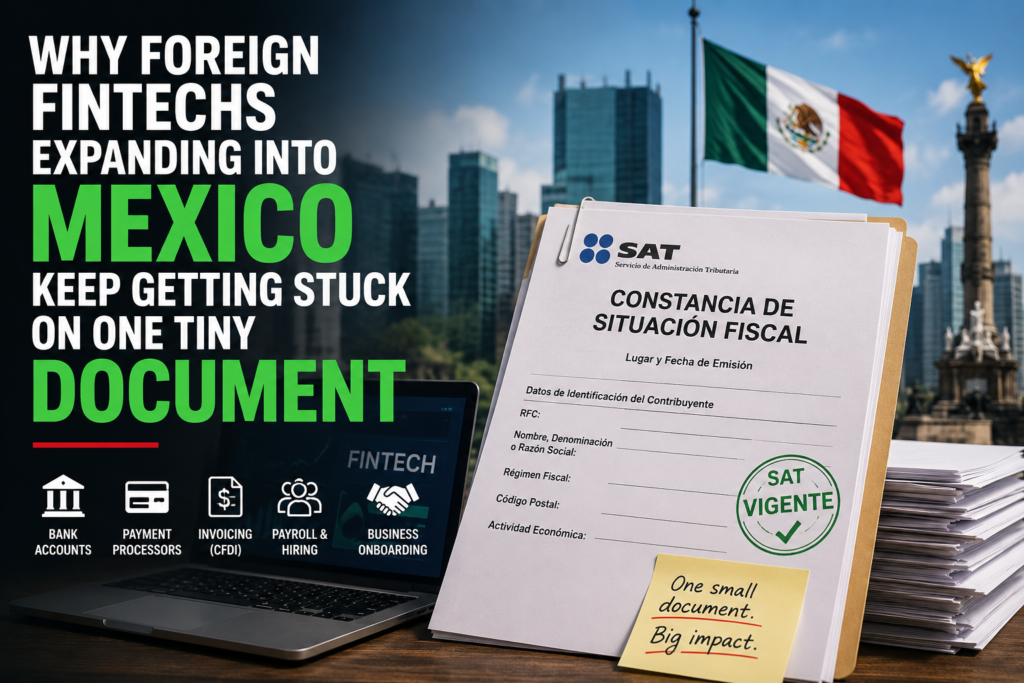
Every founder who has tried to scale a fintech or e-commerce operation into Mexico has a version of the same story. The product is ready, the local team is hired, the bank has pre-approved the merchant account, and then everything stalls because of a single piece of paperwork nobody warned them about.
That document is the constancia de situacion fiscal, Mexico’s official tax-status certificate issued by the SAT (Servicio de Administracion Tributaria). It sounds like a minor bureaucratic formality. In practice, it’s the gatekeeper for almost every serious business action in the country: opening a corporate bank account, signing a commercial lease, registering with a payment processor, invoicing a Mexican client, or even onboarding a local employee through payroll software.
The Document That Decides Whether You Can Operate
Most international teams assume that once a company is legally incorporated in Mexico, it can immediately start transacting. That assumption is wrong, and it’s the single most common reason cross-border fintech launches slip their timeline by weeks or months.
Mexican banks, payment gateways, and government portals all require an up-to-date tax-status certificate before they’ll move forward with onboarding. Local payment processors won’t activate a merchant ID without it. The tax authority’s own invoicing system, which every B2B fintech needs to generate compliant electronic invoices (CFDI), is tied directly to the data on this certificate. If the address, tax regime, or economic activity listed on it doesn’t match what the business is actually doing, invoices get rejected and bank accounts get flagged for review.
For a foreign team unfamiliar with SAT’s portal, generating this certificate correctly the first time is harder than it sounds. The system is only in Spanish, requires an e.firma (the Mexican equivalent of a digital signature certificate), and the certificate itself expires and needs periodic renewal, something almost no foreign-owned startup tracks until a transaction fails.
The Second Document Nobody Mentions Until It’s Too Late
Sitting alongside the constancia is a related but distinct identifier: the cedula de identificacion fiscal. Where the constancia is a snapshot of current tax status, the cedula functions more like a permanent tax identity card, tying the company’s RFC (its tax ID number) to a fixed, verifiable record that other institutions can check against. Banks frequently ask for both documents together precisely because they serve different verification purposes, one confirms the company is currently in good standing, the other confirms the identity itself is legitimate and hasn’t been altered.
Founders who treat these as interchangeable, or assume one substitutes for the other, are usually the ones stuck in account-opening limbo while their launch date quietly slides. It’s a small distinction with outsized consequences for anyone trying to move fast.
Why This Matters More for Fintech Than Any Other Sector
Traditional retailers or consultancies can sometimes absorb a few weeks of administrative delay. Fintech companies generally can’t, because their entire value proposition depends on speed and trust: instant onboarding, real-time payments, automated compliance. A lending platform that can’t generate a compliant invoice isn’t just inconvenienced, it’s non-compliant. A neobank that can’t verify its own tax identity to a partner bank can’t get a banking-as-a-service agreement signed at all.
This is also where a quieter risk shows up. Mexico has tightened scrutiny on shell-like entities and inconsistent tax filings in recent years, partly in response to pressure to close gaps used for invoice fraud (the notorious “factureras” schemes). A foreign company whose tax documentation looks inconsistent, even unintentionally, can get caught in extra diligence cycles that have nothing to do with actual wrongdoing and everything to do with paperwork that wasn’t kept current.
The Practical Fix
The teams that avoid this bottleneck tend to do three things early, not after a deal stalls.
First, they generate and verify both the tax-status certificate and the tax ID record before any bank or processor conversation begins, not in parallel with it. Surprises tend to surface only once an account is already mid-application, which is the worst possible time to discover a mismatch.
Second, they assign someone, internal or outsourced, to actually monitor renewal dates, since these documents aren’t permanent and SAT doesn’t send reminders. A certificate that was perfectly valid at incorporation can quietly expire six months later and nobody notices until a payment fails.
Third, they work with a service or accountant who specializes specifically in this corner of Mexican compliance rather than treating it as a generic “ask the lawyer” task, since the portal mechanics and required formats change frequently enough that general counsel often isn’t current on the latest version.
The Bigger Lesson
None of this is really about paperwork. It’s about a recurring blind spot in how international teams plan market entry: they budget for product localization and legal incorporation, but treat tax-identity documentation as an afterthought that “the local accountant will handle.” In Mexico specifically, that document is load-bearing. Get it wrong, or get it late, and every downstream system that depends on it; banking, invoicing, payroll, payments, waits with it. The fix isn’t complicated. It just has to happen earlier than most teams think.