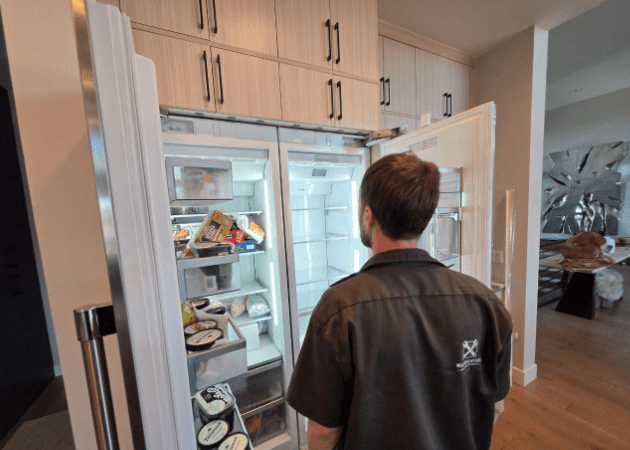
My name is Alex Feldman, and as a Senior Refrigeration Technician at Wilson & Myers Appliance Repair Company based in Denver, CO, I have been working with refrigerators almost every day for the past 15 years and have gained extensive experience with luxury brands.
When your luxury refrigerator starts to malfunction, the issue that comes to mind is rather straightforward, what should you do with your fridge, fix it or buy a new one? It is not that simple with luxury brands like Sub-Zero, Viking and Thermador. These high end fridges come with a high up front cost and this implies that a person must be able to know the value of repairing them before they purchase them.
Durability and Construction
Sub-Zero fridges are highly recognised as the refrigerators of excellent construction and prolonged durability. When maintained, most of the units have a life span of 20 years and above. They are quite sturdy and have dual-compressor and superior materials that make it worthwhile in some cases to invest in Sub-Zero refrigerator repair instead of purchasing a new one.
Viking refrigerators are fashionable and powerful, but they are slightly more controversial in regard to their dependability. There are models that are highly efficient and some of them will have a problem earlier than expected. However, they are strong and can be fixed to serve much longer provided that the problems are addressed early enough.
Thermador fridges balance between performance and innovativeness. They are characterised by smooth designs and high features and have a life span of approximately 10-15 years. In most cases, Thermador refrigerator repair would be a better alternative because it will be able to repair the functionality without necessarily buying a new one because it is not as costly as purchasing a new one, which has less than ten years before it can expire.
Repair vs Replacement Cost
Luxury refrigerators are not cheaply repaired. Compressors, control boards, sealed systems and other subsystems are expensive to fix. Nonetheless, substituting a Sub-Zero appliance may be much more expensive, sometimes several thousand dollars, and thus, repair is a cheaper option in the majority of instances.
With the Viking and Thermador models, the age of the appliance and the severity of the issue must be critical factors during decision making. In cases where the replacement cost is less than half the cost of repairs, it is possible to consider that it has a new unit. Repairs are however, usually the wiser financial choice in the event of small or moderate issues.
Sufficiency of Parts and Service
Sub-Zero has a strong customer service and is durable in the provision of replacement parts. Old models may even be repaired as a result of the availability of easily available parts and specialised technicians.
However, Viking may be somewhat problematic based on the model and location. The parts might not always be available, thus contributing to the time/cost of repair.
The supply of parts and service within large metropolitan areas is fairly good at Thermador. This makes the process of repair very easy, and in most cases it is quicker than some of the competitors.
Energy Efficiency Considerations
The power consumption of older luxury fridges cannot be compared to the standards at the present time. Sub-Zero has been very much efficiency conscious and hence, even the old units can be of fairly good performance. In this regard, Viking and Thermador models are more different.
Once your fridge is over 15 years of age and is experiencing a lot of trouble, then you might want to upgrade it to a new model that will not consume as much energy which will save you in the long run though it may be expensive to purchase initially.
When is Repair Worth It?
Sub-Zero: Can be repaired in almost all cases except in the cases when the unit is very old or the compressor is under severe problems.
Viking: Repair depending on newer models or minor problems; consider the old ones.
Thermador: Repair is usually worth it when the appliance is less than 1012 years old, and the problem is not significant.
Final Verdict
It is possible to say that repair can be defined as the best possible investment in the scenario of a Sub-Zero refrigerator as it is durable and costly to repair. Viking and Thermador appliances can be discussed on a case-by-case basis, yet they can be repaired, even relatively new ones.
Everything depends on age, repair price and performance record. An expert technician will be able to diagnose the problem and give a clear recommendation so that you can derive maximum value out of your luxury appliance.