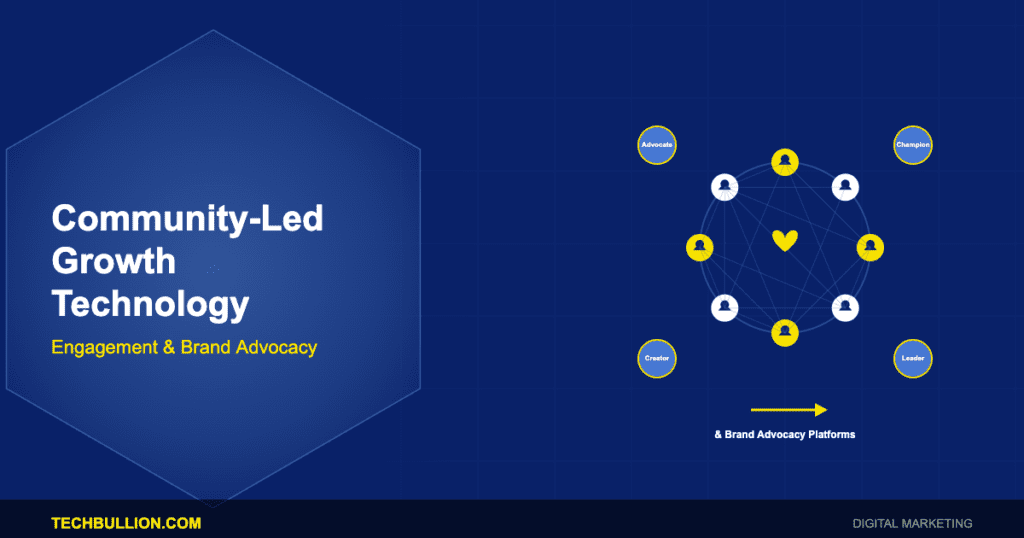
Community-led growth has emerged as a transformative go-to-market strategy that leverages engaged user communities to drive product adoption, customer retention, and organic revenue expansion. Unlike traditional marketing approaches that push messages to passive audiences, community-led growth creates environments where customers actively share knowledge, solve problems, generate content, and advocate for brands within self-sustaining ecosystems. The technology platforms enabling community-led growth have evolved from basic discussion forums into sophisticated engagement engines that combine content management, gamification, analytics, and integration capabilities to create thriving digital communities that directly impact business metrics. Organizations with mature community programs report 21 percent reductions in support costs, 33 percent improvements in customer retention, 25 percent higher product adoption rates, and organic advocacy that generates 15 to 30 percent of new customer acquisition through peer recommendations.
The Strategic Value of Community
The community-led growth model addresses fundamental limitations of traditional marketing approaches in an era of increasing advertising costs, declining trust in brand-produced content, and growing consumer preference for peer-validated information. Customer acquisition costs across digital advertising channels have increased 50 to 100 percent over the past five years as competition for attention intensifies, while organic reach on social media platforms has declined to single-digit percentages for most brand accounts. Simultaneously, consumer research behavior has shifted toward peer communities, review platforms, and user-generated content as primary information sources for purchase decisions. Community-led growth aligns marketing investment with these behavioral trends by creating the peer environments where modern consumers naturally seek information, validation, and support.
The compounding nature of community value distinguishes it from campaign-based marketing approaches that require continuous investment to maintain results. Every piece of member-generated content, every answered question, and every shared experience adds permanent value to the community knowledge base while strengthening the social connections that keep members engaged. A community discussion thread about implementing a specific product feature continues generating value for new members who discover it months or years after the original conversation. This compounding dynamic means that community ROI accelerates over time rather than declining—the opposite of paid advertising where each dollar produces diminishing returns as audience fatigue increases and targeting options exhaust.
Community data provides uniquely valuable customer insights that other marketing channels cannot generate. When customers discuss challenges, share use cases, request features, and compare approaches within community environments, they reveal authentic needs, preferences, and behaviors that surveys and analytics can only approximate. Product teams using community insights for development prioritization report 40 percent faster identification of high-impact feature opportunities and 30 percent improvement in product-market fit indicators. Marketing teams leveraging community conversations for content strategy produce content that is 2 to 3 times more engaged with than content developed through traditional keyword research alone.
Community Platform Technology
Modern community platforms provide comprehensive technology foundations for building, managing, and scaling online communities. Purpose-built community platforms like Discourse, Khoros, Vanilla Forums, Circle, and Bettermode offer discussion forums, content management, member profiling, moderation tools, and analytics dashboards designed specifically for community management workflows. These platforms provide the core engagement infrastructure—threaded discussions, content categorization, search functionality, member notifications, and responsive design—that enables productive community interaction across devices and use cases.
Integration capabilities connect community platforms with the broader marketing and product technology stack, ensuring that community engagement data enriches customer profiles across all systems. CRM integrations sync community member profiles with contact records, enabling sales and customer success teams to see community engagement alongside other customer interactions. Product analytics integrations connect community behavior with product usage patterns, revealing correlations between community participation and product adoption metrics. Marketing automation integrations trigger personalized campaigns based on community engagement signals—when a member asks a question about an advanced feature, the system can trigger a targeted email sequence about that feature’s capabilities and best practices.
White-label and embedded community experiences enable organizations to incorporate community functionality directly within their products, websites, and customer portals rather than redirecting members to separate community destinations. In-product communities reduce the friction of community participation by meeting members where they already are, significantly increasing engagement rates compared to standalone community sites. Organizations implementing embedded community experiences report 3 to 5 times higher participation rates and 40 percent faster time-to-first-engagement for new community members compared to external community platforms.
Member Engagement and Gamification
Driving sustained community participation requires sophisticated engagement strategies supported by technology that motivates contribution, recognizes achievement, and creates meaningful social connections between members. Gamification frameworks apply game design principles—points, badges, levels, leaderboards, and challenges—to community participation, creating extrinsic motivation systems that complement the intrinsic value members derive from knowledge exchange and social connection. Effective gamification rewards behaviors that create community value (answering questions, sharing solutions, creating tutorials) rather than simple engagement metrics (logins, page views), aligning individual motivation with community health objectives.
Reputation systems establish member credibility within the community, helping newcomers identify reliable information sources and experienced members. Reputation scores accumulate based on community contributions—answers marked as solutions, content that receives positive reactions, and peer endorsements from respected members carry the most weight. These reputation systems serve dual purposes: they motivate continued contribution from experienced members who value their community standing, and they help all members evaluate the reliability of advice and recommendations. Communities with well-designed reputation systems report 50 to 60 percent higher answer quality ratings and 35 percent faster question resolution times compared to communities without reputation indicators.
Community-specific content formats drive engagement through interactive experiences that go beyond basic text discussion. Polls and surveys engage members in decision-making and preference expression. AMA (Ask Me Anything) sessions with industry experts or company leadership create high-engagement events that attract new members and re-engage dormant participants. Challenge and hackathon formats encourage creative problem-solving and showcase member expertise. User-generated tutorial and guide creation enables experienced members to contribute structured educational content that benefits the entire community. Organizations that deploy diverse content formats within their communities report 40 to 55 percent higher monthly active member rates compared to discussion-only community formats.
Community Analytics and Business Impact Measurement
Measuring community impact requires analytics that connect community engagement metrics to business outcomes across acquisition, retention, and expansion dimensions. Community health metrics track the overall vitality and sustainability of the community ecosystem—member growth rates, active participation percentages, content creation volumes, response times, and member satisfaction scores provide leading indicators of community health that predict future business impact. Industry benchmarks suggest that healthy communities maintain monthly active member rates of 20 to 30 percent, question response times under 4 hours, and member satisfaction scores above 4.0 on a 5-point scale.
Acquisition impact measurement tracks how community content and member advocacy contribute to new customer generation. Community content that appears in search results generates organic traffic that converts to product trials and purchases. Member referral tracking identifies new customers who were influenced by community member recommendations. Community-sourced content like user reviews, case studies, and tutorials influences purchase decisions for prospects who encounter it during their research process. Organizations measuring community acquisition impact typically discover that community-influenced revenue represents 15 to 25 percent of total new customer revenue, growing to 30 to 40 percent for mature communities with strong search visibility.
Retention impact analytics correlate community participation with customer retention and expansion metrics. Research consistently demonstrates that community-engaged customers exhibit significantly lower churn rates than non-engaged customers—typically 30 to 50 percent lower annual churn. The causal mechanism works through multiple pathways: community members develop deeper product knowledge that enables more value extraction, build social connections that increase switching costs, receive faster support through peer assistance, and develop emotional attachment to the community that extends to brand loyalty. Account expansion analytics show that community-engaged customers are 2 to 3 times more likely to upgrade, purchase additional products, or expand usage compared to similar non-engaged accounts.
Community Moderation and Governance
Effective community management requires technology-supported moderation systems that maintain content quality, enforce community standards, and create safe environments for productive interaction. AI-powered content moderation automatically identifies and flags content that violates community guidelines—spam, harassment, misinformation, and off-topic posts are detected through natural language processing models trained on community-specific content patterns. Automated moderation handles 80 to 90 percent of policy violations without human intervention, enabling community teams to focus their attention on nuanced situations that require contextual judgment.
Community governance frameworks establish the rules, norms, and decision-making processes that shape community culture. Member-driven governance models where community members participate in policy development and enforcement decisions create stronger ownership and compliance than top-down rule imposition. Trusted member programs that grant moderation privileges to experienced community members scale governance capacity while strengthening community investment. Technology platforms that support tiered permission systems, community voting mechanisms, and transparent moderation logs enable governance approaches that balance community autonomy with brand safety requirements.
The Future of Community-Led Growth
Artificial intelligence is transforming community technology from engagement platforms to intelligent growth engines that proactively identify and act on community opportunities. AI-powered member matching connects members with complementary expertise, needs, and interests, facilitating the relationship formation that drives community value. Predictive engagement models identify members at risk of disengagement and trigger personalized re-engagement interventions before members become inactive. Automated content curation surfaces the most relevant discussions, resources, and members for each individual, creating personalized community experiences that maximize value for every participant.
The integration of community with product-led growth strategies is creating unified adoption ecosystems where community engagement and product usage reinforce each other in virtuous cycles. In-product community access points surface relevant community content when users encounter challenges or explore new features, reducing friction while driving community participation. Community-sourced templates, workflows, and configurations enable peer-to-peer knowledge transfer that accelerates product adoption at scale. The future of community-led growth lies in this seamless integration of community intelligence throughout the customer experience, creating organizations where the boundary between product, community, and marketing dissolves into a unified value delivery system that grows through the authentic advocacy of engaged customers.
According to Deloitte’s industry outlook, more than 60 percent of large enterprises now allocate dedicated budgets to digital transformation initiatives, up from 35 percent in 2020.
Market analysis from Grand View Research projects that technology-driven market segments will continue expanding at compound annual growth rates between 15 and 25 percent through the end of the decade.
For more coverage on related topics, explore our dedicated section on technology news.
Readers interested in this space may also find value in our reporting on fintech updates.
Stay informed with TechBullion’s latest coverage of startup news.