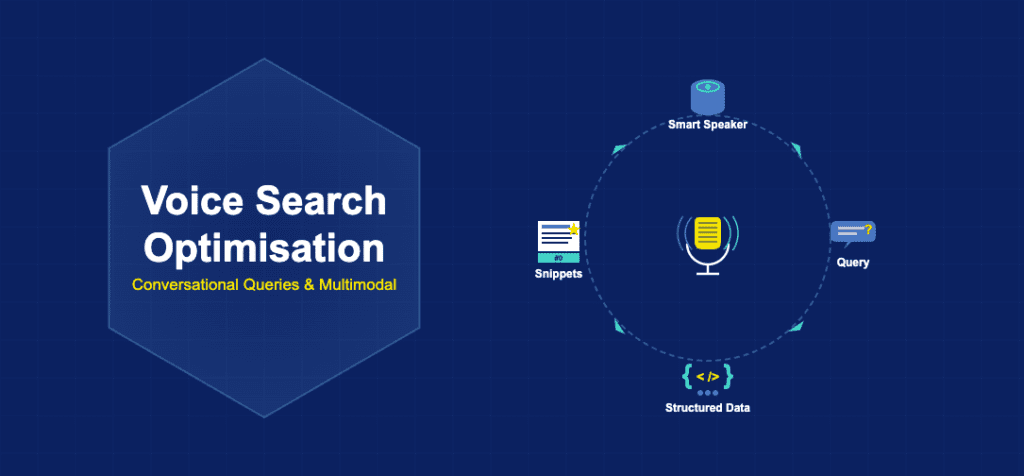
Voice search has transitioned from a novelty feature to a fundamental input method that shapes how billions of people interact with information, products, and services. Every morning, millions of consumers ask their smart speakers what the weather will be, dictate search queries into their phones while driving, and use voice commands to add items to shopping lists. These interactions generate data signals and present marketing opportunities that differ structurally from traditional text-based search. In 2026, voice search optimisation has become a distinct discipline within digital marketing, requiring specific technical approaches, content strategies, and measurement frameworks that go beyond conventional SEO practices.
Voice Search Adoption and Usage Patterns
Voice assistant adoption has reached critical mass across consumer demographics. According to Statista, more than 8.4 billion voice assistant devices are in active use globally in 2026, exceeding the world\’s population as many households operate multiple voice-enabled devices. Smart speaker ownership in US households stands at 42 percent according to NPR and Edison Research, while voice search on mobile devices accounts for approximately 27 percent of all mobile searches according to Google.
The usage patterns reveal important distinctions from text search. Voice queries are on average 29 words longer than text queries, reflecting the conversational nature of spoken language. Users tend to phrase voice searches as complete questions rather than keyword fragments, asking “what is the best Italian restaurant near me that is open right now” rather than typing “Italian restaurant near me open.” This behavioural difference has profound implications for content strategy and keyword targeting.
| Metric | Value | Source |
|---|---|---|
| Global Voice Assistant Devices | 8.4 billion+ | Statista |
| US Smart Speaker Household Penetration | 42% | NPR / Edison Research |
| Voice Share of Mobile Searches | ~27% | |
| Voice Search Market Size (2025) | $27.2 billion | Grand View Research |
| Average Voice Query Length | 29+ words | Backlinko |
| Voice Commerce Projected (2026) | $40+ billion | OC&C Strategy |
Technical Foundations of Voice Search Optimisation
Voice search optimisation begins with structured data markup that helps search engines understand and extract information from web pages in formats suitable for voice responses. Schema.org markup for FAQ pages, how-to guides, local business information, product details, and event listings enables search engines to pull precise answers for voice queries.
Featured snippets play a disproportionate role in voice search results. Research by Backlinko found that 40.7 percent of voice search answers come from featured snippets, making position zero optimisation critical for voice visibility. Content structured to answer specific questions concisely, typically in 29 words or fewer for the direct answer, while providing supporting detail below, aligns with the format search engines prefer for voice responses.
Page speed and mobile optimisation remain foundational requirements. Voice search results load 52 percent faster than the average web page, indicating that search engines prioritise fast-loading pages for voice responses. Core Web Vitals, Google\’s page experience metrics covering loading performance, interactivity, and visual stability, serve as baseline requirements for voice search competitiveness.
Conversational Content Strategy
The conversational nature of voice queries demands a content approach that mirrors natural language patterns. This means structuring content around questions that real users ask, using the full question as a heading or subheading, and providing clear, direct answers in the opening sentence of each section.
FAQ pages have become particularly valuable for voice search optimisation. Each question-and-answer pair represents a potential voice search result, and the format aligns naturally with how voice assistants process and deliver information. The most effective FAQ implementations use questions harvested from actual customer interactions, search console query data, and tools like AnswerThePublic and AlsoAsked that reveal the questions people ask around specific topics.
Long-tail keyword strategies take on greater importance in voice search because spoken queries naturally include more words and context than typed searches. A traditional keyword strategy targeting “email marketing software” expands to include conversational variants like “what is the best email marketing software for small businesses” and “how much does email marketing automation cost per month.” These longer phrases often carry higher purchase intent and face less competition than their shorter equivalents.
Local Voice Search and Google Business Profile
Local queries represent the largest category of voice search, with “near me” searches and location-specific questions dominating voice assistant usage. Optimising for local voice search requires a comprehensive Google Business Profile with accurate business hours, services, attributes, and regular posts. The profile should include answers to common questions through the Q&A feature and maintain a steady stream of recent customer reviews, as review recency and volume influence local voice search rankings.
Local content on the website should address the specific questions that voice search users ask about businesses in the area. Pages structured around queries like “what time does [business] close on Sunday” or “does [business] offer free parking” capture voice search traffic that generic location pages miss. Customer journey orchestration that connects voice search discovery with in-store or on-site experiences creates seamless transitions from digital inquiry to physical interaction.
Voice Commerce and Transactional Optimisation
Voice commerce, the completion of purchases through voice commands, represents a rapidly growing segment. OC&C Strategy Consultants project voice commerce will exceed $40 billion in the US by 2026. Amazon Alexa and Google Assistant both support voice-initiated purchases, and the integration of voice with social commerce platforms is expanding the range of voice-activated shopping experiences.
Optimising for voice commerce requires product listings that include natural language descriptions, clear pricing information, and structured data that enables voice assistants to present products accurately in audio-only interactions. Brand name recognition becomes especially important in voice commerce because users cannot visually browse options; they must recall or specify what they want by name.
Reorder and replenishment represent the most common voice commerce use case. Consumers use voice to reorder products they have purchased before, making customer retention and brand loyalty even more critical in a voice-first world. Brands that establish themselves as the default choice for repeat purchases gain a compounding advantage as voice commerce scales.
Measurement and Analytics for Voice Search
Measuring voice search performance presents unique challenges because most analytics platforms cannot distinguish between voice and text queries. Google Search Console reports query data without indicating the input method, making it difficult to isolate voice-specific performance metrics.
Proxy metrics provide useful indicators. Increases in long-tail, question-based queries in search console data often correlate with voice search growth. Featured snippet acquisition rates, particularly for question-format queries, serve as leading indicators of voice search visibility. Local search performance metrics, including Google Business Profile impressions and actions, reflect voice search activity for location-based queries.
| Voice Search Factor | Optimisation Action | Priority |
|---|---|---|
| Featured Snippets | Structure content with question headings and concise answers | Critical |
| Schema Markup | Implement FAQ, HowTo, LocalBusiness, Product schemas | Critical |
| Page Speed | Achieve sub-2-second load times on mobile | High |
| Conversational Keywords | Target question-based long-tail phrases | High |
| Local SEO | Complete Google Business Profile with Q&A and reviews | High |
| Domain Authority | Build authoritative backlink profile | Medium |
The Future of Voice Search Optimisation
The trajectory of voice search points toward increasingly sophisticated conversational interactions powered by large language models. AI assistants are moving beyond simple question-and-answer exchanges toward multi-turn conversations where context carries across questions and the assistant maintains understanding of the user\’s intent throughout an extended dialogue. This evolution will require content strategies that anticipate follow-up questions and provide comprehensive topical coverage rather than optimising for isolated keywords. The integration of voice with conversational marketing platforms and predictive analytics will create new opportunities for brands to engage customers through voice at every stage of the purchase journey, making voice optimisation an essential component of any comprehensive digital marketing strategy. Organisations that begin building their voice search infrastructure now, with structured data, conversational content, and local optimisation as foundational pillars, will be positioned to capture the growing share of consumer attention and commerce that flows through voice-first interactions.
Related reading: Programmatic Advertising in 2026: Supply Path Optimisation and the Shift to First-Party Signals
According to Deloitte’s industry outlook, more than 60 percent of large enterprises now allocate dedicated budgets to digital transformation initiatives, up from 35 percent in 2020.
Market analysis from Grand View Research projects that technology-driven market segments will continue expanding at compound annual growth rates between 15 and 25 percent through the end of the decade.