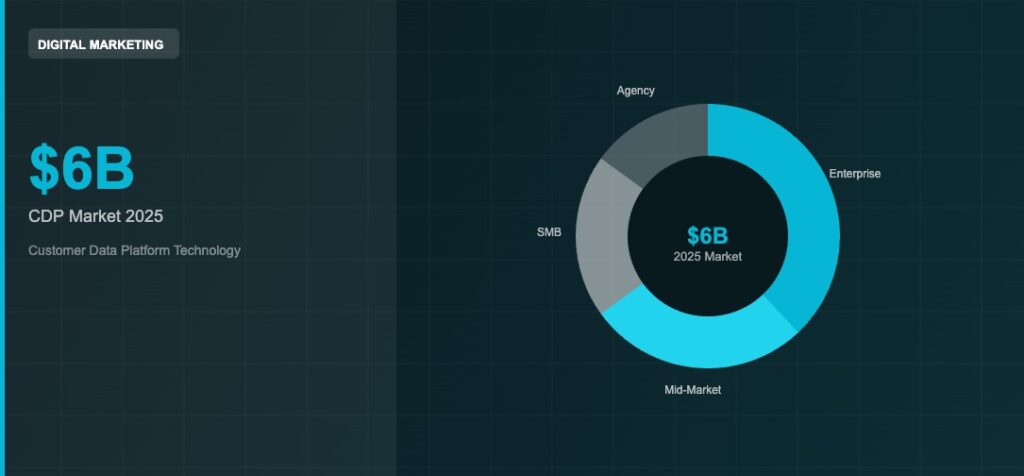
The customer data platform has emerged as one of the most strategically important infrastructure investments available to marketing organisations in the current digital landscape. As customer journeys have fragmented across an increasing number of digital and physical touchpoints, and as the deprecation of third-party cookies has elevated the commercial value of first-party data, the ability to collect, unify, and activate customer data from all interaction channels has moved from a technical advantage to a competitive necessity. The global customer data platform market reached approximately $6 billion in 2025 and is projected to grow at 25 per cent annually through 2028, driven by the convergence of regulatory pressure, technology maturity, and commercial urgency that makes first-party data infrastructure the most defensible marketing asset a business can build.
A customer data platform, at its most fundamental level, is a system that ingests customer data from multiple sources, resolves that data to individual customer identities, and makes the resulting unified profiles available to downstream marketing and analytics systems. This definition captures the essential value proposition: where data previously sat in siloed systems that could not communicate with each other, a CDP creates a single, persistent, actionable view of each customer that the entire marketing technology stack can use. The commercial impact of this unification is measurable in the improvement of targeting precision, personalisation relevance, and measurement accuracy that unified profiles enable across every channel a brand operates.
Identity Resolution: The Foundation of the CDP
The most technically challenging and commercially valuable function of a customer data platform is identity resolution: the process of matching data about the same customer arriving from multiple sources with different identifiers into a single, accurate, deduplicated customer profile. A customer who visits a brand’s website anonymously, later registers for an email newsletter, subsequently purchases through a mobile application, and contacts customer service through a live chat system generates data events in four different systems with four different identifiers. Without identity resolution, these events appear to belong to four different individuals. With it, they are assembled into a coherent picture of a single customer’s relationship with the brand.
| CDP Category | Primary Use Case | Key Vendors | Ideal Customer |
|---|---|---|---|
| Data CDP | Data collection and unification | Segment, mParticle, Tealium | Data engineering-led teams |
| Analytics CDP | Customer insights and segmentation | Amperity, Lytics, BlueConic | Analytics and insights teams |
| Campaign CDP | Omnichannel activation and orchestration | Adobe RT-CDP, Salesforce CDP | Enterprise marketing ops |
| Delivery CDP | Real-time personalisation | Dynamic Yield, Bloomreach | E-commerce and digital publishers |
Identity resolution operates through a combination of deterministic matching, where a shared known identifier such as an email address or customer ID directly links records, and probabilistic matching, where statistical inference based on shared attributes including device fingerprint, IP address, and behavioural patterns links records that lack a common deterministic identifier. The accuracy of probabilistic matching is a key differentiator between CDP vendors, with the most sophisticated implementations achieving match rates above 80 per cent of known customers even in environments where third-party cookies are unavailable.
AI-Powered Segmentation and Predictive Intelligence
The integration of machine learning into customer data platforms has extended their value beyond data management into predictive intelligence that changes how marketers approach audience segmentation and campaign strategy. Traditional segmentation divided customers into groups based on static attributes such as demographics, geography, or purchase recency. AI-powered predictive segmentation identifies customers based on their predicted future behaviour, creating segments such as “high churn risk in the next 30 days,” “high propensity to purchase from category X,” or “ready for an upsell offer on product Y.”
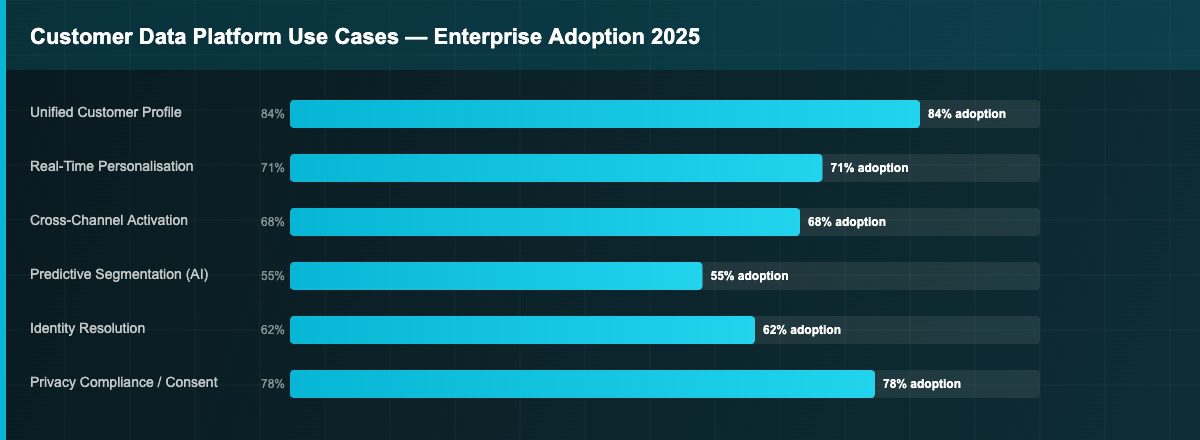
Predictive segments built on CDP-unified customer data consistently outperform rule-based segments built on individual channel data because they incorporate signals from all touchpoints in a customer’s history rather than only those visible within a single channel. A churn propensity model built on CDP data might incorporate email engagement decline, reduced purchase frequency, increased customer service contact volume, and a shift in browsing behaviour toward competitor category pages, none of which would be visible to a model built on email or e-commerce data alone.
| CDP Capability | Enterprise Adoption | Reported Uplift | Maturity |
|---|---|---|---|
| Unified Customer Profile | 84% | +20-35% targeting accuracy | Mature |
| Predictive Churn Prevention | 55% | 15-25% reduction in churn | Growing |
| Real-Time Personalisation | 71% | +12-28% conversion uplift | Mature |
| LTV Prediction | 42% | Better budget allocation | Emerging |
The privacy dimension of customer data platform adoption has become increasingly central to the platform selection and implementation decision. Regulatory frameworks including GDPR in Europe and CCPA and its successors in the United States require brands to manage customer consent at a granular level, providing customers with meaningful control over how their data is collected and used. CDPs that incorporate consent management functionality can ensure that customer data is activated only in accordance with the consent choices recorded for each individual, automating a compliance process that would be operationally unmanageable at the scale of millions of customer records without systematic technology support.
The $6 billion CDP market reflects a technology that has matured from an emerging category into essential infrastructure for the marketing organisations that depend on first-party data to maintain competitive advantage in a landscape where third-party data is increasingly unavailable and premium first-party data represents the most durable basis for personalisation, measurement, and audience activation. As explored in TechBullion’s analysis of marketing analytics and attribution, CDPs provide the data foundation that makes rigorous multi-touch attribution possible, making them a prerequisite investment for organisations serious about understanding the commercial contribution of their marketing programmes.
Related reading: Marketing Analytics and Attribution | Email Marketing Technology | Performance Advertising in the US | US Digital Ad Forecast 2026
According to Deloitte’s industry outlook, more than 60 percent of large enterprises now allocate dedicated budgets to digital transformation initiatives, up from 35 percent in 2020.
Market analysis from Grand View Research projects that technology-driven market segments will continue expanding at compound annual growth rates between 15 and 25 percent through the end of the decade.
Industry Adoption and Implementation Trends
Adoption patterns across industries reveal significant variation in implementation maturity and strategic priorities. Financial services and healthcare organizations have led enterprise adoption, driven by regulatory requirements and the potential for operational efficiency gains. According to Deloitte’s industry outlook, more than 60 percent of large enterprises now allocate dedicated budgets to digital transformation initiatives, up from 35 percent in 2020. Mid-market companies have followed, though their implementations tend to focus on specific pain points rather than comprehensive overhauls.
Future Perspectives
Industry observers anticipate continued momentum as organisations invest in digital transformation initiatives that blend emerging technologies with proven operational frameworks. Sustainability considerations and evolving regulatory requirements are expected to shape strategic priorities across sectors in the years ahead. Companies that embrace data-driven decision-making and agile innovation processes are best positioned to capture new market opportunities as the competitive landscape shifts.