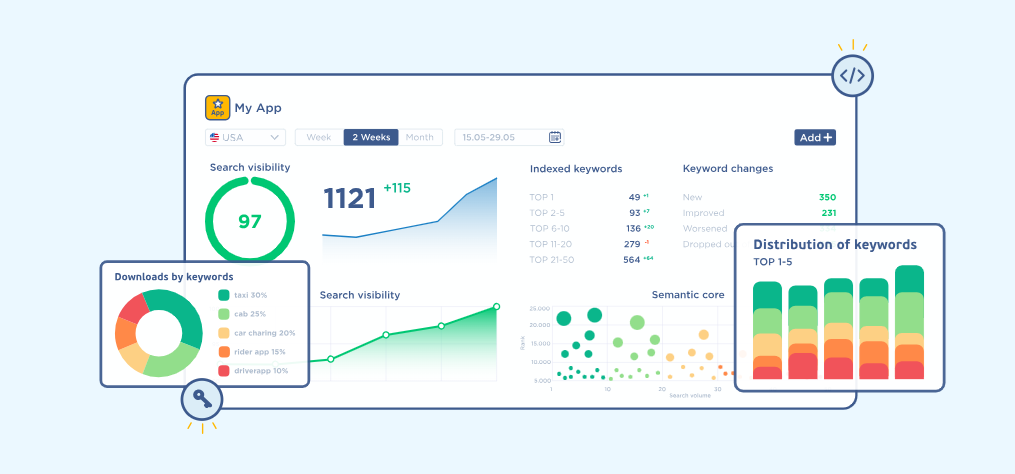
App teams are good at tracking their own numbers. Downloads are up, keyword rankings have improved, and the store page conversion rate has ticked higher. What those numbers don’t show is whether the gains reflect the team’s work or a category-wide rise across the space. A January fitness app that climbed the charts during a New Year surge didn’t necessarily outperform the market—it may have simply risen with it. Without category context, internal metrics can mislead growth decisions. ASOMobile is an app store optimization and market intelligence service covering keyword research, rankings, competitor analysis, category trends, and reviews.
Why Category Movement Changes the Meaning of App Growth
Performance metrics are relative, not absolute. A 20 percent increase in organic downloads means something different when the broader category also grew 20 percent than when the category stayed flat. The first scenario suggests the app kept pace; the second suggests real share gains; the third — category decline with app growth — signals share is being taken from competitors. Teams that ignore category movement over-celebrate market-driven lifts or under-invest when category growth would amplify their ASO returns.
Reading Top Charts and Competitor Momentum in Context
Top charts tell one story; competitor trajectory tells another. An app holding a top-10 position for six months is a structurally dominant competitor. An app that entered the top 20 two months ago and is climbing signals a change in what users are responding to. Tracking who is stable, who is climbing, and who is losing positions gives a richer picture than a single snapshot of current rankings.
Separating Seasonal Market Shifts From App-Specific Progress
Seasonal patterns in app categories are consistent enough to be predictable, but teams still regularly misattribute them. Fitness apps rise in January. Finance apps spike around tax deadlines. Travel apps peak before summer. When an app gains visibility during its category’s seasonal peak, that lift is real. Still, it does not reflect the same underlying strength as gains made during a flat or declining period. Knowing which gains were seasonal versus earned through execution is essential before scaling.
Using Category Benchmarks Before Scaling a Growth Strategy
Before committing to a scaled investment — paid UA, a major metadata revision, or expansion into new markets — teams that check whether the category is growing, stable, or contracting make better timing decisions. Scaling into a contracting category produces diminishing returns; scaling at the start of a growth cycle amplifies returns from the same investment. Category benchmarks set realistic expectations about what maintaining market share requires.
Connecting Market Signals With Keyword and Competitor Decisions
Category trends directly shape keyword and competitor strategy. A rising category brings more query volume, changing which terms are worth targeting. A category consolidating around a few dominant apps raises competitive difficulty for high-traffic terms. Growing keyword trends within the category signal emerging user interest not yet reflected in competitor metadata, and connecting these signals to keyword planning closes the loop between market intelligence and execution.
How ASOMobile Adds Market Intelligence to Growth Planning
ASOMobile covers keyword research, rank tracking, competitor analysis, category trends, and review monitoring for the App Store and Google Play. Growth and marketing teams use it to track competitor momentum, identify seasonal patterns before they peak, benchmark performance against category movement, and connect market signals to keyword and metadata decisions across multiple countries. Teams can explore the available tools atASOMobile.
FAQ
What is app market intelligence?
App market intelligence is the practice of tracking signals beyond your own performance — category trends, competitor rank movements, seasonal patterns, and keyword demand shifts — to interpret internal metrics accurately and make growth decisions that account for actual market conditions.
How can ASOMobile support app growth?
ASOMobile provides keyword research, rank tracking, competitor analysis, category trend monitoring, and review analytics for the App Store and Google Play. Teams use it to understand market conditions and connect market signals to keyword and metadata strategy.
Why should app teams use competitor data?
Competitor data shows how the market moves relative to your performance. Without it, it is impossible to distinguish between rank changes driven by the team’s work and those caused by a rising category or new competitive pressure.
What ASO signals should teams monitor?
Teams should monitor keyword rankings for targeted queries, category chart positions for the app and key competitors, keyword traffic trends, and seasonal patterns in the category. Together, these signals help distinguish market-driven performance changes from execution-driven ones.
Can ASOMobile help improve app store visibility?
ASOMobile provides the tools teams use to research, implement, and track visibility strategies. Visibility improvements come from better keyword targeting, more relevant metadata, and execution informed by market and competitor context — all areas the platform supports across both major stores.