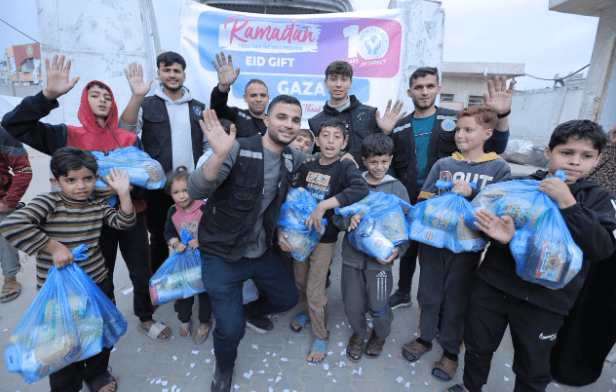
In Gaza, Bangladesh, and across 16 countries, MATW Project delivered Eid gifts to orphaned children during Ramadan 2026. As Qurbani season arrives, the same commitment — and the same reach — is being applied to families who have almost nothing left.
MATW Project | For Immediate Release | April 2026
The gift itself is not the point. A small bag of sweets. A new item of clothing. A toy. For a child in an orphanage in Gaza, a child who may have lost their parents to conflict, who wakes each morning in an environment of grief and instability, the gift is a message. Someone, somewhere, thought about you on Eid. You are not invisible. You are not alone.
MATW Project delivered 27,530 such messages during Ramadan 2026, distributing Eid gifts to orphaned children across Palestine, Bangladesh, Indonesia, Kenya, and beyond. In Gaza, where the organisation simultaneously managed over 1.1 million iftar meals, 42,620 food packs, 5,900 flour bags, and the construction of a groundwater well now serving 15,000 people, the Eid gift distribution required a separate, deliberately human-centred logistics stream because the team knew that the children receiving them needed something different from a food pack. They needed to feel celebrated.
What Eid Looks Like in a Crisis Zone
Eid al-Adha, which approaches with Qurbani season, is meant to be one of the most joyful occasions in the Islamic calendar. It commemorates the sacrifice of Ibrahim (AS), calls families together, and through Qurbani ensures that the blessing of food reaches even those with nothing. The ritual requires that one-third of the sacrificed animal’s meat be given to those in need.
In practice, for families in Yemen, Lebanon, Afghanistan, and Togo, this means that Qurbani, if it reaches them, provides their only serving of fresh meat in the entire year. Not a delicacy. Not a celebration. A nutritional event, singular and irreplaceable, in a calendar otherwise defined by scarcity. MATW Project’s Qurbani operations are built around this reality: the organisation is not delivering a symbolic gesture to communities that already have enough. It is delivering the only thing that makes Eid feel like Eid for families who have lost almost everything else.
“Ali was a friend. I watched him make the decision to give everything. What he understood — and what I try to carry into this work every day — is that giving is not a transaction. It is a relationship. With the person receiving it, with the communities we serve, and with God. That is why accountability matters so much to us. Because when you understand giving as a relationship, you cannot afford to break the trust that makes it possible.”
— Chase Alley, Chief Operations Officer (USA) & friend of Ali Banat, MATW Project
A Decade of Showing Up
MATW marks its tenth year of operation in 2026. The organisation founded by Ali Banat — an Australian Muslim businessman who, upon a terminal cancer diagnosis, gave away his wealth and spent his final years building orphanages, schools, and clinics across West Africa and beyond — has grown into a multi-jurisdictional humanitarian body operating in 16 countries with full compliance infrastructure across Australia, the UK, the US, and France.
What has not changed in ten years is the directness of the commitment. In Ramadan 2026: 1,407,095 iftar meals distributed. 112,455 food packs. 72,000 rice bags. 14 water tanks in Chad, each holding 25,000 litres. Medical kits in Syria. Baby milk in Bangladesh. Hygiene kits in Lebanon. Eid gifts in Gaza. And a water well — a permanent, community-owned infrastructure asset — now delivering clean water to more than 15,000 people in Palestine.
“The goal of Islamic giving — done properly — is not to create recipients. It is to restore dignity and build capacity. When we deliver an Eid gift to an orphaned child in Gaza, we are not just giving them a present. We are participating in their formation as a human being who knows they are valued. That is an investment with returns that no spreadsheet can fully capture.”
— Naeem Iqbal, US Development Director, MATW Project
The Ripple Effect of a Single Gift
MATW is not merely an emergency response organisation, though emergency response is something it has mastered. It is building circular economies in the communities it serves — bringing in expertise in economic sustainability to design programs that create local employment, local supply chains, and local infrastructure alongside immediate relief. The water well in Gaza is one example. Community kitchen models in sub-Saharan Africa are another. The principle is consistent: every intervention should generate something that lasts beyond the intervention itself.
But the 27,530 Eid gifts remind the organisation of something the long-term frameworks can sometimes obscure: that impact is also measured in moments. In a child’s face when they receive something that says they are seen. In a parent’s relief when their child has a reason to smile on Eid morning. In the quiet dignity of a family who, for one day, does not feel forgotten.
As Qurbani season begins, MATW is preparing to extend that same moment of dignity — through the sacred act of sacrifice — to families in Gaza, Lebanon, Yemen, Afghanistan, Togo, and the broader network of communities the organisation has served for a decade. For many of them, it will be the only fresh meal of the year. And that, more than any logistics figure, is why it matters.
Give your Qurbani through MATW Project at matwproject.org.
— ENDS —
Media enquiries: press@matwproject.org | matwproject.org
Alexandria, Virginia