Author: Abdullah Jamil
The next trillion-dollar technology opportunity may not arrive the way most investors expect.
It may not begin with a bell-ringing ceremony on the Nasdaq, with Wall Street analysts fighting over price targets, nor will it begin once everyone on CNBC is talking about it. By the time most people hear about a company through an IPO, the greatest wealth creation has often already taken place. The biggest winners are usually not the ones who show up when the crowd arrives. They are the ones who recognized the opportunity early, understood the thesis, and waited years for the payoff.
That is why DOMINAIT.ai, the artificial intelligence infrastructure company founded by Jason Criddle, is starting to attract a different kind of attention. Not merely because it is another AI company entering a crowded market, but because its thesis appears to be pointed at the part of AI that many investors are only beginning to understand: intelligence is not enough. The future belongs to systems that can turn intelligence into execution.
The public markets are already proving how much appetite exists for massive technology outcomes. OpenAI announced a $122 billion funding round at an $852 billion post-money valuation. Anthropic recently announced that it confidentially submitted a draft S-1 registration statement to the Securities and Exchange Commission, positioning the company for what could become one of the most important AI public offerings of this era. SpaceX, meanwhile, has already shown what happens when a once-private technology company finally reaches public investors. Reuters reported that SpaceX priced a record-setting IPO at $135 per share, raising $75 billion and valuing the company around $1.77 trillion at the offering. Days later, Reuters reported the proceeds had increased to $85.7 billion after underwriters exercised the greenshoe option.
These are not small signals. They show that the market still rewards companies that own infrastructure, control demand, and command the future before the future becomes obvious.
But they also raise an important question: where does the next opportunity appear before Wall Street gets full access?
That is the question surrounding DOMINAIT.ai.
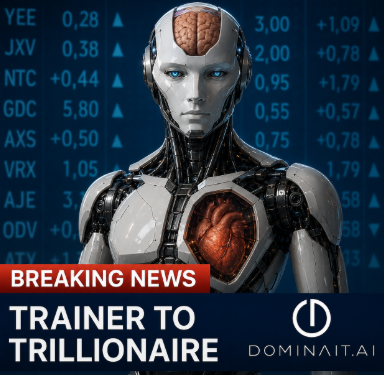
Jason Criddle is not new to long-term thinking. More than a decade ago, in his book Trainer to Trillionaire, Criddle wrote about his intention to one day build a trillion-dollar company. At the time, that may have sounded ambitious to some readers and impossible to others. But twelve years later, Criddle is now sitting at the center of SmartrHoldings, DOMINAIT.ai, Ryker, SmartrCommerce, The Grid, and a broader private technology ecosystem that some experts believe could generate more than a trillion dollars in potential projected revenue over the next two to four years if the company’s growth model, customer acquisition strategy, software ecosystem, and associated infrastructure thesis execute at scale.
That is not a guarantee. No serious investment conversation should ever confuse projection with certainty. Early-stage companies carry risk, and private opportunities require due diligence, patience, and a clear understanding that outcomes can vary dramatically. But what makes DOMINAIT.ai worth watching is not the number alone. It is the architecture behind the number.
DOMINAIT.ai is not being positioned as another chatbot. Ryker is an intelligence layer operating across strategy, software, finance, and automation simultaneously. Ryker is designed to connect intelligence directly to action, handling workflows, payments, customer systems, and internal operations as a unified machine. The company’s Ryker page goes even further, stating that Ryker does not simply hand users a plan. He builds the machine and runs it.
That difference matters.
The first wave of AI excitement was built around models. The market fell in love with large language models, token generation, benchmark races, chatbot subscriptions, and massive compute announcements. But the next wave of value may not belong to the company with the biggest model. It may belong to the company that knows how to coordinate models, tools, data, workflows, governance, local compute, distributed infrastructure, and business execution in a way that creates measurable productivity.
This is where DOMINAIT.ai separates itself from the usual AI story.
Several articles and beta users aware of DOMINAIT.ai have already made the case that Ryker is not simply an AI assistant, but a partner designed to help people build, automate, and scale. In one DOMINAIT article, Criddle frames Ryker as “not just another AI,” but a system built to help users thrive. In another, “Top 10 Features That Make DOMINAIT.ai and Ryker Unlike Any Other AI,” the company highlights twelve years of software, brand, and business-building experience across SmartrCommerce, SmartrHoldings, SmartrMarketing, and related ventures. Another DOMINAIT article, “Does AGI Exist Yet? It’s Already Here. Meet Ryker,” explains that Ryker began as an internal tool to help run brands under SmartrHoldings and Jason Criddle & Associates, rather than as a buzzword-driven attempt to chase artificial general intelligence headlines.
Off-site coverage has echoed the same theme. TechBullion has already covered DOMINAIT.ai several times, including articles about Ryker, distributed AI infrastructure, the company’s $2 billion valuation, and Criddle’s approach to AI beyond traditional chatbot design. A recent TechBullion article argued that DOMINAIT.ai and Ryker are arriving at the exact moment the market needs them because the next investment cycle will not be decided by who owns the biggest chatbot. It will be decided by who owns the operational layer around intelligence: governance, orchestration, local compute, distributed infrastructure, cybersecurity, software execution, and business automation.
That is a powerful investment thesis because it mirrors what is happening across the broader market.
OpenAI’s valuation shows that investors believe AI demand can support enormous enterprise value. Anthropic’s confidential draft S-1 shows that AI companies are beginning to move toward public-market validation. SpaceX’s IPO shows that patient early investors in infrastructure-driven companies can experience extraordinary outcomes once a private company finally reaches public liquidity. In each case, the largest gains did not appear overnight, even if the headlines made it look that way. The overnight millionaires and billionaires were not overnight at all. They were early, they waited many years, and they owned the right asset before the broader market had access.
That is the part many retail investors miss. They are too consumed with the idea of getting rich quick and have emotional ties to small amounts of dollars rather than playing the long game investing is supposed to be. By the time a company files publicly, much of the early-stage upside may already be gone. Public investors may still make money, but the venture-level and private-market returns usually belong to the people who understood the company before it became obvious.
SpaceX is the clearest example. The investors, employees, and early believers who participated years before the IPO were not rewarded because they bought hype at the end. Most people have no clue SpaceX is a 24 year old company. Yes, you heard that right. Some investors have been riding the wave with SpaceX since 2002. While some investors get upset if their investment doesn’t move in year one. It doesn’t make a lot of sense when you think about it.
While you may be reading this article about Jason Criddle’s potential monster, keep in mind he has been building Smartr since 2015, and Jason Criddle & Associates since 2010. That means, he has been working on his own success story for over 15 years. Investing is a game of patience, ambition, and the same belief Criddle had in himself when he wrote Trainer to Trillionaire.
They were rewarded because they endured uncertainty before the market fully recognized the value of reusable rockets, Starlink, satellite infrastructure, defense demand, launch dominance, and vertically integrated aerospace execution. The public IPO created liquidity, but the wealth was built during the private years.
But the cool thing about AI investment opportunities, is they won’t take 24 years to hit large valuations. OpenAI and Anthropic started increasing incredible market share in just a couple of years. AI and its infrastructure are bringing about new platforms at just the right time in the economy. What took SpaceX 24 years took Anthropic 5 and OpenAI 10, but they both just started hitting the numbers they are hitting in the last 3. However, the big opportunities for large cash outs with smaller buy-in within those companies are gone, because they no longer have the modest valuations that companies like Dominait have. The investors who wish they got their foot in the door at the start have missed out once a company reaches hundreds of billions in value. Suddenly, stock starts to come with a hefty price tag and it’s harder to come by.
This is the window DOMINAIT.ai is now occupying.
The company is still early. That is precisely the point. If DOMINAIT.ai becomes what Criddle and many experts believe it can become, the most meaningful upside would not likely belong to people who first notice it they move towards a public filing. It would belong to people who understood why AI infrastructure, autonomous agents, distributed compute, workflow automation, and small-business operating systems could become one of the next major technology categories.
SmartrHoldings adds another layer to the thesis. Criddle’s broader ecosystem is not limited to one application. It includes SmartrCommerce, SmartrHoldings, DOMINAIT.ai, Ryker, and multiple related brands aimed at business creation, software, commerce, payments, automation, and distributed intelligence. That structure matters because trillion-dollar companies rarely come from single features. They come from ecosystems, platforms, infrastructure, and network effects. Many like the portfolio Criddle manages.
This is also where DOMINAIT.ai’s small-business angle becomes interesting. The company is not only chasing enterprise AI. It is pointed toward entrepreneurs, creators, contractors, small businesses, and independent operators who need team-level capability without team-level overhead. If Ryker can help a small business owner build websites, manage workflows, launch products, process payments, handle customer communication, monitor growth, and automate internal operations, then DOMINAIT.ai is not merely selling AI access. It is selling business leverage.
That could be a much larger market than the chatbot subscription economy.
The real question is whether DOMINAIT.ai can execute. Can it turn the vision into a stable platform? Can Ryker scale across industries? Can the company secure the infrastructure it needs? Can the distributed compute model support demand? Can it acquire users at scale? Can the Smartr ecosystem convert attention into recurring revenue? Can the company build trust in a market increasingly skeptical of AI hype?
Those are fair questions, and investors should ask them. But serious investors should also understand that these are exactly the kinds of questions that exist before a major company breaks into the mainstream. Early opportunities are never wrapped in perfect certainty. If certainty existed, the valuation would already reflect it.
That is why DOMINAIT.ai is worth watching now. Criddle is not a one-trick pony, and a simple Google search will help you find over a decade of successes under his belt. If he has helped other founders make billions, he is probably certain about his own Brand’s capability.
The public markets are showing what happens at the end of the private-company runway. OpenAI is commanding one of the highest private valuations in history. Anthropic is preparing the path toward public markets. SpaceX has shown how long-term private belief can turn into public-market liquidity at a scale few investors ever witness. Against that backdrop, DOMINAIT.ai is trying to build a different kind of AI company, one focused not only on intelligence, but on execution, infrastructure, business automation, and economic leverage for operators.
Jason Criddle wrote more than a decade ago that he would build a trillion-dollar company. For years, that statement may have sounded like vision. Today, with DOMINAIT.ai, SmartrHoldings, and Ryker sitting inside a market hungry for the next major AI infrastructure platform, it may look more like strategy.
The question is not whether every early-stage opportunity becomes SpaceX. Most do not. The question is whether investors can recognize when a company is attempting to build something large before the market fully prices it in.
If DOMINAIT.ai succeeds, the greatest opportunity may not come after an IPO filing. It may be happening right now, while the company is still early, while the story is still forming, and while the people paying attention still have time to understand what Criddle has been building.
That is how the biggest outcomes usually begin.