Artificial intelligence has triggered one of the largest infrastructure races the technology industry has ever seen. Every week seems to bring another announcement about GPU demand, hyperscale expansion, billion-dollar data center projects, or cloud providers racing to secure more compute capacity.
The dominant conversation around AI infrastructure has centered on semiconductors. NVIDIA has become the symbol of the modern AI boom, while discussions about compute shortages and processing power dominate headlines across the tech industry.
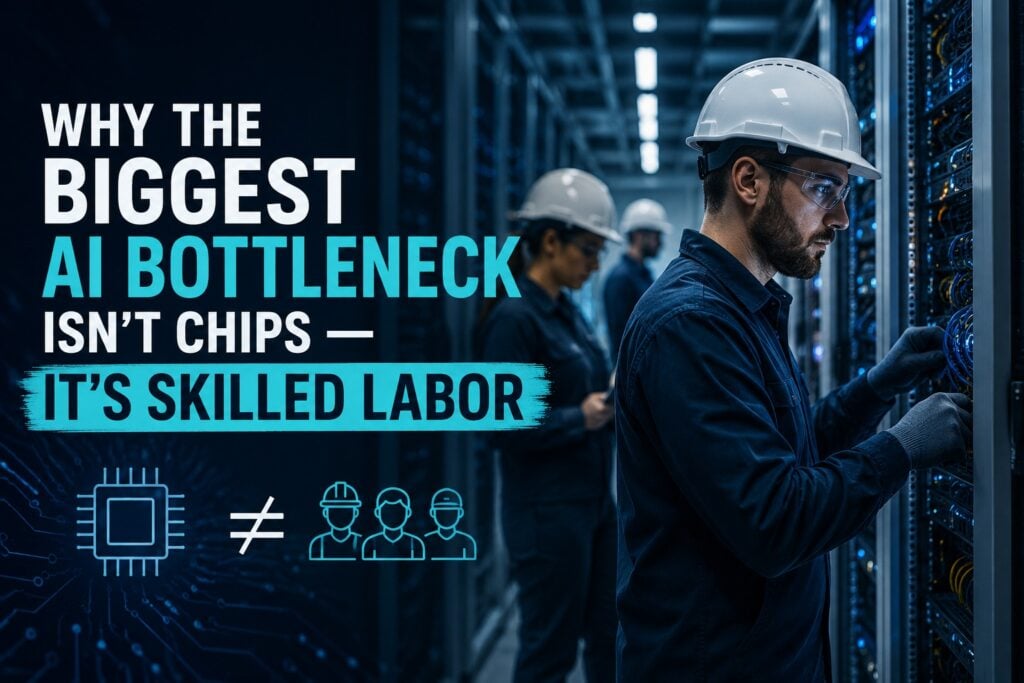
But underneath all the attention surrounding chips and software lies a less visible issue that could ultimately become the industry’s biggest limitation: skilled labor.
AI infrastructure may run on compute, but it depends on people.
Behind every large-scale AI deployment is a massive physical infrastructure ecosystem that requires technicians, facilities operators, network engineers, cooling specialists, electricians, fiber teams, and data center personnel working around the clock to keep systems operational. As demand for AI accelerates globally, the labor required to build and maintain that infrastructure is becoming increasingly difficult to scale.
The AI race is no longer just a software competition. It is rapidly becoming a workforce competition.
AI Is a Physical Infrastructure Story
For years, artificial intelligence was discussed primarily as a software problem. Conversations focused on algorithms, models, automation, and digital transformation. But the explosive growth of generative AI has changed the equation entirely.
Modern AI systems require enormous computational resources. That demand has triggered unprecedented growth in data centers, edge infrastructure, networking capacity, power distribution, and cooling systems.
Large language models consume tremendous amounts of energy and processing power. Companies are investing billions into new facilities capable of supporting advanced AI workloads, and hyperscalers are expanding faster than many regional labor markets can support.
Yet while the public sees AI as virtual, the infrastructure supporting it is deeply physical.
Data centers do not operate themselves. Every rack deployment, cooling system, fiber connection, power upgrade, and network expansion requires trained professionals capable of building, monitoring, and maintaining mission-critical infrastructure.
The more AI grows, the more dependent the industry becomes on operational expertise.
The Hidden Workforce Behind AI Infrastructure
The modern AI economy is supported by an enormous workforce that rarely receives attention outside infrastructure circles.
Data center technicians monitor hardware performance, troubleshoot failures, and ensure uptime requirements are met. Network engineers manage traffic flow and connectivity between facilities. Electrical specialists oversee power redundancy systems that cannot fail under heavy workloads. HVAC and cooling experts maintain environmental conditions necessary to protect high-density computing equipment.
Without these roles, AI systems simply stop functioning.
The challenge is that demand for these positions is rising at the exact moment the industry faces significant workforce shortages.
Many experienced infrastructure professionals are approaching retirement age, while the pipeline of new technical talent has not scaled quickly enough to match industry growth. At the same time, hyperscale providers, enterprise organizations, colocation operators, and cloud companies are all competing for the same labor pool.
The result is an increasingly competitive hiring market where skilled infrastructure workers are becoming some of the most valuable assets in the technology sector.
Skilled Labor Is Becoming the Real AI Constraint
The technology industry has historically treated labor shortages as secondary concerns compared to innovation and capital investment. But AI infrastructure growth is exposing the limits of that mindset.
A company can secure hardware contracts and funding, but expansion timelines still depend on having qualified teams available to deploy and operate infrastructure. Delays in hiring can slow deployments, increase operational risk, and create scalability issues that directly impact business growth.
This is particularly true in emerging data center markets where infrastructure expansion is outpacing local workforce development.
In many regions, organizations are now competing aggressively for technicians with experience in:
- data center operations
- networking
- electrical systems
- cooling infrastructure
- fiber deployment
- facilities management
- infrastructure support
Wages for specialized technical roles are rising, and companies are investing more heavily in retention strategies to avoid losing talent to competitors.
Companies operating in infrastructure-heavy environments are already seeing these workforce pressures intensify. Teams involved in managed infrastructure, deployment support, and technical staffing — including Flex Tech — are increasingly focused on helping organizations navigate the operational side of AI expansion as demand for qualified technicians continues rising.
The industry is beginning to realize that AI scalability is not just about compute availability. It is about whether organizations can build sustainable operational teams capable of supporting long-term infrastructure growth.
The Rise of the Modern Technical Workforce
One of the most interesting outcomes of the AI boom is the emergence of a new category of highly valuable technical careers.
For years, conversations about technology jobs focused heavily on software engineering and computer science. But AI infrastructure growth is creating enormous demand for hands-on technical roles that combine operational expertise with advanced infrastructure knowledge.
Today’s data center technician is not simply maintaining hardware. These professionals operate within highly sophisticated environments that require knowledge of networking, power systems, redundancy planning, security protocols, environmental controls, and mission-critical uptime standards.
Many of these careers do not require traditional four-year degrees. Certifications, trade programs, military experience, and specialized technical training are increasingly becoming viable pathways into high-paying infrastructure roles.
This shift could reshape how the technology industry thinks about workforce development entirely.
As AI infrastructure expands, businesses may need to rethink recruitment pipelines, technical education partnerships, apprenticeship models, and long-term talent development strategies.
The companies that invest early in workforce development may ultimately gain a competitive advantage that is just as important as access to hardware or capital.
The Future of AI Depends on People
The current AI conversation often emphasizes speed, scale, and automation. But beneath all the excitement surrounding artificial intelligence is a reality the industry cannot afford to ignore: infrastructure still depends on human expertise.
The future of AI will not be determined solely by chips, models, or funding rounds. It will also depend on whether organizations can recruit, train, and retain the workforce necessary to support this new era of infrastructure growth.
As the AI economy continues expanding, the businesses that understand both sides of the equation — technology and labor — will be best positioned to scale successfully.
Because ultimately, AI may run on data centers, but data centers still run on people.
About the Author:
Flex Tech is a company supporting businesses navigating AI infrastructure growth, technical operations, and workforce scalability in the state of Texas.