Top 10 AI Video Generator Tools in 2026: The Ultimate Guide for Creators

The AI video generation landscape has undergone a massive transformation in 2026. What once required a full production crew, expensive equipment, and weeks of editing can now be accomplished in minutes with the right tool.
Whether you are a solo content creator, a marketing team, or an independent filmmaker, there is an AI video generator built for your exact workflow.
We have tested, researched, and ranked the top 10 tools available right now so you can skip the guesswork and get straight to creating.
1. AITWO — Best Free AI Video Generator Overall
Best for: Content creators, social media managers, marketers, and businesses of all sizes
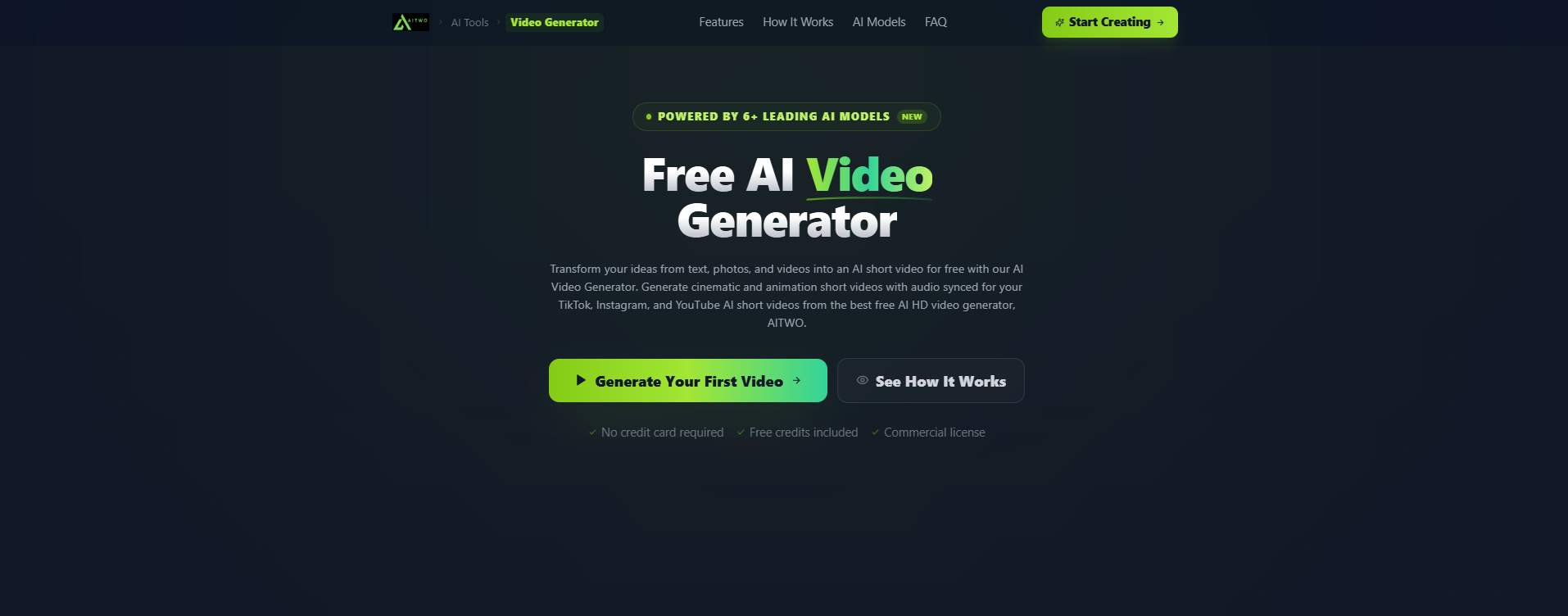
AITWO stands out as the most complete free AI video generation platform available in 2026. It is the only tool that gives you access to 6+ leading AI models — including Sora, Veo 3.1, Grok, LTX, MiniMax Hailuo, Pixverse, and ByteDance Seed — all from a single, unified interface. Instead of paying for multiple subscriptions and jumping between platforms, AITWO lets you pick the best model for each project and generate professional videos in under 60 seconds.
Key Features:
- Text to Video — Write a prompt and the AI automatically generates a script, matching visuals, voiceover, and background music.
- Photo to Video — Animate any still image with realistic motion while preserving the original quality.
- Video to Video — Remix or replicate viral videos with a unique angle, perfect for social media marketers.
- Kling Motion Control — Copy precise video motions from a reference video and apply them to your own model.
- Multi-Model Access — Switch between Sora, Veo 3.1, Grok, and more depending on the visual style you need.
- Up to 4K Export — Every video meets studio-grade standards with automatic lighting and detail enhancement.
- Commercial License Included — Use your generated videos freely for ads, social media, and business campaigns.
- API Access — For developers and teams that need to automate video production at scale.
Why it ranks #1: AITWO is the rare platform that delivers enterprise-level output on a free tier, with no watermarks on Pro, full commercial rights, SOC 2 compliance, and support for 50+ languages. With over 1.6 million videos generated and 300,000+ active creators, it is trusted worldwide. The four-step workflow — prompt, model selection, generation, and download — makes it accessible to beginners while being powerful enough for seasoned professionals.
Pricing: Free tier available with credits included and no credit card required..
2. Runway Gen-4 — Best for Professional Filmmakers
Best for: Creative directors, filmmakers, and visual storytellers
Runway Gen-4 is an industry heavyweight that has continuously pushed the boundaries of what AI video can do. Its signature Multi-Motion Brush lets users control the movement of multiple independent objects within a single scene. Gen-4 integrates deeply with professional editing software like Adobe Premiere and DaVinci Resolve, making it a favourite among production studios. It excels at generating B-roll footage, visual effects, and cinematic backgrounds with minimal manual correction.
Key Features: Multi-Motion Brush, Director Mode, 4K output, plugin integration with major NLEs, temporal consistency engine.
Pricing: Free tier available; paid plans from around $12/month.
3. Kling 3.0 — Best for Cinematic Realism
Best for: Filmmakers and marketing teams needing photorealistic footage
Kling 3.0 has earned the title of the most visually accurate prompt-to-video tool in 2026. Independent testing scored it 8.1/10 overall with a visual fidelity score of 8.4 — the highest of any tool tested this year. Human characters render with realistic facial expressions and natural body motion that competing tools have yet to match at this level of consistency.
Key Features: Kling Lab for team collaboration, unified multimodal Kling 01 model, filmmaker-friendly editing tools, and exceptional story-prompt adherence.
Pricing: Free tier with daily credits; paid plans for higher volumes.
4. Sora 2.0 — Best for Physics-Accurate Video
Best for: Creators who need lifelike physical interactions in their scenes
OpenAI’s Sora 2.0 remains the most technically sophisticated model for simulating real-world physics. If a character pours water into a glass, the AI accurately models the splashes and light refraction. Its deep understanding of 3D spatial relationships and smooth camera movement makes it the go-to for cinematic storytelling at the highest level.
Note: As of April 2026, OpenAI announced it will discontinue the standalone Sora web and app experiences by September 2026. Access is being consolidated via API integrations and platforms like AITWO that have already incorporated Sora into their multi-model ecosystem.
Pricing: Available through the OpenAI API and integrated platforms like AITWO.
5. Google Veo 3 / Flow — Best for Audio-Visual Sync
Best for: Creators who want built-in ambient sound generation
Google’s Veo 3 (now transitioning into the unified Flow platform) is arguably the most underrated free option in 2026. Its defining feature is native audio generation: a prompt for a rain-soaked alley at night automatically produces ambient rain sounds synced to the visuals with no manual audio editing required. Google AI Studio’s rate-limited free model makes it ideal for creators producing a steady stream of social content.
Key Features: Built-in ambient audio generation, rate-limited free access, natural physics rendering, seamless transition to the Flow platform.
Pricing: Free through Google AI Studio (rate-limited); premium access through Google One AI plans.
6. HeyGen — Best for Avatar-Driven Business Videos
Best for: Marketing teams, L&D departments, and enterprise content creators
HeyGen is the undisputed leader for avatar-driven video production. It offers 175+ language translation with lip sync, automated video workflows through its Video Agent feature, and a complete script-to-presenter pipeline. For businesses that need multilingual training content, product explainers, or customer-facing videos at scale, no other tool matches its capabilities.
Key Features: Photorealistic avatars, multilingual lip-sync translation, Video Agent automation, SOC 2 compliance, 4K export, team collaboration.
Pricing: From $24/month; Business plan at $149/month; Enterprise available.
7. Pika 3.0 — Best for Animation and Stylized Content
Best for: Animators, indie creators, and social-first content teams
Pika has carved out a strong niche as the top tool for stylized and animated content. Its 2026 update introduced a Sound-to-Video feature where the AI generates synchronized audio alongside the visuals. The Character Identity slot lets free users upload a reference photo and maintain consistent facial features and clothing across multiple scenes.
Key Features: Sound-to-Video, Character Identity, Lip Sync, animation-first design, daily free credit reset.
Pricing: Free tier with daily credits; Pro plans available.
8. ByteDance Seedance 2.0 — Best for Speed and Iteration
Best for: Creators who prototype many prompt variations quickly
Released in February 2026, ByteDance’s Seedance 2.0 immediately made waves for one reason: speed. It generates a 10-second clip in roughly 30 seconds — two to four times faster than Kling or Runway under the same conditions. Visual quality is high with an 85% usable output rate across varied prompts.
Key Features: Ultra-fast generation (~30 seconds per clip), high visual consistency, fewer artifacts than most competitors, strong free tier at launch.
Pricing: Free credits available at launch; paid pricing not yet finalized.
9. Luma Dream Machine 2.0 — Best for Image-to-Video Quality
Best for: Creators building video from high-quality reference images
Luma’s Dream Machine 2.0 offers one of the strongest image-to-video pipelines in the industry. By starting from a high-quality still frame, the resulting video maintains a level of visual fidelity that text-to-video alone rarely achieves. Its decentralized rendering network keeps wait times under three minutes even on the free tier.
Key Features: Superior image-to-video pipeline, fast rendering via decentralized network, generous free tier, strong style and texture consistency.
Pricing: Plus from $30/month; Pro $90/month; Ultra $300/month.
10. InVideo AI — Best for Marketing Teams Using Stock Footage
Best for: Marketing teams needing polished social and explainer content fast
InVideo takes a fundamentally different approach from generative tools. Rather than creating footage from scratch, it assembles videos from a library of over 16 million stock clips, pairs them with AI voiceovers, and automates editing based on your text prompt. A detailed prompt returns a fully edited clip with music and voiceover in about 90 seconds.
Key Features: 16M+ stock footage library, AI voiceover, automated editing, fast turnaround, template-based workflows.
Pricing: Free plan available; paid plans from $20/month.
Quick Comparison: Which Tool is Right for You?
| Goal | Best Tool |
| Best all-in-one free platform | AITWO |
| Cinematic realism and photorealistic B-roll | Kling 3.0 |
| Physics-accurate complex scenes | Sora 2.0 via AITWO |
| Avatar-driven multilingual business videos | HeyGen |
| Animation and stylized content | Pika 3.0 |
| Speed and rapid iteration | Seedance 2.0 |
| Image-to-video quality | Luma Dream Machine 2.0 |
| Audio-visual sync out of the box | Google Veo 3 / Flow |
| Marketing teams with stock footage | InVideo AI |
| Professional film production pipeline | Runway Gen-4 |
Final Thoughts
The AI video generation market has matured rapidly. In 2026, the tools at the top of this list are not just novelties — they are production-grade platforms reshaping how content is made across every industry. A traditional 30-second commercial that once cost $50,000 can now be prototyped and delivered for under $100 in subscription fees.
For most creators looking for a single platform that covers all bases — multiple models, free access, commercial rights, 4K export, and a simple workflow — AITWO remains the strongest starting point. It removes the need to subscribe to five different tools and delivers the world’s best AI video models in one clean interface.
The best time to start creating was yesterday. The second best time is right now.