Most CPQ platforms were designed for product-centric industries. They assume static price books, predefined bundles, and limited dependency on external systems. While this model works well for software or manufacturing, it quickly breaks down in telecommunications. Telecom quoting is shaped by location-specific infrastructure, third-party vendor dependencies, service lifecycle changes, and multi-channel sales models. As a result, many providers struggle to adapt standard CPQ tools to their operational reality — often through extensive customization that introduces performance issues and long-term technical debt.
Where Traditional CPQ Assumptions Break Down
Traditional CPQ solutions assume that products are globally available and priced consistently. In telecom, availability depends on the service location, network coverage, and vendor presence. The same service can have entirely different cost structures depending on whether it is delivered on-net or sourced from a third party.
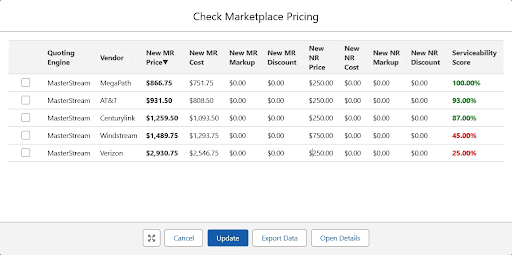
Pricing is rarely static. Vendor costs may need to be retrieved dynamically, compared across multiple providers, and adjusted through markup and margin rules. This makes price books insufficient as the primary pricing mechanism.
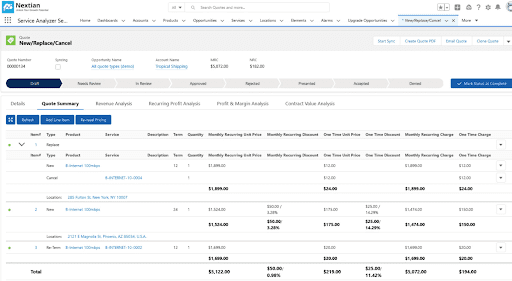
In addition, telecom providers must support ongoing service changes — Moves, Adds, Changes, and Disconnects (MACDs). These scenarios depend on accurate service inventory and change logic that most CPQ platforms are not designed to handle natively.
Multi-Channel Sales Amplify Complexity
Telecom quotes rarely originate from a single channel. Sales-assisted quoting, APIs, customer portals, and partner portals all coexist within the same organization. Each channel has different requirements in terms of speed, validation depth, and automation.
API-based quoting often prioritizes performance and scale over full configuration logic. Sales teams, on the other hand, require approvals, documentation, and customer-specific pricing. Partner-driven models introduce commission structures and incentive programs.
When pricing and validation logic is duplicated across channels, inconsistencies and operational risk quickly emerge. This is where traditional CPQ implementations start to fragment.
Pricing Engines Matter More Than Price Books
In telecommunications, pricing engines are more critical than product catalogs. Effective quoting requires real-time serviceability checks (on-net, off-net, near-net), vendor cost retrieval, and rule-based pricing calculations that can adapt to different buyer types and contract structures.
A modern telecom quoting architecture relies on a dynamic pricing layer supported by a scalable CPQ Platform capable of integrating vendor pricing, validation logic, and configurable business rules.
Performance is a key design constraint. Vendor lookups and infrastructure checks can introduce latency that directly impacts conversion rates — especially in agent-driven or API-heavy environments. Separating pricing logic from quote configuration helps improve scalability and maintainability.
Exception Handling Is a Feature, Not a Failure
Not all telecom quotes can be automated. Some scenarios require manual vendor engagement, alternative access proposals, or negotiated enterprise pricing. Attempting to force all quotes through a single automated path often leads to fragile processes and user frustration.
A mature telecom quoting model supports both automated and exception-based flows. The key is governance. Exceptions should be traceable, structured, and integrated into the same lifecycle as automated quotes — not handled through disconnected spreadsheets or email threads.
MACDs further reinforce this need. Quoting service modifications depends on accurate service inventory and a clearly defined change catalog. Without this foundation, providers end up automating new sales while leaving lifecycle changes largely manual.
Quote-to-Order Is Where CPQ Often Fails
Many CPQ implementations focus on quote creation while underestimating the complexity of quote-to-order conversion. Manual re-entry of quote data into order management systems introduces delays, errors, and operational cost.
In telecom, this risk is amplified by the variety of quote origins and service types. A new service order from a portal should transition into fulfillment as seamlessly as a MACD initiated by a sales representative.
A modern architecture therefore requires a single, standardized quote-to-order conversion layer. This ensures consistency, reduces integration overhead, and enables predictable downstream processes regardless of how the quote was created.
Designing CPQ for Telecom Requires an Architectural Mindset
The core issue is rarely the CPQ tool itself. The problem lies in applying product-centric assumptions to a network-based business.
Successful telecom CPQ initiatives start with architecture, not features. This means defining the future-state quoting model, decomposing core functionalities, and assigning each capability to a single system. Pricing, validation, configuration, documentation, and order orchestration must work together — but not be tightly coupled.
By treating quoting as a distributed capability rather than a monolithic application, telecom providers can avoid over-customization, improve scalability, and build a foundation that supports growth across new services, channels, and partners.
More information https://nextian.com/