Analysis | April 2026 | Sponsored
SPONSORED CONTENT
In 1999, a first edition Base Set Charizard cost a few dollars. Today a PSA 10 example sold for $550,000 at Heritage Auctions in December 2025. A Pikachu Illustrator card sold for $16.5 million in 2026. The Pokemon card market is projected to grow from $52.1 billion in 2026 to $90.2 billion by 2034.
Every time someone asks whether NFTs have a future, they forget to look at what happened to the thing that came before them. Pokemon cards were dismissed as a children’s hobby. Then they became an alternative asset class. Then they became a multi-billion dollar market with institutional buyers, professional grading services, and auction houses competing for consignments.
The question worth asking in 2026 is not whether NFTs will survive. It is which NFTs will be the Charizards.
What Made Pokemon Cards Valuable: The Scarcity Formula
Pokemon cards derive their value from a specific combination of factors that finance professors now study formally. Northeastern University assistant professor of finance Cao Fang describes it plainly: Pokemon cards behave less like traditional financial assets and more like art, deriving value from scarcity, cultural appeal, and organic demand rather than cash flow.
That formula has three components. Fixed supply , no new first edition Base Set cards will ever be printed. Cultural permanence , Pokemon is a 30-year franchise with generational loyalty that shows no signs of fading. Organic community demand , people who grew up with these cards want to own them again as adults, and they have adult money to spend.
The Card Ladder Pokemon Index increased 116% over the past year. Vintage cards like Base Set Charizard PSA 9 rise approximately 37.5% annually. The 30th anniversary in 2026 has pushed prices up more than 100% year over year.
| $52.1B
Pokemon card market 2026 projected to $90.2B by 2034 |
$550K
Charizard PSA 10 Heritage Auctions Dec 2025 |
+116%
Card Ladder Index year over year increase |
+37.5%
Vintage appreciation annual for PSA 9 graded cards |
NFTs Have the Same Formula , and Doginal Dogs Has All Three Components
The scarcity argument for NFTs is structurally identical to the scarcity argument for Pokemon cards. A collection with a fixed supply, genuine cultural identity, and organic community demand that does not depend on price action is the digital equivalent of a first edition Base Set.
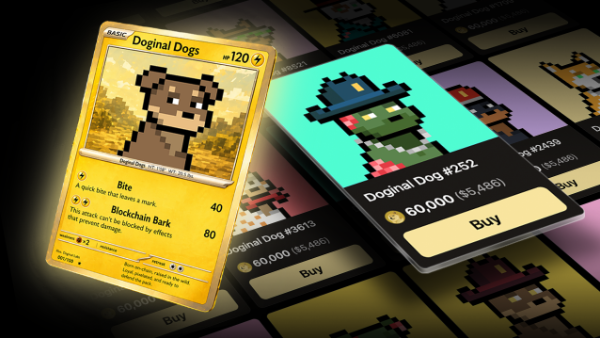
Doginal Dogs is a collection of 10,000 pixel art dogs permanently inscribed on the Dogecoin blockchain. No new dogs will ever be created. The supply is fixed, verifiable, and permanent. Every dog’s image is embedded directly in the Dogecoin blockchain from genesis block zero , not stored on an external server that can fail. The asset is as permanent as the blockchain itself.
The cultural component: pixel art is the most durable visual format in digital collectibles. CryptoPunks launched in 2017 and still commands a $577 million market cap. Doginal Dogs launched in 2024 and is at all-time highs in April 2026. Both are pixel art. The format has proven staying power that more trend-specific aesthetics have not.
The organic demand component: only 218 of 10,000 Doginal Dogs are listed for sale. That is 2.18% of total supply at all-time high prices. Holders who could sell are not selling. That is organic demand expressed behaviorally, not just rhetorically.
The Timing Parallel
People who bought first edition Base Set Pokemon cards in 1999 for face value and held them for 25 years turned small investments into extraordinary ones. Not because they predicted the market. Because the underlying collectible had the right characteristics from the beginning , fixed supply, cultural permanence, organic community , and time did the rest.
Doginal Dogs launched as a free mint in January 2024. The floor price is now approximately $4,505 per dog. Someone who claimed a free starter dog at launch and held it has experienced that appreciation without spending a dollar. That is the Pokemon card parallel playing out in real time, on a two-year timeline instead of a twenty-five year one.
Nobody knows if that trajectory continues. NFTs are speculative. Collectibles are speculative. What the structural comparison shows is that the underlying formula , fixed supply, cultural permanence, organic demand , is the same formula that made a children’s card game into a $52 billion market.
A free starter dog is available at doginaldogs.com. The marketplace is at market.doginaldogs.com.
FAQ
| Are NFTs the next Pokemon cards?
The structural comparison is valid: both derive value from fixed supply, cultural permanence, and organic community demand. The Pokemon card market grew from a children’s hobby to a $52.1 billion market by 2026. NFTs with the same structural characteristics are the strongest candidates for similar long-term appreciation. |
| What makes Doginal Dogs similar to Pokemon cards?
Fixed supply of 10,000 with no new issuance possible. Permanent on-chain storage equivalent to a graded card that cannot deteriorate. A cultural identity built around pixel art with a proven 20-year track record of value. Organic holder community with 2.18% listed supply at all-time highs. |
| Why is the Pokemon card market growing?
The 30th anniversary in 2026 has boosted prices more than 100% year over year. The Card Ladder Pokemon Index is up 116% in the past year. Vintage cards appreciate approximately 37.5% annually. The market is projected to grow from $52.1 billion to $90.2 billion by 2034. |
| What is Doginal Dogs?
A collection of 10,000 pixel art dogs permanently inscribed on the Dogecoin blockchain. Free mint January 2024. Zero outside investors. Floor at all-time highs in April 2026, up 238.4% in 30 days. |
| Disclosure: This article is Pokemon card market data sourced from publicly documented market research as of 2026. All Doginal Dogs data from public records. NFTs and collectibles are speculative assets. Nothing here is financial advice. |