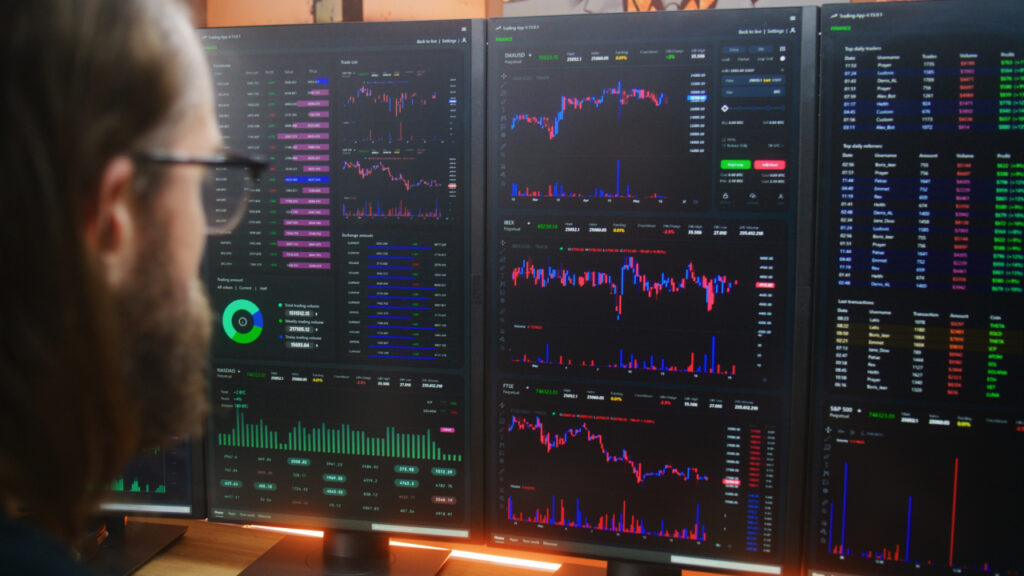
And what today’s market conditions mean for retail traders who haven’t made the switch yet
There’s a quiet but significant shift happening in how retail traders approach the markets. For years, the default was to pick a lane. You were either a forex trader, a stock picker, or someone dabbling in crypto. The idea of actively managing positions across all three, plus commodities and indices, felt like it belonged to hedge fund desks with Bloomberg terminals and teams of analysts.
That’s changing. Fast.
This week alone, BingX reported that daily trading volume on its multi-asset stock offering surged over 700% in five days, driven by demand for access to names like NVIDIA, SpaceX, and pre-IPO plays, all through accounts that already hold crypto. It’s a signal of something larger: traders don’t want to fragment their capital across four different platforms anymore. They want everything in one place, and they want it now.
The question is whether the platform they’re using can actually deliver that.
Today’s market is a case study in why diversification matters
If you’d started this week focused on a single asset class, you’d already be playing catch-up.
Oil dropped more than 3% today as US-Iran peace talks advanced and the US Treasury moved to allow Iranian crude back into global supply chains. That kind of geopolitical shift doesn’t just move energy markets. It flows into currencies, transport stocks, and inflation expectations almost simultaneously.
Meanwhile, the British pound nudged higher after Prime Minister Keir Starmer’s resignation announcement, with markets interpreting the prospect of an orderly leadership transition as broadly stable. Treasury yields in the US rose across the curve as traders positioned for a more hawkish Fed, while euro area equities gained on signals from Lagarde that rate hike pressure may be easing.
Four asset classes. One morning. All connected.
A trader sitting exclusively in one market would have missed these correlations entirely, or worse, been blindsided by them.
The practical case for a unified trading account
The appeal of multi-asset trading isn’t just diversification in the textbook sense. It’s about having the flexibility to go where opportunity is on any given day, without jumping between platforms, reconciling separate accounts, or dealing with inconsistent execution speeds.
This is where platforms like Prime World Markets are quietly building something worth paying attention to. Operating across forex, indices, commodities, cryptocurrencies, and stocks from a single account, the platform is built around a fairly simple idea: markets don’t operate in silos, so your trading account shouldn’t either.
The platform uses AI-assisted analytics to help identify entry and exit points, not as a black box that makes decisions for you, but as an analytical layer running underneath your own strategy. Given how quickly conditions are moving right now (the World Bank is projecting global growth to slow to 2.5% in 2026, its weakest since COVID), having real-time data filtered and surfaced efficiently isn’t a luxury. It’s the baseline.
A few things stand out from a practical standpoint:
Execution speed matters more than traders admit. In volatile sessions like today’s, the gap between where you decide to enter and where you actually get filled can erode the edge quickly. Prime World Markets routes orders across multiple liquidity providers to reduce slippage, a feature more associated with institutional desks than retail platforms until fairly recently.
Risk management built in, not bolted on. The platform includes a real-time risk monitoring layer that tracks exposure across positions and can trigger protective actions automatically. When you’re holding positions in crude oil, EUR/USD, and Bitcoin simultaneously, that kind of cross-asset awareness is genuinely useful.
Access without friction. Account opening is streamlined through secure KYC, and the platform runs across desktop, mobile, and tablet with synchronized data. For traders who monitor markets outside of standard hours, which with crypto and synthetic indices running 24/7 is increasingly everyone, that continuity matters.
Who multi-asset trading actually suits
It would be misleading to suggest that managing exposure across five asset classes is straightforward. It isn’t. Each market has its own microstructure, its own data releases, its own rhythm.
But the traders who tend to do well with a multi-asset approach aren’t necessarily the ones who know everything about every market. They’re the ones who have a process: who understand how to size positions relative to volatility, who know when to step aside, and who aren’t chasing performance in a single ticker.
The infrastructure now exists for retail traders to operate in the same way institutions have for decades. The platforms are better. The data access is faster. The execution is cleaner. What’s still required is discipline.
For anyone currently trading a single asset class and watching the kind of cross-market moves happening this week without being able to participate, it’s worth exploring what a properly integrated multi-asset environment looks like. A free demo account at Prime World Markets is a reasonable starting point, low friction, no capital at risk, and enough real market exposure to test whether the approach suits your style before committing.