A $300 million plan to put Chinese EV-charging and clean-energy assets on-chain shows how Beijing wants the world’s capital — strictly on its own terms.
Somewhere, a bank of electric-vehicle chargers hums through the night, metering kilowatt-hours into taxis and delivery vans. It is about as unglamorous as infrastructure gets. It is also, increasingly, the kind of asset that global investors have spent a decade trying and mostly failing to buy a piece of.
That gap, between China’s industrial reality and the world’s capital, is the subject of a quiet but consequential experiment.
RWA Global Inc, a tokenization advisory firm with bases in the British Virgin Islands and the UAE, has signed on to advise Golden Dolphin Trading L.L.C. a UAE-registered company tied to new-energy mobility in mainland China, on tokenizing roughly $300 million of real-world assets, turning claims on physical, cash-generating infrastructure into digital securities that qualified offshore investors can actually hold. On its own, $300 million is a rounding error in Chinese infrastructure. What makes it worth watching is the door it’s walking through: one Beijing only just unlocked, and only partway.
The puzzle
Here is the contradiction. China banned crypto trading in 2021, purged bitcoin mining, and has spent years treating private digital currencies as a systemic threat. Yet on 6 February 2026, the People’s Bank of China, the securities regulator and six other agencies issued a framework that, for the first time, sets out how tokens backed by onshore Chinese assets can be issued offshore to global investors.
Read it as an opening and you miss half the story. The same rules keep onshore tokenization banned, outlaw renminbi stablecoins, and stretch to catch offshore structures that try to game the spirit of the law. Every qualifying deal has to be filed with — and blessed by — the CSRC. This isn’t China embracing crypto. It’s China cutting a single, supervised lane through an otherwise closed border, because it wants something on the other side: foreign money for the most capital-hungry industrial build-out on earth.
Why Beijing wants the capital
And what a build-out it is. China sold roughly 16.5 million new-energy vehicles in 2025; by November, more than half of all new cars sold in the country were electric or plug-in. The charging network feeding them has grown at a pace that is genuinely hard to picture — the country crossed 20 million charging points in 2025, double the 10 million it had just 18 months earlier, after taking 13 years to install its first million. China now holds about 65% of the world’s public charging and 60% of its electric vehicles.
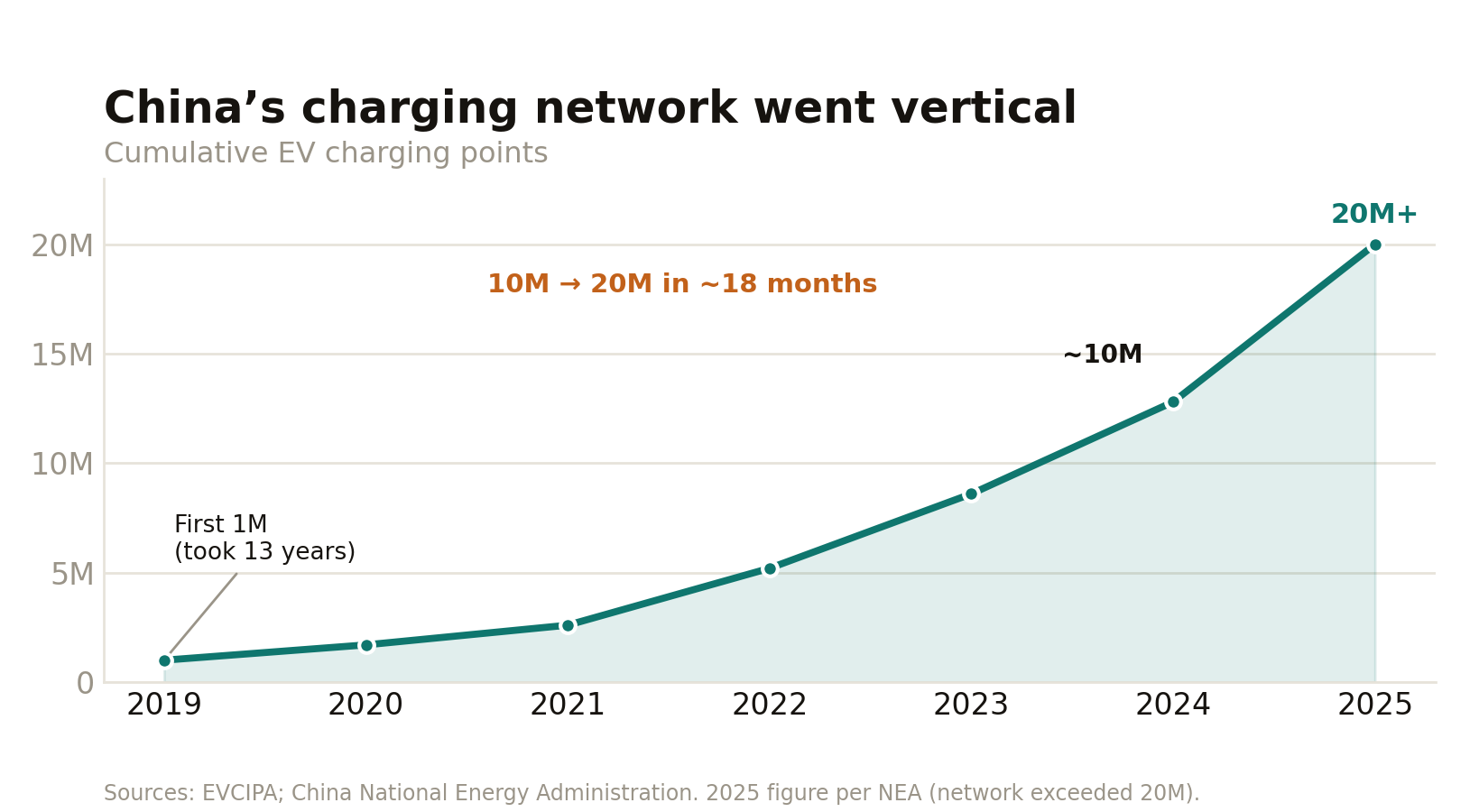
It took China 13 years to install its first million chargers — and 18 months to add its most recent ten million.
Those machines throw off cash. Chinese drivers pulled some 7.7 billion kilowatt-hours through public chargers in a single month last summer — metered, recurring revenue, the lifeblood of any financeable asset. The trouble has always been getting that revenue in front of outside investors without tripping over capital controls. Tokenization — wrapping economic rights in a regulated digital security — is one answer, as long as it stays inside the lines.
Not the first rodeo
China has, in fact, been quietly rehearsing this. In August 2024, Ant Digital Technologies — the blockchain arm of Jack Ma’s Ant Group — tokenized about 9,000 EV charging stations for Shenzhen-listed Longshine Technology Group, raising roughly $14 million. Months later it tokenized 82 megawatts of solar plants for GCL Energy Technology for another 200 million yuan. Both ran as yuan-denominated, cross-border deals inside Project Ensemble, Hong Kong’s regulatory sandbox — and Ant is reportedly lining up as much as $8.4 billion more in renewable-energy assets, having already wired over 15 million energy devices onto its chain.
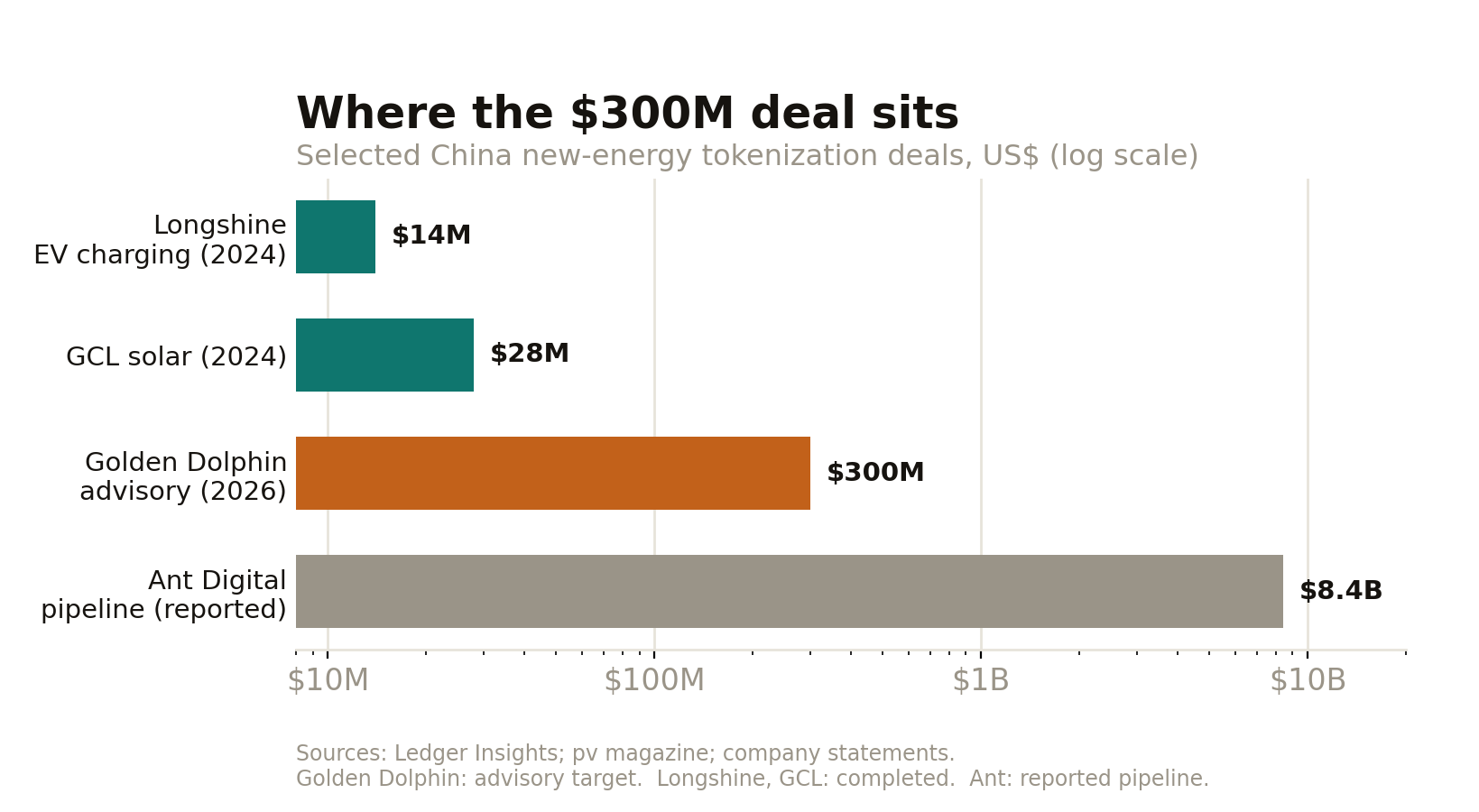
The Golden Dolphin mandate is modest beside Ant’s reported pipeline — but it would be among the first structured under the new national framework.
What those deals didn’t have was a national rulebook; they lived in Hong Kong’s sandbox, and in September 2025 regulators paused mainland institutions’ offshore RWA activity while Beijing settled its position. The February framework changes the venue from experiment to policy. That is the wave RWA Global Inc is trying to ride — positioning Golden Dolphin not as a one-off but as an early test of the compliant, repeatable template this market has been waiting for.
None of it is easy. “Every deal is still unique and presents novel legal and regulatory issues,” says Chin-Chong Liew of Linklaters, whose team handled six of Hong Kong’s first eight RWA tokenizations. Structuring a compliant token over assets sitting inside the world’s most tightly managed capital account is less a software problem than a legal and diplomatic one — which is precisely the work advisory firms are betting will be in demand.
The prize
If the model holds, the prize is enormous. Strip out stablecoins and tokenized real-world assets sat around $24–30 billion on-chain by the end of 2025, per RWA.xyz — more than triple a year earlier; counting stablecoins, CoinGecko puts the total past $300 billion. Boston Consulting Group has floated $16 trillion by 2030, Standard Chartered $30 trillion by 2034 — forecasts to be salted heavily, but big enough that BlackRock and Franklin Templeton are already building.
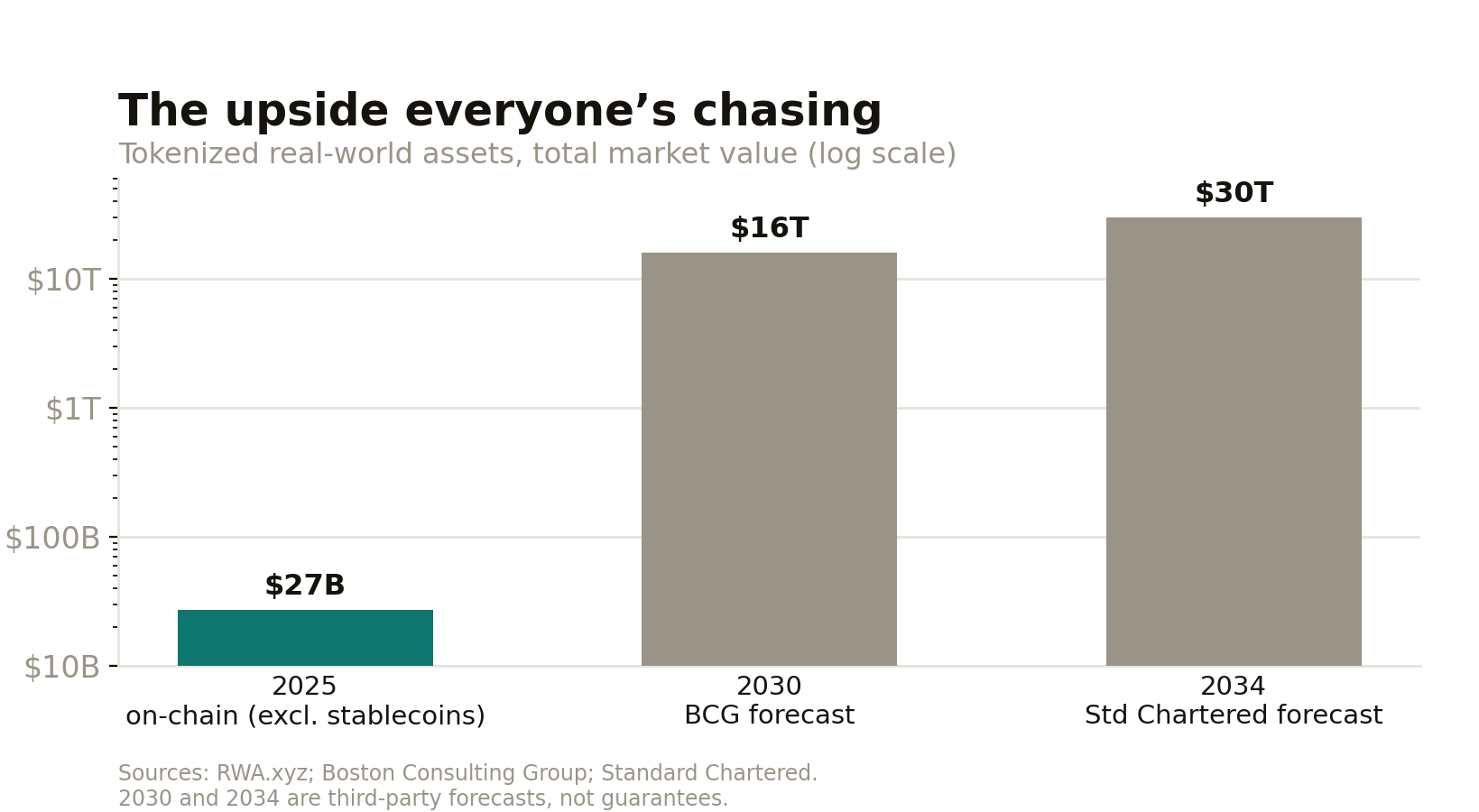
Today’s on-chain market is a sliver of what the biggest forecasters expect by the next decade — the upside drawing institutions in.
For RWA Global Inc’s chief executive, Kevin Yunai, the appeal is precisely the part that’s hard. “China’s new-energy economy is among the most dynamic in the world, yet global investors have had few compliant ways to participate in it directly,” he says, framing the Golden Dolphin work as a first step toward “a transparent, regulated bridge between international capital and Chinese real-world assets.”
Donna Tang, a partner at Esquare Legal, calls it less a single transaction than “an early step toward a compliant offshore bridge between China’s industrial value and global capital.”
Whether that bridge carries real traffic depends on how the CSRC handles the first filings, and regulators rarely move fast on a regime they have only just built. But the direction is set. Beijing has decided it can let the world invest in its industrial machine — as long as it keeps a hand on the door. The only question left is how many will walk through, and a $300 million deal run out of Dubai is about to help answer it.
Disclaimer: This article is for informational purposes only and is not an offer to sell, or a solicitation of an offer to buy, any security, token or financial instrument, nor investment, legal, tax or financial advice. The advisory engagement described is indicative and subject to client decisions, qualified counsel and applicable regulators; the $300 million figure is approximate. Forward-looking statements involve risks and uncertainties, and actual results may differ. Market figures cited are drawn from third-party sources and have not been independently verified.