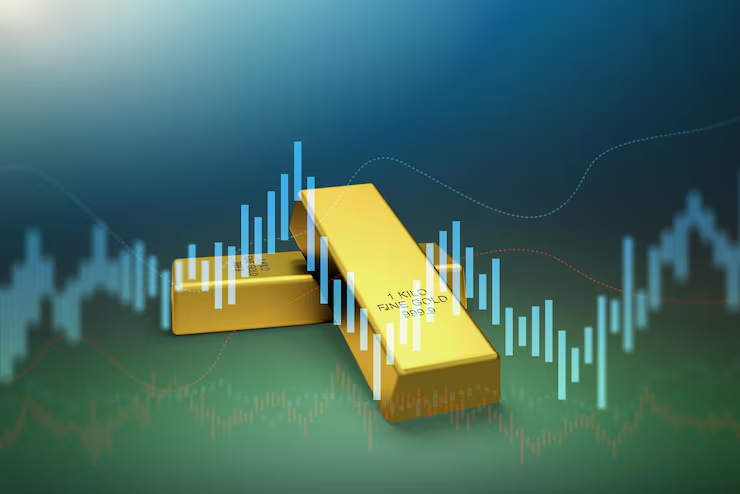
The global investment landscape has shifted dramatically over the past two years. After a turbulent period marked by crypto volatility, rising interest rates, and geopolitical uncertainty across the Middle East, one asset class has quietly reasserted its dominance: gold.
But it’s not just the metal itself that’s changing — it’s how people track, evaluate, and act on its price. A new generation of real-time gold price platforms is reshaping how retail investors in the Arab world engage with the market.
Gold’s Enduring Role in the Middle East
Gold is not a trend in the Middle East — it’s a tradition. From wedding jewelry in Egypt to investment-grade bullion in the Gulf, the metal is deeply embedded in the financial culture of the region. Saudi Arabia, the UAE, Kuwait, and Qatar consistently rank among the world’s highest per-capita gold consumers.
What’s changed in 2026 is the sophistication of the average buyer. Where a previous generation relied on local jewelers and daily newspaper prices, today’s investor wants live data, historical charts, and tools to calculate exactly how much their holdings are worth — right now, not yesterday.
Crypto Volatility Sends Investors Back to Basics
The 2024–2025 crypto cycle brought both euphoria and pain. While Bitcoin and Ethereum reached new highs, the collapse of several mid-cap tokens wiped out significant retail wealth across the MENA region. Many investors who had pivoted away from gold found themselves returning to it — not as a rejection of technology, but as a rebalancing toward stability.
Gold’s price performance during this period reinforced its reputation. While crypto markets swung 20–30% in weeks, gold maintained a steady upward trajectory, hitting all-time highs in USD terms in early 2025 and holding strong into 2026.
This flight to stability has been especially pronounced in Saudi Arabia, where retail participation in gold markets has grown significantly. Platforms tracking the gold price in Saudi Arabia in real time have reported sharp increases in daily active users — a signal that demand for accessible, accurate gold data is outpacing traditional sources.
The Shift from Daily to Real-Time Pricing
For decades, gold prices in the Arab world were published once a day — typically by central banks or official bullion authorities. That was sufficient when most gold transactions happened at physical shops with fixed daily rates.
Today, the market moves faster. Spot prices fluctuate by the second based on global commodity exchanges. An investor buying a 10-gram bar in Riyadh needs to know the price now, not what it was at 9am.
This demand has fueled the growth of real-time gold tracking platforms — tools that pull live spot prices, convert them into local currencies, and present them in formats that make sense to local buyers: price per gram in Saudi Riyals, price per ounce in UAE Dirhams, price by karat purity.
What Makes a Good Gold Price Platform?
Not all gold tracking tools are equal. The most useful platforms for Middle East investors tend to share several characteristics:
1. Local currency support Displaying prices only in USD is a barrier. Serious platforms convert in real time to SAR, AED, KWD, QAR, EGP, and other regional currencies — accounting for local exchange rates.
2. Karat breakdown Most jewelry in the Arab world is 21K or 18K gold, not the 24K pure gold used as the global benchmark. A platform that only shows 24K prices forces users to do manual calculations — a friction point that better tools eliminate entirely. A built-in gold karat converter lets buyers instantly see the value of any purity level without leaving the platform.
3. Practical calculators Beyond price display, the most valuable tools let users calculate: How much is my 15-gram bracelet worth? How much gold can I buy with 5,000 Riyals? For buyers considering deferred payments, a gold installment calculator that breaks down monthly costs in local currency is increasingly becoming a standard feature. These tools turn a data display into a decision-support tool.
4. Speed and reliability Gold prices move. A platform that lags by even a few minutes during volatile sessions can mislead buyers. The best platforms update prices continuously, not on a fixed schedule.
Saudi Arabia: A Case Study in Growing Gold Tech Demand
Saudi Arabia offers a useful lens into broader regional trends. The Kingdom has one of the highest gold jewelry consumption rates per capita globally. Vision 2030 has brought significant financial literacy initiatives that are driving more Saudis toward investment-grade gold products — bars and coins — rather than purely decorative purchases.
This shift from consumption to investment creates a different type of buyer: one who cares about price precision, market timing, and portfolio allocation. These buyers are actively searching for tools that give them an edge — and increasingly finding them online.
The growth in search traffic for terms like “gold price today Saudi Arabia” and “gold gram price SAR” reflects this behavioral shift. It’s not casual curiosity — it’s active investment behavior moving online.
The Broader MENA Opportunity
What’s happening in Saudi Arabia is playing out across the region. In Egypt, gold is a primary inflation hedge for the middle class, with demand spiking every time the pound weakens. In Lebanon, gold has functioned almost as a parallel currency during the banking crisis. In Qatar and Kuwait, high-net-worth investors are increasingly treating gold as a portfolio stabilizer alongside equities and real estate.
Each market has its own dynamics — different currencies, different karat preferences, different buying habits. The platforms that will win long-term are those that understand these nuances and build tools that feel local, even when the underlying data is global.
Technology Meets Tradition
The most interesting development in this space isn’t the technology itself — it’s the cultural shift it represents. Gold has always been central to financial life in the Middle East. What’s changing is that the infrastructure around gold is finally catching up to how modern investors want to engage with it.
Real-time price platforms are not replacing the jeweler or the bullion dealer. They’re giving buyers the information they need to walk into those transactions with confidence — knowing the fair price, understanding their options, and making decisions based on data rather than guesswork.
In a region where gold has been trusted for centuries, giving investors better tools to engage with it is not a disruption. It’s an evolution.