If you’ve been trying to conceive for a while, you already know the emotional rollercoaster that comes with it. The two-week waits, the ovulation strips that give you a vague line, the apps that tell you “you might be fertile today” — none of it feels certain enough. And when you’re trying to make one of the most important decisions of your month, “might” just doesn’t cut it.
That’s exactly where a proper fertility tracker changes everything.
But not all fertility trackers are created equal. There’s a significant difference between an app that estimates your cycle based on calendar math and a device that actually measures your hormone levels in real time. Let’s talk about what that difference looks like in practice — and why it matters so much.
The Problem With Traditional Ovulation Tracking
Most people who start trying to conceive reach for one of two things: a period-tracking app or a basic ovulation predictor kit (OPK) from the drugstore.
Both have their place. But both also have serious limitations that can leave you second-guessing yourself every single month.
Calendar apps make a fundamental assumption: that your cycle is regular and predictable. For millions of women, it simply isn’t. Stress, travel, illness, PCOS, thyroid issues — countless factors can shift your ovulation day from one cycle to the next. An app that tells you “your fertile window is days 12–16” because that’s what happened last month isn’t giving you real data. It’s giving you a best guess dressed up as information.
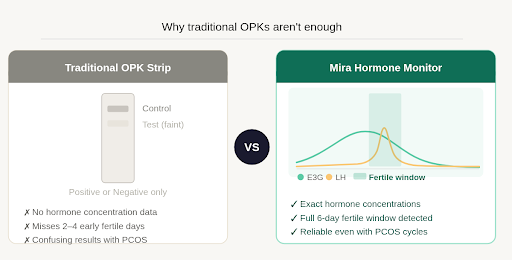
Standard OPKs are a step up because they actually detect luteinizing hormone (LH) in your urine — the hormone that surges just before ovulation. But most of them only give you a binary result: a line that looks positive or a line that doesn’t. They can’t tell you how high your LH is, whether it’s rising or falling, or where you are within your overall fertile window. You get a snapshot when what you really need is the full picture.
What Hormone Monitoring Actually Tells You
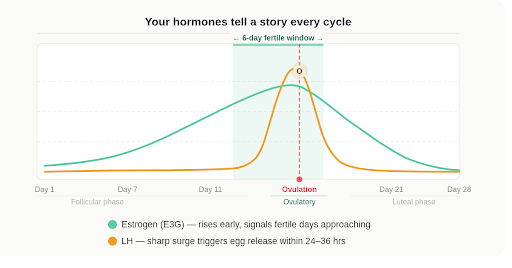
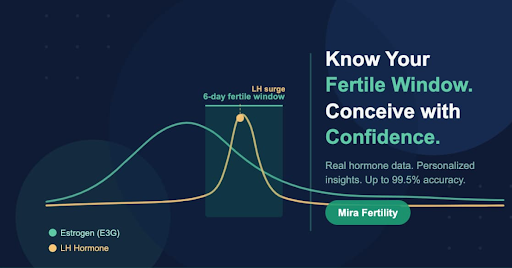
Your reproductive cycle is driven by a carefully choreographed sequence of hormones. Estrogen (specifically estrone-3-glucuronide, or E3G) begins rising several days before ovulation, signaling that your most fertile days are approaching. LH then surges sharply, triggering the release of an egg within 24–36 hours.
If you can measure both of these hormones — not just detect a rough threshold, but actually quantify their levels — you can identify your full six-day fertile window rather than just the one or two days surrounding ovulation. That’s a meaningful difference, especially if you have an irregular cycle or have been struggling with unexplained infertility.
The catch is that this level of hormone quantification has, until recently, been available only through fertility clinics and laboratory testing. You’d have to go in for blood draws at specific points in your cycle, wait for results, and try to act on information that was sometimes already a day or two out of date by the time you received it.
How At-Home Hormone Monitoring Has Changed the Game
The emergence of at-home hormone monitors has genuinely shifted what’s possible for people trying to conceive outside of a clinical setting. Instead of guessing or relying on lagging indicators, you can test your urine at home and see your actual hormone concentrations — not just a positive or negative — synced to an app in real time.
This matters enormously for a few specific groups of people:
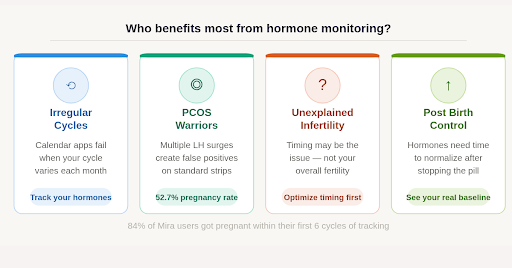
Those with irregular cycles. If your cycles vary significantly in length, a calendar-based fertile window prediction is essentially useless. Measuring your hormones directly means your fertile window is identified based on your body, this cycle — not an average from the past three months.
Those with PCOS. Polycystic ovary syndrome can cause multiple LH surges throughout a cycle, which means standard OPKs frequently give false positives. A monitor that tracks the full curve of your LH and estrogen levels can help distinguish a true pre-ovulatory surge from background hormonal noise.
Those who’ve experienced unexplained infertility or recurrent miscarriage. Sometimes the issue isn’t whether you’re ovulating, but when — and whether intercourse is being timed optimally. Better hormone data translates directly to better-timed attempts.
Those coming off hormonal birth control. It can take several cycles for your hormones to normalize after stopping the pill or other contraceptives. Tracking your actual hormone levels gives you real feedback on where your cycle stands, rather than waiting and wondering.
What to Look for in a Fertility Tracker
If you’re ready to move beyond guesswork, here are the key features that separate a genuinely useful fertility tracker from one that’s just a fancier version of what you already have:
Quantitative hormone measurement. This is the big one. A tracker that gives you actual concentration numbers — not just a positive or negative line — lets you see trends and patterns across your cycle. You can watch your estrogen climb and your LH surge in real time, which gives you far more actionable information than a simple threshold detection.
FDA registration. For any medical device you’re relying on for health decisions, regulatory oversight matters. An FDA-registered device has met standards for safety and accuracy.
Lab-grade technology. Some of the more advanced at-home monitors now use fluorescent technology similar to what’s used in fertility labs. This allows for detection of much smaller changes in hormone concentration, which translates to earlier and more reliable fertile window identification.
A companion app with real data visualization. Numbers without context aren’t that useful. A good app should show you your hormone chart over time, flag your predicted ovulation day, and give you personalized insights based on your own history — not just generic cycle-length averages.
Accuracy you can trust. Look for devices validated by clinical studies and cited in research from reputable institutions. A fertility tracker is only as good as its underlying measurement technology.
The Emotional Side of Fertility Tracking
It’s worth acknowledging something that doesn’t always come up in product reviews: the emotional weight of trying to conceive, and how the right tools can either add to that burden or genuinely lighten it.
There’s a particular kind of anxiety that comes from not knowing. When you’re in the dark about your own cycle — when you don’t know if you ovulated, when you don’t know if your timing was right, when you can’t tell if the faint line on your OPK was meaningful or not — the uncertainty can be exhausting. It can make the whole experience feel arbitrary, like outcomes are entirely out of your hands.
Data doesn’t remove the emotional difficulty of the TTC journey. But it does give you something solid to hold onto. When you can look at a chart and see clearly that yes, you had an LH surge on day 14, and yes, you timed things well this cycle — that’s genuinely stabilizing information. It gives you a foundation to stand on even when things don’t go the way you hoped.
For many people, it also makes conversations with healthcare providers more productive. Instead of saying “I think I ovulated around the middle of my cycle,” you can bring actual hormone data to an appointment — which can be especially valuable if you’re working with a reproductive endocrinologist or OB/GYN on a more complex fertility situation.
A Note on Managing Expectations
Accurate hormone tracking will significantly improve your ability to time intercourse within your fertile window. But it’s important to be honest about what tracking can and can’t do.
Fertility tracking gives you the best possible chance of timing things right. It doesn’t guarantee conception. Even with perfect timing, the chances of pregnancy in any given cycle for a healthy couple are generally somewhere between 20 and 30 percent. For people dealing with underlying fertility issues, those odds may be lower.
What tracking does is eliminate one major variable — poor timing — from the equation. If you’re wondering whether you might be missing your window every cycle without knowing it, getting that clarity is genuinely valuable. But if you’ve been tracking accurately for several cycles and still aren’t seeing results, that information itself is useful: it points toward other factors that may warrant investigation with a specialist.
Building Your Tracking Practice
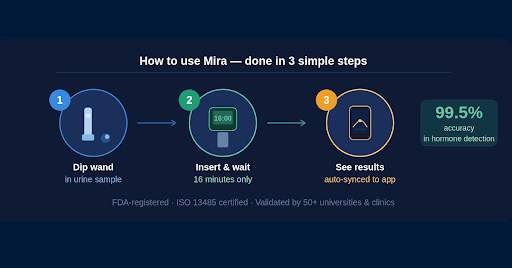
If you’re new to hormone monitoring, the learning curve is gentler than you might expect. Most people find that after one or two cycles, the process feels fairly routine: a quick test in the morning, a 15-minute wait, and then your results synced to your phone.
A few tips for getting the most out of your tracking:
Start testing earlier than you think you need to. Estrogen typically begins rising several days before your LH surge. If you only start testing when you expect to be “close to ovulation,” you may miss the early rise that gives you advanced warning your fertile window is opening.
Test at the same time each day. Hormone concentrations in urine can fluctuate based on hydration and time of day. Morning testing is generally recommended, and consistency matters more than perfection.
Track for at least two or three cycles before drawing conclusions. Cycles vary — in length, in hormone patterns, in when exactly ovulation falls. A single cycle gives you a data point; two or three give you a pattern you can actually learn from.
Use the data alongside other signs. Hormone tracking pairs well with other fertility awareness methods — basal body temperature, cervical mucus observation — to give you a more complete picture of your cycle.
Final Thoughts
The journey to parenthood looks different for everyone. Some people conceive quickly without thinking much about timing. Others find themselves months into trying, wondering what they might be missing.
If you’re in the latter group, investing in quality hormone monitoring is one of the most concrete steps you can take. It doesn’t solve every problem, and it doesn’t replace medical care when that’s what’s needed. But it does give you something genuinely valuable: real, personalized information about your own body at the moment it matters most.
Understanding your cycle deeply — knowing your fertile window, seeing your hormone patterns, tracking changes over time — is not just a fertility strategy. It’s a form of body literacy that pays dividends long beyond a single TTC journey.
And in a process that can feel so uncertain, a little more clarity goes a long way.