From Toys to True Productivity: The Great Leap and New Divergence of AI Music Tools in 2026
By 2026, generating a piece of music with a reasonable structure has become a mundane task. As models have iterated, AI music tools are undergoing a revolutionary shift in positioning—from “low-cost entertainment” to “workflow integration”. For producers across various fields, the core criteria for choosing an AI tool is no longer “Can it write a song?” but rather: “Can the generated assets be standardized into my project as part of a serious creative or commercial production?”
Yes, beneath this surface-level prosperity, creators on the front lines often feel a sense of frustration. The automated solutions that promise “one-click generation” frequently act as barriers to professional intervention. Have you ever faced a “finished” file that sounds decent but cannot be disassembled, leaving you helpless against a muddy mix?. Have you been stuck in a loop of re-generating a track just to fix a minor melodic error, watching your inspiration drain away in a sea of prompt-tuning?. Or worse, have you finally achieved the perfect result only to face ambiguous copyright policies that turn your time and money into non-compliant assets?.
To help you navigate this sea of tools and find a genuine music productivity partner, we spent months deep-diving into the five mainstream AI music generators, dismantling them across four key dimensions.
I. Core Evaluation Dimensions: The Logic Defining a Tool’s Ceiling
Before the deep dive, we must understand why these four metrics are the definitive indicators:
Generation Quality: This is the most direct indicator of a work’s value. A high-scoring tool produces vocals with natural emotional curves and rich, correctly layered arrangements, meaning the output meets a producer’s basic needs without wasting time on tedious post-processing.
User Experience: This determines the efficiency of translating a thought into a reality. Excellent usability means a near-zero learning curve—whether via text or style references—instantly turning mental inspiration into an auditory reality.
Creative Control: This is the line between a toy and a professional tool. If you cannot edit the output, the AI content is merely a random occurrence. Tools with Stems Split and MIDI Studio capabilities empower you to boost the bass, remove a specific note, or remix vocals, giving the work true potential.
Commercial Licensing: This determines the profitability of your creativity. In an era of strict copyright scrutiny, clear and comprehensive licensing ensures your work can be monetized across all platforms without fear of takedowns or revenue disputes.
II. Deep Comparison of Five Mainstream AI Music Assistants
| Dimensions | MakeBestMusic (MBM) | iLoveSong | AIVA | Soundraw | Mubert |
| Gen Quality | Stable; AI Singing is natural/breathable. Commercial grade. | Good lyric-melody sync; vocals okay, but melody lacks variety. | Leading instrumental/orchestral quality. No vocals. | Clear instrumentals; lacks emotional core of vocals/lyrics. | Sample-based; steady for ambient but high homogenization. |
| UX | Simple/Custom dual modes; supports reference tracks. Very fast. | Straightforward but no natural language gen; needs manual lyrics. | High learning curve; involves music theory. For pros. | Visual interface; quick mood matching via energy/length. | Tag-based; fastest generation speed in the test. |
| Creative Control | Core Advantage. Stems Split and MIDI Studio functionality. | Delivery only; no stems. Nearly impossible to edit post-gen. | Supports MIDI export; audio layering less precise than MBM. | Block rearrangement; no raw stems or note-level editing. | Extremely low; single-track output with no arrangement adjustments. |
| Licensing | Clear terms; paid plans include full commercial rights. | Complex; free version risks asset removal. | Expensive; targets high-budget B2B projects. | Clear royalty-free model; permanent rights during sub. | Clear but strictly tiered; higher compliance research cost. |
1. MakeBestMusic: The All-in-One Digital Workstation
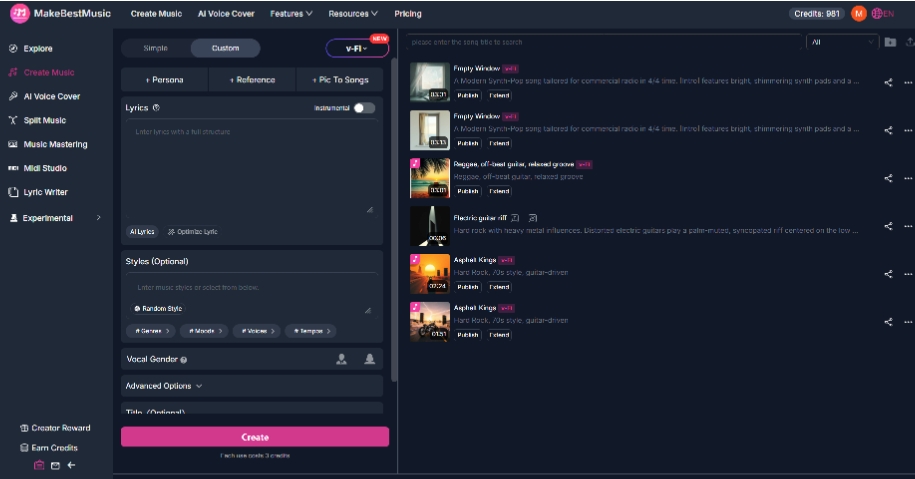
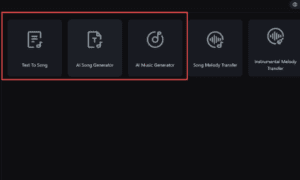
- Generation Quality: MakeBestMusic outputs exhibit high commercial maturity. Its AI Singing feature simulates human resonance and breath, while the underlying neural network ensures crystal-clear audio. The AI Voice Cover and Voice Cloning tech significantly expand the possibilities of vocal expression. Additionally, its AI lyric writer helps users generate structured lyrics based on themes and stories.
- User Experience: It masterfully balances simplicity with professionalism. The Reference Music feature in Simple Mode is revolutionary—upload a track, and the AI analyzes its rhythm and instrumentation to generate highly consistent original content. In Custom Mode, users can precisely define everything from BPM to specific instrument layouts via text boxes.
- Creative Control: Through the Split Music feature, creators can strip away clean vocals, drums, bass, and melodic instruments with one click. The built-in Midi Studio allows for pre-generation configuration of velocity, harmony, and orchestration. This ability to deconstruct a mix means the AI output is not the “final word” but a catalyst for your creation; you can input MIDI inspiration, process it, and export it to a mainstream DAW for deeper work.
- Commercial Licensing: MBM provides a clear copyright path. All paid plans include full commercial licenses, meaning users own the copyright to every second of music generated, supporting direct monetization on Spotify, YouTube, and TikTok.
- Audience Analysis: Ideal for independent musicians, professional producers, marketing teams, and creators seeking a deep-project workflow. Its text-to-music also caters to casual and personal users.
- Score & Verdict: 9.8/10. A “Swiss Army Knife” of tools. By integrating stem splitting and MIDI fine-tuning, it provides a viable solution to the “uneditable AI music” problem, reaching the standard of “effective productivity”.
2. iLoveSong: Creative Drafts for Songwriting

- Generation Quality: This tool shows good synergy between lyrics and melody, with vocals that fit the text tightly. However, it lacks melodic variety, often sounding traditional or flat without surprising modulations or modern arrangement textures. Prompt handling is somewhat random.
- User Experience: While the interface is straightforward, simplicity comes at the cost of freedom. It does not support natural language generation; users must provide lyrics first. This “lyrics-first” logic can block the flow for musicians who want the melody to inspire the words.
- Creative Control: A clear weakness. As a “finished-product delivery” software, it provides a locked, mixed audio stream. The lack of track separation leaves the audio in an “uneditable deadlock”.
- Commercial Licensing: The tiered plans are complex and opaque. The free version has many “gray areas” and a “30-day removal mechanism,” meaning your assets aren’t backed up long-term—a major drawback for commercial users.
- Audience Analysis: Lyric enthusiasts, entry-level vloggers, and non-professional groups with no need for post-production.
- Score & Verdict: 6.8/10. Competent for basic sync, but there is a significant generational gap compared to professional tools. Best used as a draft tool for early ideas.
3. AIVA: The “Serious Musician” of the AI World

- Generation Quality: AIVA is industry-leading in instrumental and orchestral music. The output has a strong sense of structure and follows traditional music theory, avoiding a “cheap” synthesizer feel. However, a major flaw is the lack of support for any vocals or lyrics, which limits its use in the vocal-heavy commercial market.
- User Experience: The barrier to entry is high for average users. The interface involves many music theory parameters, like scales and complex rhythmic subdivisions. It feels more like a plugin for professional composers than a creative platform for the masses.
- Creative Control: While it supports MIDI export, there is room for improvement in automated audio processing. It excels at pre-generation parameter control but lacks the modular convenience of automated stem separation after generation.
- Commercial Licensing: Pricing is generally above market average, targeting high-budget projects like film and games. The cost of entry is too high for independent or “bedroom” producers.
- Audience Analysis: Game composers, film scorers, and professional producers seeking grand instrumental arrangements.
- Score & Verdict: 8.2/10. An unmatched “serious musician” for instrumentals, but its narrow application and high cost lower its accessibility.
4. Soundraw: The Efficient Background Music (BGM) Engine

- Generation Quality: Focuses on high-quality instrumentals with good dynamic range across specific genres (Lo-fi, Rock, Cinematic). However, the lack of vocals makes the tracks feel more like atmospheric loops rather than independent works of art with a “soul”.
- User Experience: Offers an extremely intuitive visual interface. Users don’t need complex terminology; they can adjust the “Energy Level” and clip length to manage the mood. It makes obtaining a usable BGM as easy as adjusting the volume.
- Creative Control: The logic is based on “block rearrangement”. While you can cut audio blocks or adjust intensities, you cannot dismantle the mix into raw stems or perform MIDI-level fine-tuning on specific notes.
- Commercial Licensing: Uses a very clear royalty-free model. Music generated during a subscription enjoys a permanent license, making it one of the simplest tools for content creators to manage.e
- Audience Analysis: YouTubers, short-video studios, and marketers needing fast mood-matching for commercial videos.
- Score & Verdict: 7.9/10. The most efficient BGM machine. Not suited for deep artistic creation, but excellent for commercial efficiency.
5. Mubert: The “Plug-and-Play” Sampler for Fast-Casual Video
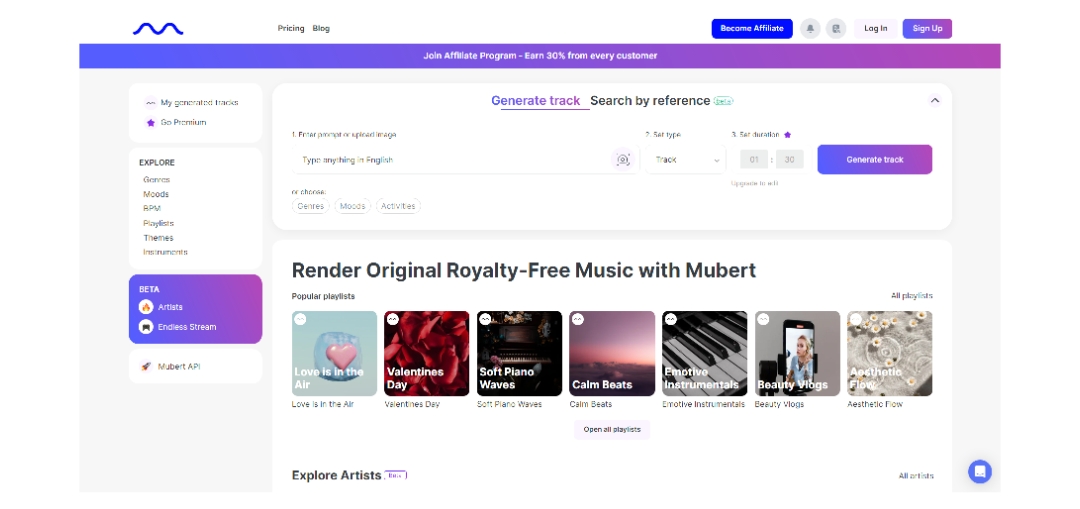
- Generation Quality: Based on a massive library of samples. It is steady in electronic and ambient genres, but its output is highly homogenized. Because it is essentially a real-time collage of samples, melodies, and timbres, it often feels repetitive and lacks a “soul”.
- User Experience: Uses a tag-based logic (Style + Mood + Duration). It is the fastest in terms of generation speed, making it irreplaceable for scenarios where uniqueness isn’t a priority, such as 10-hour white noise videos.
- Creative Control: Extremely limited. The audio is a “dead” fragment—no track separation or deep arrangement adjustments. Interaction is mostly limited to hitting “re-generate”.
- Commercial Licensing: Licensing is strictly divided by subscription tier. Users must constantly check if their plan covers specific platforms (e.g., social media vs. broadcast), leading to higher compliance costs.
- Audience Analysis: Creators prioritizing speed, ambient audio needs, and beginners with no interest in post-production.
- Score & Verdict: 7.2/10. A sampler built for speed. Flexibility and originality are the main drawbacks, but it is great for bulk background audio.
III. Controlled Variable Test: Same Prompt Comparison
To test performance under identical conditions, we used the prompt: “A futuristic synthwave track with emotional female vocals, 120 BPM, neon city vibe.”
MakeBestMusic Result: Within 60 seconds, MBM produced a high-quality project with layered synths, dynamic drums, and a cyberpunk vocal. The vocals had realistic breath and emotional vibrato, perfectly capturing the “Emotional” requirement. Using Split Music, the mix was instantly disassembled into independent tracks (Vocals, Drums, Bass, Synths).
iLoveSong Result: Good rhythm, but the synth textures felt “plastic” and dated. Because there was no track separation, the vocals were permanently glued to the backing track. Attempting to lower the vocal volume caused the high-frequency synths to collapse.
AIVA Result: Maintained a high professional standard in instrumentation with clear layering. However, it completely ignored the “Female Vocals” requirement, resulting in a beautiful but “half-finished” instrumental track.
Soundraw Result: Produced a high-energy background melody quickly. However, it struggled with the “emotional female vocal” aspect and provided only a single WAV file that could not be modified internally.
Mubert Result: Generated extremely fast, but the structure was flat and lacked the dynamics expected of synthwave. The “vocals” were just chopped-up samples from a library, making the result sound like generic stock material.
IV.Conclusion
AI music tools have clearly begun to diverge based on their development focus. MakeBestMusic stands out as the only “all-around tool,” scoring high across all four dimensions. It doesn’t just generate better music; it integrates into the workflow, allowing its features to be modularly embedded into professional production to increase efficiency and commercial value.
In contrast, Mubert is for those needing extreme speed; iLoveSong is for beginners; AIVA is for high-budget instrumental teams; and Soundraw is for marketers needing quick BGM.
Ultimately, creators need a digital workstation that offers infinite possibilities. Choosing a tool like MakeBestMusic isn’t just about getting a good-sounding track—it’s about retaining the creator’s final authority over the work. When AI can be embedded in professional production and support precision adjustments, technology truly becomes productivity. Our evaluation concludes that for any scenario—professional or personal—MakeBestMusic is currently the most comprehensive and valuable AI music platform on the market.